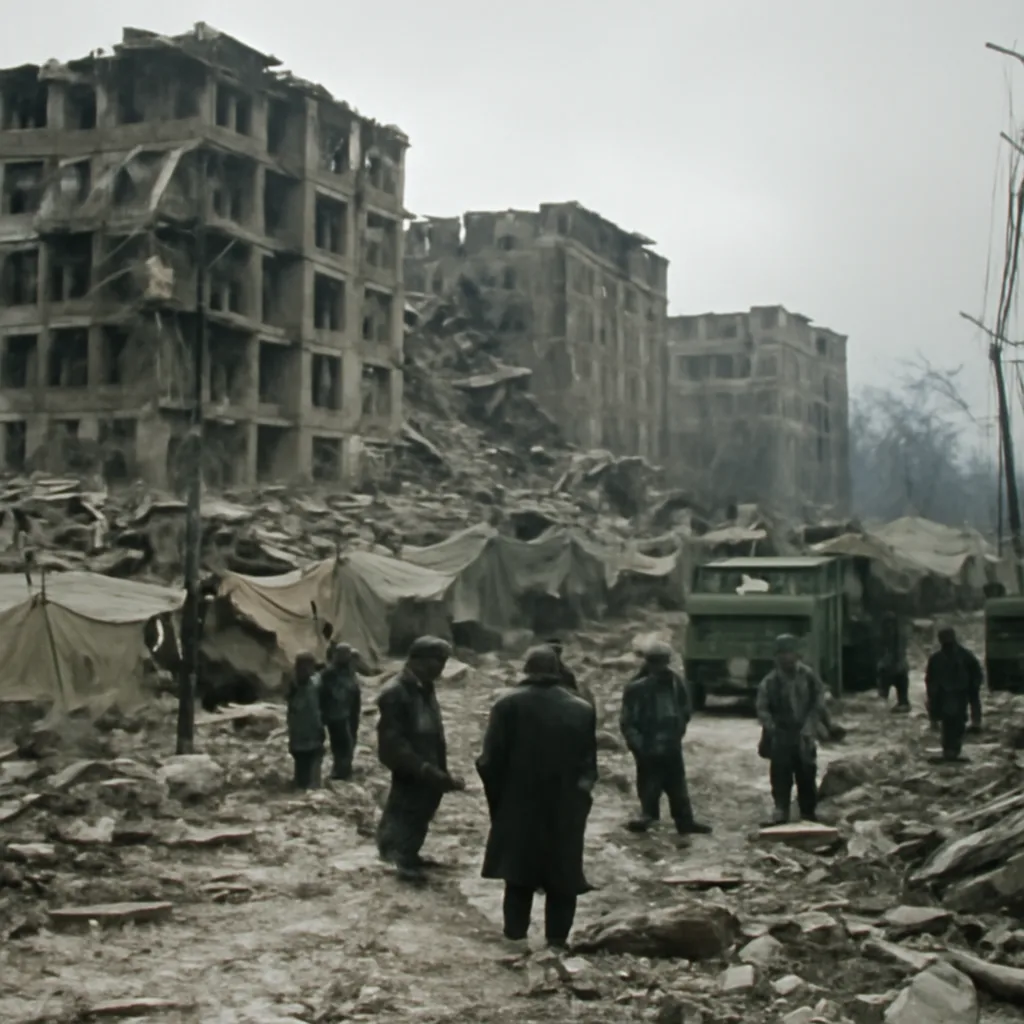
1988 Armenia earthquake levels cities, kills tens of thousands
On December 7, 1988, a magnitude 6.8 earthquake struck northern Armenia, devastating the cities of Spitak, Leninakan (Gyumri) and surrounding towns; official Soviet figures and later estimates place the death toll in the tens of thousands and hundreds of thousands left homeless.
On the morning of December 7, 1988, at 11:41 a.m. local time, a powerful earthquake with a surface-wave magnitude of about 6.8 struck northern Armenia, then part of the Soviet Union. The quake’s epicenter was near the town of Spitak, roughly 120 kilometers northwest of the capital, Yerevan. The shallow depth and proximity to densely built cities produced catastrophic damage across a swath of the Armenian Soviet Socialist Republic.
The worst-hit urban centers included Spitak, which was effectively destroyed; Leninakan (now Gyumri), Armenia’s second-largest city, which suffered extensive structural collapse; and the towns of Kirovakan (now Vanadzor) and Stepanavan. Large numbers of apartment blocks, schools, hospitals and factories—many built to Soviet-era standards that performed poorly in strong shaking—collapsed or were rendered unusable. The winter cold, damaged infrastructure and interruptions to water, heating and communications compounded the humanitarian emergency.
Casualties and displacement: Official Soviet reports initially placed the death toll at around 25,000–50,000; later scholarly estimates and contemporary international assessments commonly cite a figure of approximately 25,000–50,000 dead and tens of thousands injured. Precise accounting has been difficult: records were incomplete, some bodies remained under rubble for extended periods, and different agencies used varying methods for counting the dead and missing. The disaster left an estimated 400,000–500,000 people homeless or displaced, creating a large-scale shelter, medical and logistics challenge during winter.
Immediate response: The Soviet government declared a state of emergency and mobilized Soviet rescue units, military engineers and medical teams. The scale and visibility of the destruction prompted a significant international response—an unusual opening for Soviet-era foreign assistance—including search-and-rescue teams, medical aid, humanitarian supplies and field hospitals from dozens of countries. International crews participated in rescue operations, and aid flights delivered equipment and relief goods despite political sensitivities and logistical obstacles.
Search, rescue and recovery efforts faced harsh conditions: unstable structures, aftershocks, cold weather and damaged transport networks slowed operations. Many trapped survivors were extracted in the days following the quake, but large portions of some towns were effectively ruined and required prolonged recovery and clearance work. The destruction of critical infrastructure—roads, rail links, power and heating systems—complicated relief distribution and reconstruction planning.
Aftermath and reconstruction: The earthquake exposed shortcomings in building practices, seismic preparedness and emergency response within the Soviet system. In the years after the disaster, reconstruction programs included international funding, Soviet and later Armenian government projects, and the relocation of some communities. Reconstruction proceeded slowly in some areas due to economic constraints and the political upheavals accompanying the dissolution of the Soviet Union in 1991. The catastrophe had long-term social and demographic impacts: family losses, population displacement, and shifts in urban development and housing policy.
Commemoration and legacy: The Spitak earthquake remains one of the deadliest seismic events in the late Soviet period and a formative national tragedy for independent Armenia. It influenced earthquake engineering, emergency response practices, and international cooperation on disaster relief. Memorials and annual commemorations honor the victims, and the event is remembered in Armenian public memory and documentation as a benchmark for preparedness and humanitarian response.
Notes on sources and figures: Fatality and displacement figures vary across sources—Soviet-era official counts, independent scholarly estimates and international aid assessments differ in methodology and totals. Where exact numbers differ, historians and disaster researchers typically characterize the toll as ‘‘tens of thousands’’ killed and several hundred thousand displaced.