
12/07/1972 • 5 views
Apollo 17 Launches on NASA’s Final Moon Mission
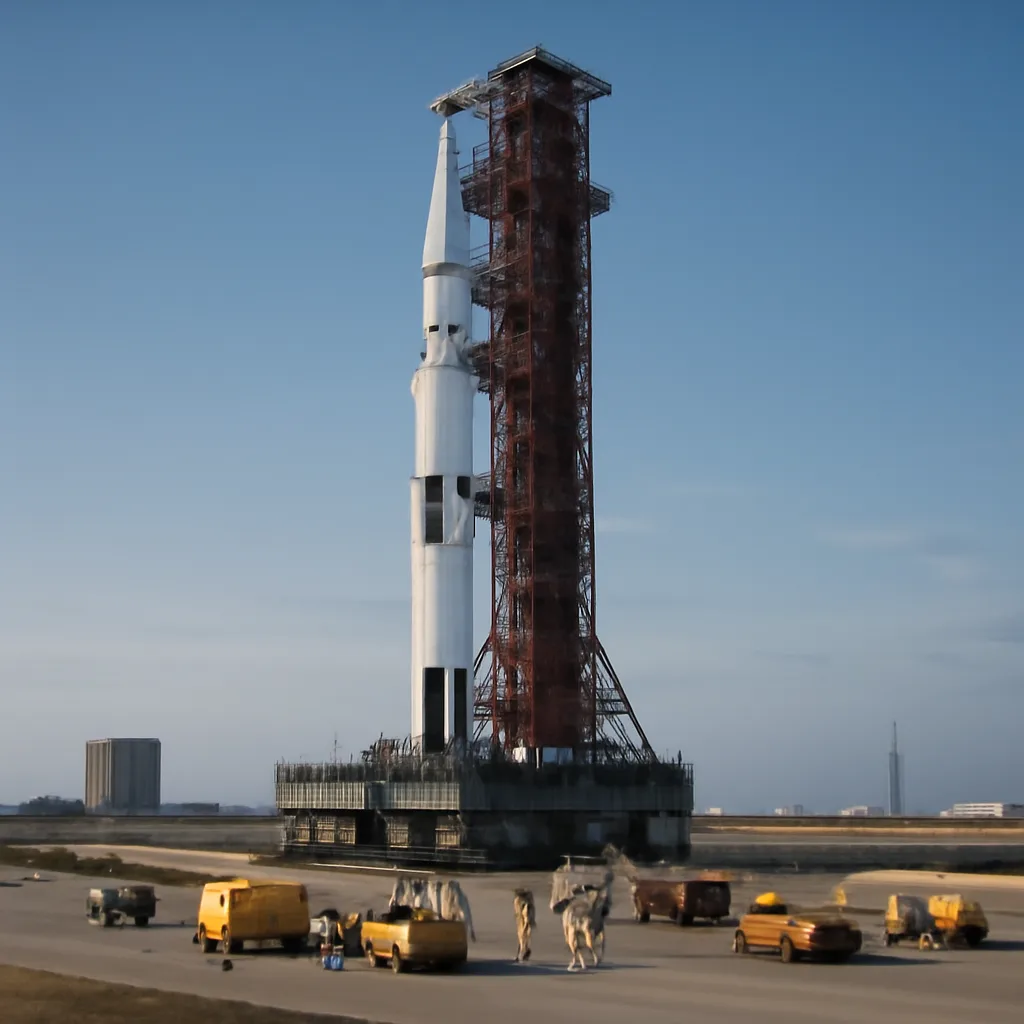
On December 7, 1972, NASA launched Apollo 17—the last crewed mission of the Apollo lunar program—carrying Eugene Cernan, Harrison Schmitt and Ronald Evans to the Moon for a final series of scientific experiments and surface explorations.
Crew and purpose
Apollo 17’s crew consisted of commander Eugene A. Cernan, command module pilot Ronald E. Evans, and lunar module pilot Harrison H. Schmitt, a geologist and the first professional scientist to walk on the Moon. The mission’s objectives emphasized geology and scientific investigation: extended surface stays, systematic sampling, deployment of scientific instruments, and orbital observations.
Launch and transit
The Saturn V rocket carrying Apollo 17 launched from Launch Complex 39A at Kennedy Space Center. After translunar injection and coast to the Moon, the spacecraft entered lunar orbit. Evans remained in the command and service module (CSM) while Cernan and Schmitt descended in the lunar module (LM) for surface operations.
Surface activities
Cernan and Schmitt conducted three moonwalks (extravehicular activities) totaling over 22 hours on the lunar surface. They deployed a range of scientific instruments, collected about 243 pounds (110 kilograms) of rock and regolith samples, and used the lunar rover to travel to multiple geological sites. The samples and observations aimed to improve understanding of lunar geology, stratigraphy, and the Moon’s thermal and impact history.
Scientific results and legacy
Apollo 17 returned a diverse suite of samples, including the famous orange soil discovered during a previous mission’s context (Apollo 17 samples contributed to broader lunar science). The mission’s extensive sampling from highland and valley locations, combined with in-situ measurements and orbital photography, provided important data on the Moon’s composition and evolution. Harrison Schmitt’s presence as a trained geologist emphasized the shift in Apollo’s later missions toward scientific investigation over demonstration of capability.
End of an era
Following lunar surface operations and rendezvous with the CSM, Apollo 17 returned to Earth, splashing down in the Pacific Ocean. It remains the most recent crewed lunar landing to date. The mission represented both a culmination of the Apollo scientific program and a pivot point in U.S. space policy: budgetary constraints and shifting priorities led NASA to end crewed lunar missions after Apollo 17.
Context and significance
Apollo 17 stands as a milestone in human space exploration: the last time humans visited another celestial body, the only scientist-astronaut to conduct lunar fieldwork, and a mission that prioritized systematic scientific study. Its samples and data continue to inform lunar science, and its historical place underscores the interplay of technological achievement, scientific inquiry, and political decision-making in space exploration.
Notes on sources and certainty
This summary is based on established historical records of the Apollo program, NASA mission documentation, and widely reported facts about Apollo 17’s crew, objectives, and outcomes. Specific phrasing and interpretation here avoid speculative claims; where controversies or debates exist in lunar science interpretations, those are not asserted as settled in this overview.