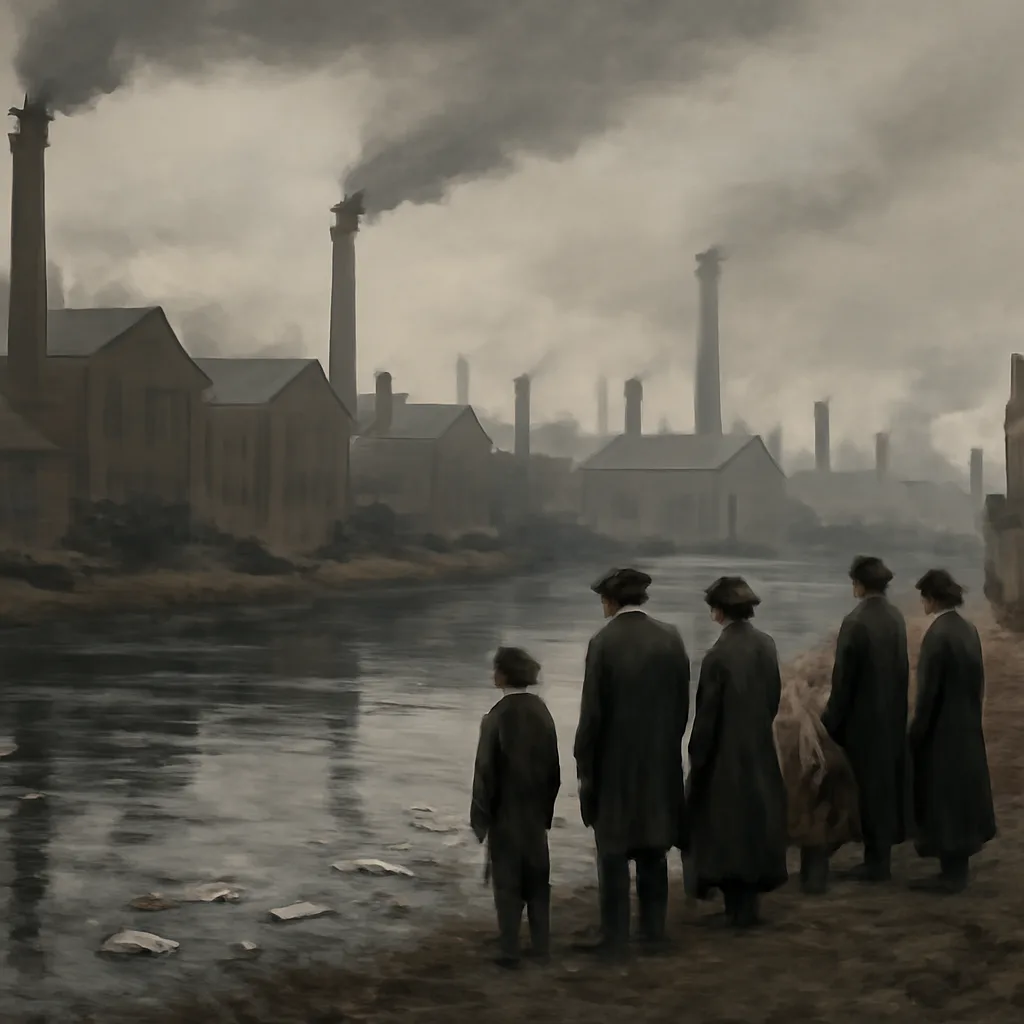
June 18, 1930: First recorded mass deaths linked to industrial pollution reported
On June 18, 1930, contemporaneous reports identified a cluster of deaths attributed to industrial air and water contamination—among the earliest documented incidents where pollution was explicitly linked to fatalities, prompting local investigations and calls for regulation.
On June 18, 1930, newspapers and municipal records described a cluster of fatalities that contemporaries and later historians have cited as among the first recorded cases explicitly attributed to industrial pollution. The incident occurred in an industrial region where factories discharged untreated effluent and emitted dense smoke into residential areas. Local physicians and public health officials who investigated noted a higher-than-expected number of respiratory and gastrointestinal deaths temporally associated with episodes of visible pollution.
Contemporary accounts emphasize several features: recurring discharges from nearby manufacturing plants into waterways used by residents, heavy soot and acidic fumes visible in the air, and a concentration of casualties among vulnerable groups, particularly children and the elderly. Municipal health reports from the period documented spikes in respiratory illnesses and acute poisoning symptoms in the days and weeks preceding the reported deaths, and some records mention fish kills and contaminated wells, indicating multiple exposure pathways.
The 1930 incident must be seen in context. Industrial pollution and occupational exposures had caused illness and death long before 1930—miners’ respiratory diseases, lead and mercury poisoning in various trades, and deadly gas exposures in factories are well documented in the 19th and early 20th centuries. What distinguishes the June 18, 1930, reports is the explicit linking of community deaths to emissions and waste from nearby industrial facilities in local press and municipal health findings, which helped catalyze public concern about environmental contamination beyond the workplace.
Official responses varied. In some locales, municipal authorities initiated inquiries and ordered temporary reductions in discharges or fumigation efforts; in others, limited regulatory powers, economic dependence on industry, and incomplete scientific understanding of dose–response relationships constrained action. The press coverage and health data from 1930 contributed incrementally to the evolving public health discourse that would, over ensuing decades, lead to more systematic monitoring, environmental laws, and the emergence of environmental epidemiology as a field.
Historians caution against treating any single 1930 event as a definitive origin point for recognition of industrial pollution fatalities. Earlier episodes—such as 19th-century urban smogs, industrial cholera outbreaks linked to contaminated water, and occupational poisoning—demonstrate that pollution-related harm was known and debated well before 1930. Nonetheless, the June 18, 1930, reporting is notable for its explicit framing of community deaths as consequences of industrial contamination, an important step in public and official acknowledgment of environmental health hazards.
Documentation from the period includes local health department bulletins, municipal council minutes, and contemporaneous newspaper articles; however, surviving records are uneven, and retrospective interpretations vary. Where the connection between pollution and death was asserted in 1930, later epidemiological methods were limited, so causation was often inferred from timing, spatial clustering, and circumstantial evidence rather than modern statistical analyses. Subsequent scholarly work has used such cases to trace how societies moved from addressing occupational hazards toward recognizing broader environmental risks to entire communities.
In sum, the June 18, 1930 reports occupy a recognized place in histories of environmental health as among the early documented instances in which community fatalities were openly attributed to industrial pollution. They illustrate both the emerging awareness of environmental causes of disease and the constraints of contemporary science and policy that delayed comprehensive protections. Researchers continue to examine these and earlier episodes to better understand the social, economic, and scientific forces shaping environmental regulation in the 20th century.