
06/18/1815 • 4 views
Napoleon Defeated at the Battle of Waterloo
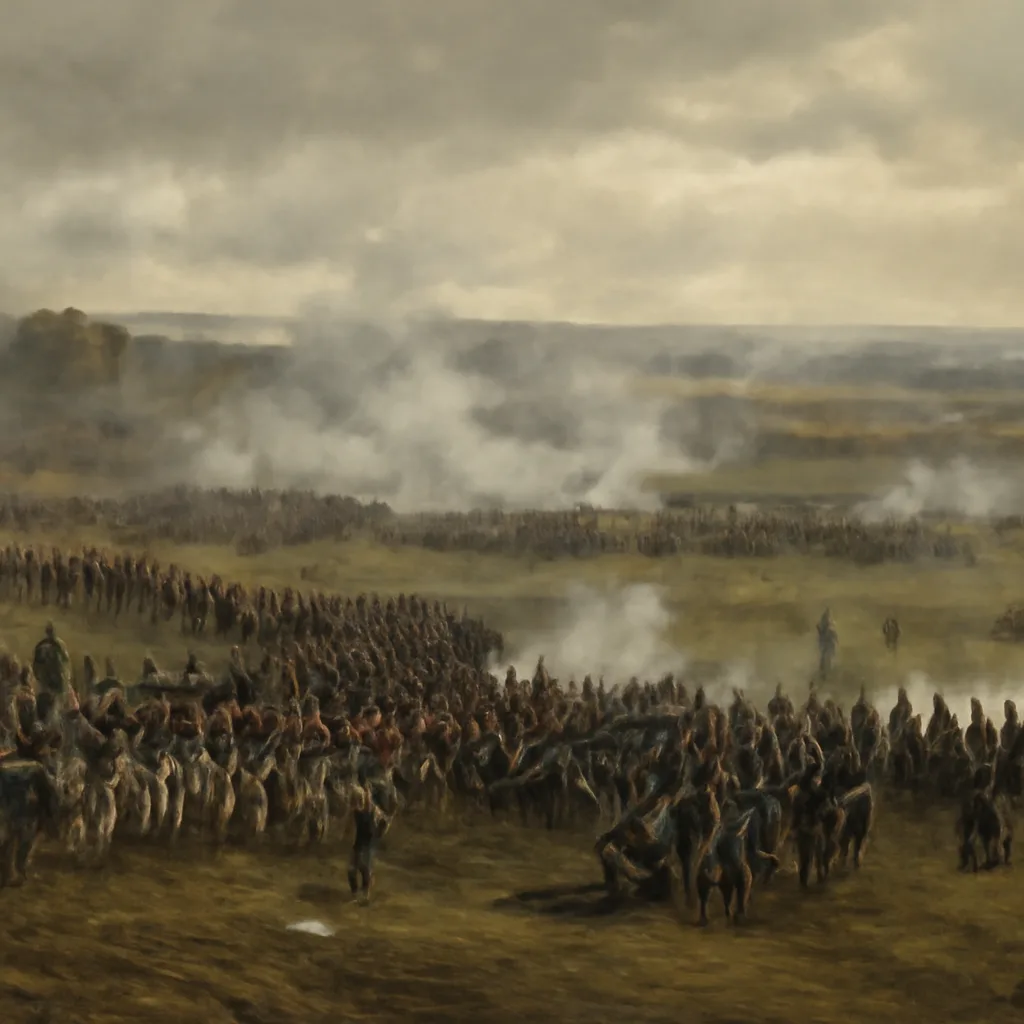
On 18 June 1815, Napoleon Bonaparte’s forces were decisively beaten near Waterloo in present-day Belgium by a coalition led by the Duke of Wellington and Gebhard Leberecht von Blücher, ending the Hundred Days and Napoleon’s rule.
Background: After escaping from Elba in March 1815, Napoleon quickly regained power in France. The Seventh Coalition—composed of Britain, Prussia, the Netherlands, Hanover, Nassau, and other states—mobilized to remove him. Napoleon acted first, aiming to defeat Coalition forces in the field before they could fully unite, marching into what is now Belgium to strike British and Prussian forces separately.
Forces and dispositions: Napoleon commanded roughly 70,000–75,000 troops; Wellington’s Anglo-allied force counted about 65,000, while Blücher’s Prussians brought approximately 50,000–60,000. The battlefield featured key defensive positions held by the Anglo-allied forces at Mont-Saint-Jean ridge, and important outlying farmhouses such as Hougoumont and La Haye Sainte, which shaped the fighting. Heavy rain the night before impeded operations and affected mobility and artillery effectiveness.
The battle: Fighting began late morning and intensified through the afternoon. Napoleon ordered attacks against Wellington’s center and flanks, including a major assault on the farmhouse of Hougoumont intended to draw in enemy reserves. Despite repeated French assaults, Hougoumont held for most of the day, tying down substantial French resources. A crucial French attack on La Haye Sainte initially succeeded in breaching Wellington’s line but by late afternoon the farmhouse fell to French grenadiers after defenders ran low on ammunition—this threatened the allied center.
The turning point came with the arrival and intervention of the Prussian army on Napoleon’s right flank and rear. Blücher’s corps engaged French forces at Plancenoit and pressured Napoleon’s positions, forcing the diversion of troops that could otherwise have been used against Wellington. Late in the afternoon, after the Prussians were increasingly effective and French reserves were committed, Wellington ordered a general advance. Concurrently, Napoleon launched his Imperial Guard in a final attempt to break the allied line. The Guard’s attack was repulsed; its rout then precipitated the collapse of French resistance and a general retreat.
Casualties and aftermath: Estimates vary but combined casualties on both sides likely exceeded 50,000 killed, wounded, or captured, with thousands taken prisoner during the French retreat. The defeat ended Napoleon’s bid to retain power. He abdicated for the second time on 22 June 1815 and surrendered to the British in July; he was subsequently exiled to the island of Saint Helena in the South Atlantic, where he remained until his death in 1821. Politically, Waterloo restored the Bourbon monarchy in France and led to a reassertion of conservative order across Europe at the Congress of Vienna.
Historical significance: Waterloo became shorthand for final and crushing defeat. Historians debate aspects such as Napoleon’s strategic choices, Wellington’s defensive tactics, and the extent to which weather and logistics shaped the outcome. Nonetheless, the combination of Wellington’s resilient defense and timely Prussian support is widely accepted as decisive in ending Napoleon’s rule and reshaping 19th-century European geopolitics.