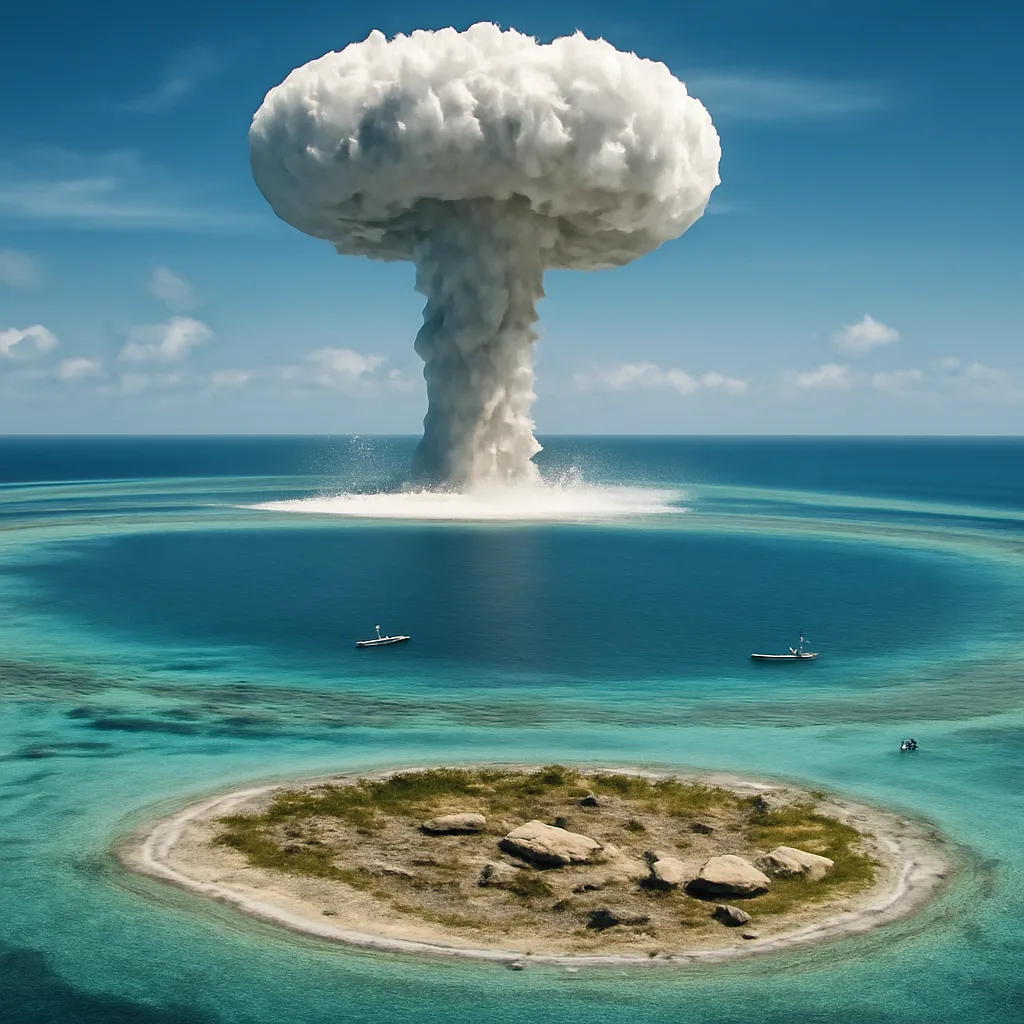
United States detonates first thermonuclear device at Enewetak Atoll
On August 8, 1952, the United States conducted Ivy Mike, the first full-scale test of a thermonuclear (hydrogen) device, at Enewetak Atoll in the Pacific, marking a major advance in nuclear weapons technology with far-reaching military and scientific consequences.
On August 8, 1952, at Enewetak Atoll in the Marshall Islands, the United States detonated Ivy Mike, the first full-scale thermonuclear device designed to demonstrate the practicality of a hydrogen bomb. The test was part of Operation Ivy, conducted by the U.S. Atomic Energy Commission and the Department of Defense. Ivy Mike was not a deliverable weapon but an experimental cryogenic device that used liquid deuterium as fusion fuel and weighed many tons; its purpose was to prove the staged thermonuclear concept developed by American physicists in the postwar years.
The Ivy Mike shot produced a yield of about 10.4 megatons of TNT, vastly greater than contemporary fission bombs. The explosion vaporized the island of Elugelab, produced a mushroom cloud that rose to the stratosphere, and generated powerful shock and thermal effects observed for miles. The test required extensive instrumentation, a large support crew, and new logistical measures: prefabricated structures, long-range observation platforms, and protective procedures for personnel and equipment. Scientists recorded data on temperature, pressure, radiation, and the efficiency of fusion ignition.
Ivy Mike validated the Teller-Ulam design—a two-stage configuration separating a fission “primary” and a fusion “secondary”—and confirmed that staged radiation implosion could compress and ignite fusion fuel. The success accelerated thermonuclear weapons development, informing subsequent U.S. designs that were later miniaturized for deployment. The test intensified the nuclear arms competition with the Soviet Union and contributed to the strategic calculus of the early Cold War.
The environmental and human consequences of thermonuclear testing became a subject of concern. Ivy Mike and other Pacific tests released large amounts of radioactive debris and altered local geography; eyewitness accounts and later studies documented contamination of islands and lagoon waters. Indigenous populations of the Marshall Islands had already been relocated for earlier tests, and subsequent research has linked testing to long-term health impacts among some Marshallese communities, although assessments of specific doses and outcomes have been complex and contested.
Ivy Mike also had scientific significance beyond weapons development. The test yielded insights into high-energy physics, radiation transport, and the behavior of matter under extreme conditions—data that were recorded, analyzed, and published in technical reports of the era. Still, many details remained classified for years, and the moral and legal questions surrounding atmospheric nuclear testing spurred public debate domestically and internationally, eventually contributing to movements for test bans and arms-control negotiations.
Historically, Ivy Mike represents a turning point: the transition from fission-only arsenals to thermonuclear capabilities that reshaped military strategy, international diplomacy, and civil-society responses to nuclear risk. While the physical experiment was a technical success for its designers, its legacy includes environmental damage, displacement and suffering among Pacific Islanders, and an intensified global nuclear arms race that influenced policy and public consciousness for decades.
Sources for this account include declassified government reports and contemporaneous scientific summaries of Operation Ivy, historical studies of U.S. nuclear testing, and research into the Marshall Islands’ post-testing conditions. Where assessments of health and environmental impacts remain contested, this summary notes the existence of ongoing study and debate rather than asserting definitive causal findings.