
← Back
11/19/1863 • 5 views

Lincoln’s Gettysburg Address: Four Score and a Nation Tested
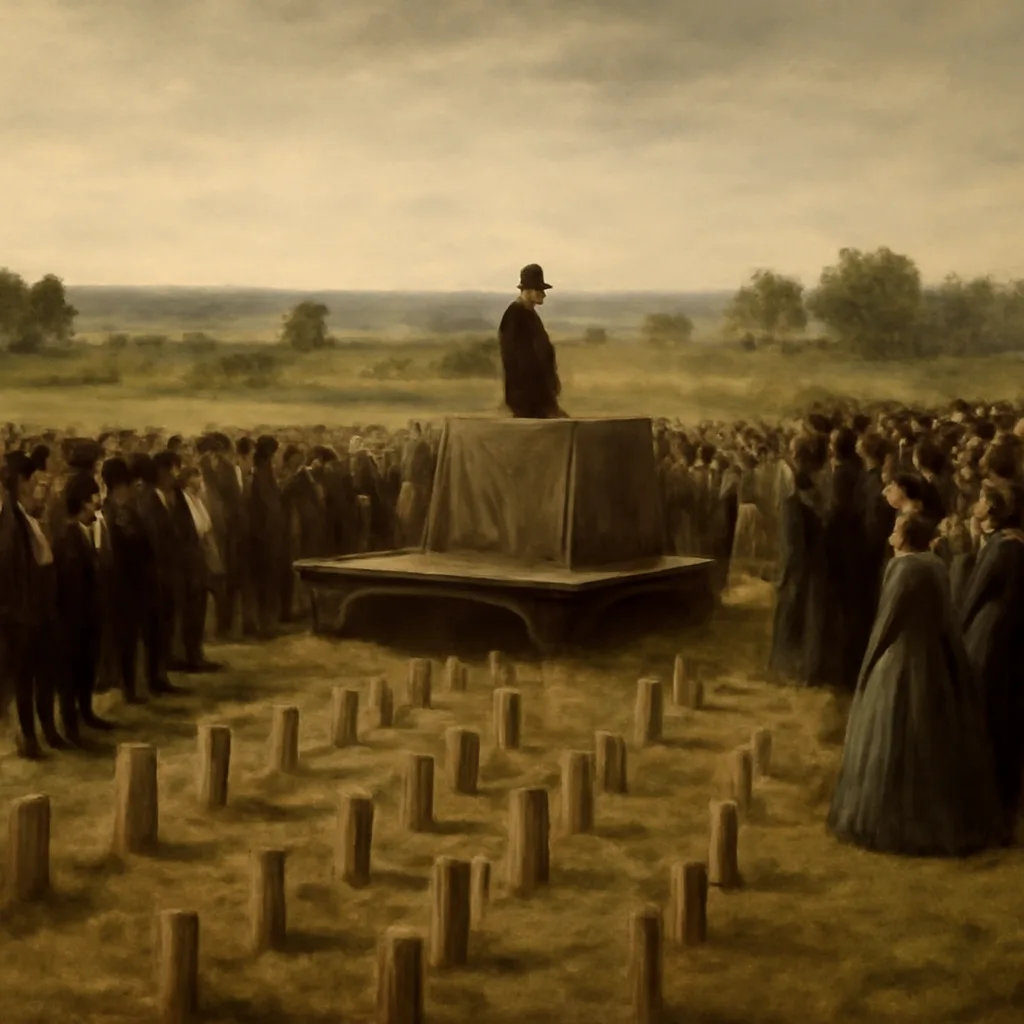
Crowd gathered at the dedication of Gettysburg National Cemetery, 1863, with a speaker’s platform and rows of newly marked graves in a rural landscape.

On November 19, 1863, President Abraham Lincoln spoke at Gettysburg National Cemetery, delivering a brief but enduring address that reframed the Civil War as a test of American democracy and national unity.


On November 19, 1863, Abraham Lincoln delivered what became known as the Gettysburg Address at the dedication of the Soldiers’ National Cemetery in Gettysburg, Pennsylvania. The speech followed a major Union victory at the Battle of Gettysburg (July 1–3, 1863), one of the war’s bloodiest engagements. Lincoln’s remarks—remarkably concise at roughly two to three minutes and about 272 words in most commonly cited texts—contrasted with the longer oration by Edward Everett, a noted orator who spoke earlier that day.

Context and purpose
The cemetery dedication provided a ceremonial moment to honor Union dead and to consecrate hallowed ground. Lincoln’s role was intended to be brief and symbolic: to dedicate the cemetery and to offer a moral frame for the sacrifices made there. In his address, Lincoln invoked the Declaration of Independence (“all men are created equal”) and recast the Civil War as not merely a war to preserve the Union but as a test of whether a nation founded on liberty and equality could endure.

Textual history and versions
No single definitive manuscript exists; multiple versions and copies of the speech survive, produced by Lincoln and others shortly after the event. The most commonly referenced texts are the Nicolay and Hay drafts—named for Lincoln’s secretaries—and several newspaper transcriptions that vary slightly in wording and punctuation. These differences have fueled scholarly attention, but the core themes and key phrases are consistent across versions.

Content and themes
Lincoln’s address is notable for its rhetorical compression and repetition. In roughly ten sentences, he moved from honoring the dead to articulating a national purpose: that the living must be dedicated to the unfinished work of ensuring “a new birth of freedom” and that government “of the people, by the people, for the people, shall not perish from the earth.” The speech emphasizes sacrifice, national rebirth, democratic legitimacy, and moral resolve—framing the Union cause in principled as well as political terms.

Reception and legacy
Contemporary reactions were mixed; some newspapers gave it modest notice while others praised its moral clarity. Edward Everett, the day’s principal speaker, later complimented Lincoln’s words, calling the address “the little speech that made the day memorable.” Over time, Lincoln’s brief remarks achieved iconic status, becoming central to American civic memory and public education. Historians and rhetoricians study the address for its economy of language, moral framing, and enduring civic vocabulary.

Commemoration and historical significance
The Gettysburg Address has been widely reproduced, memorized, and quoted in American public life. It is inscribed on monuments, taught in schools, and invoked in political and civic debates about equality, democracy, and national purpose. The site of the address, Gettysburg National Cemetery and the Gettysburg battlefield, remains a place of mourning, study, and reflection.

Scholarly notes and cautions
Details such as the exact wording Lincoln spoke aloud and the precise length of time he spoke are subject to historical uncertainty because of inconsistent contemporary reports and multiple manuscript versions. Scholars rely on comparison of drafts, newspaper reports, and other documents to reconstruct the event and its language. While the broad significance of the speech is well documented, some specific textual and circumstantial details remain debated.

The Gettysburg Address endures as a compact statement of democratic ideals delivered in a moment of national crisis, linking the Union war effort to a language of equality and framing the conflict as foundational to the future of American government.

Share this

Email Share on X Facebook Reddit

Did this surprise you?