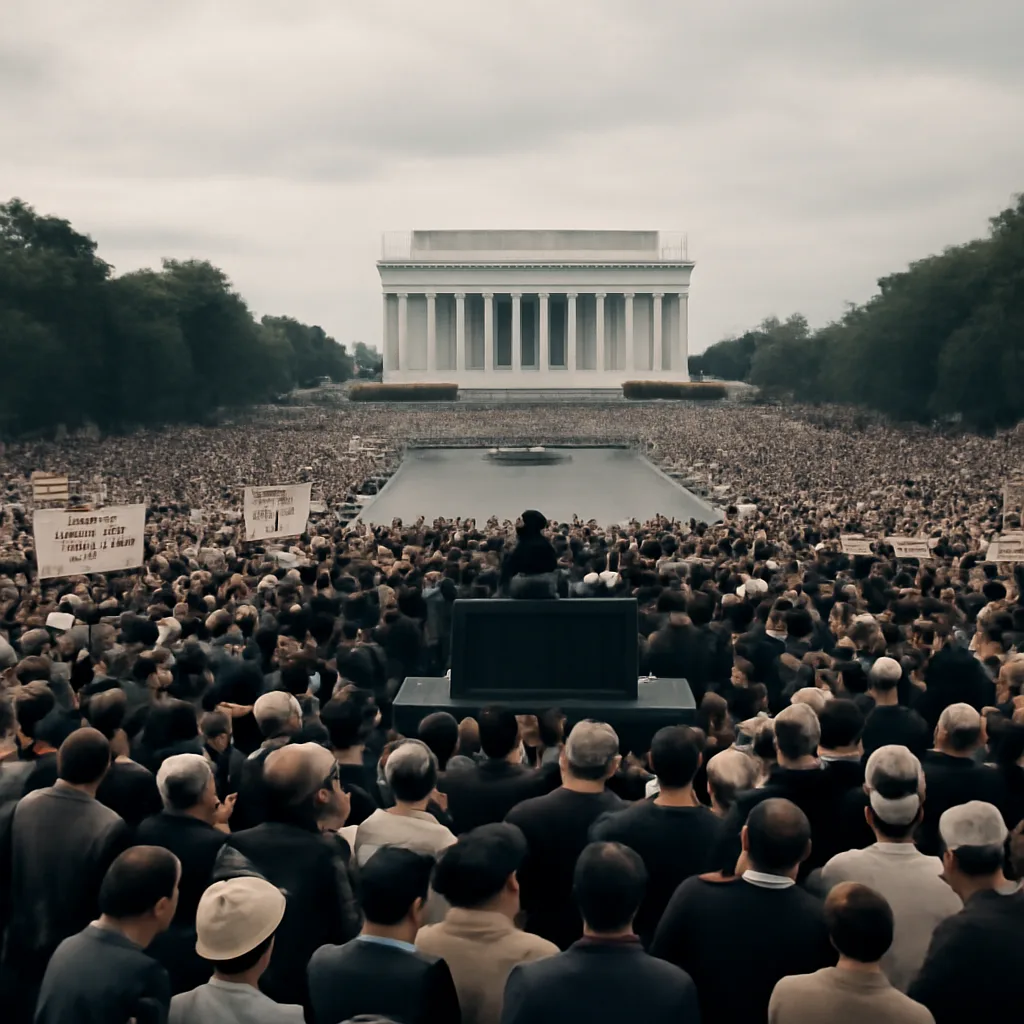
Martin Luther King Jr. Delivers 'I Have a Dream' at 1963 March on Washington
On August 28, 1963, Martin Luther King Jr. delivered the 'I Have a Dream' address during the March on Washington for Jobs and Freedom, a pivotal moment in the U.S. civil rights movement that helped focus national attention on racial inequality and segregation.
On August 28, 1963, an estimated 200,000 people gathered at the Lincoln Memorial in Washington, D.C., for the March on Washington for Jobs and Freedom. Organized by civil rights, labor, and religious groups, the march aimed to press for civil and economic rights for African Americans. The event is widely remembered for the speech delivered by Martin Luther King Jr., then a 34-year-old Baptist minister and prominent civil rights leader.
King's address was part of a larger program that included speeches, musical performances, and prayers. While several leaders spoke that day, King's remarks — which came near the end of the program — became the most enduring. The speech combined moral and political appeals, drawing on biblical, historical, and constitutional references to call for an end to racism, segregation, and economic injustice. It articulated a vision of racial equality and nonviolent protest, culminating in the now-famous passage that begins with the phrase "I have a dream." That passage, and other memorable lines from the address, were not all scripted: King and his aides had prepared a text, but he also improvised parts of the delivery, responding to the crowd and to gospel singer Mahalia Jackson's exhortation to "Tell them about the dream."
The speech resonated widely at the time and has since become a central document in U.S. history. It helped galvanize public support for civil rights legislation that followed, including the Civil Rights Act of 1964 and the Voting Rights Act of 1965, though historians note that the march and the speech were among many factors influencing those laws. Contemporary reactions were mixed: many civil rights supporters hailed the march as a breakthrough in public visibility and moral authority, while opponents condemned it; some activists also debated tactics and priorities within the movement.
Scholars analyze the speech's rhetorical structure, its use of American founding texts and prophetic religious language, and its blending of immediate policy demands with a broader visionary appeal. The best-documented portions of the address are those recorded and widely circulated soon after the event; historians rely on audio recordings, transcripts, contemporaneous news coverage, and participants' accounts to study how King adapted his prepared remarks in performance.
The March on Washington and King's speech had tangible and symbolic consequences. The mass demonstration demonstrated the organizational capacity of the civil rights movement, attracted international attention to the struggle against segregation and disenfranchisement, and helped frame civil rights as a central national issue. However, change was neither immediate nor complete: legal victories were followed by continued resistance, regional disparities in enforcement, and ongoing debates about economic inequality and structural racism.
Today the speech is commemorated in books, curricula, and public ceremonies. Historians continue to examine both its immediate impact and its evolving status as a symbol — noting where memory has simplified complex events and where multiple participants' contributions are sometimes overshadowed by a single iconic moment. The speech remains significant for its rhetorical power and for its role within a broader movement that combined grassroots activism, legal strategies, and legislative advocacy to challenge racial injustice in the United States.