
11/02/1804 • 5 views
Napoleon Bonaparte Crowned Emperor of the French
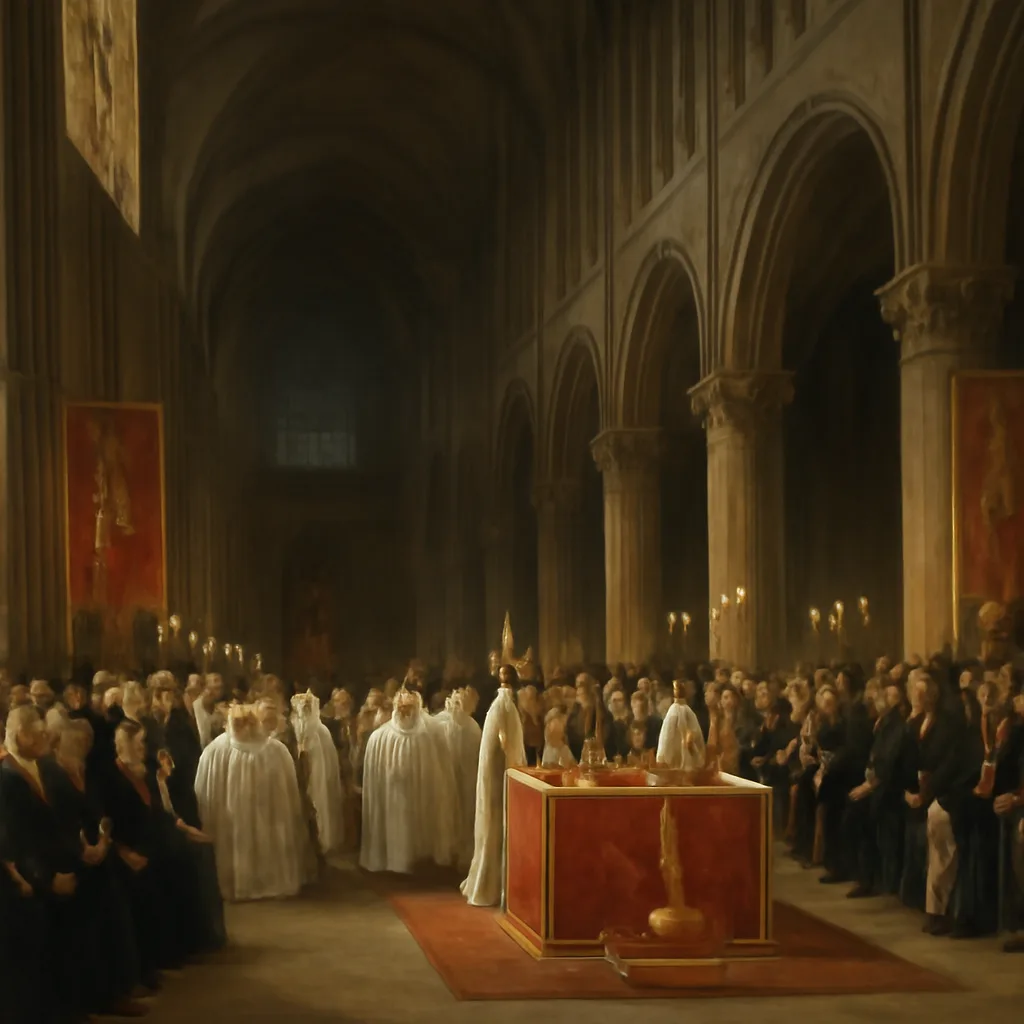
On 2 November 1804, Napoleon Bonaparte was crowned Emperor of the French in a ceremony at Notre-Dame de Paris that marked the formal transformation of the French Consulate into a hereditary empire and a new chapter in post-revolutionary France.
Preparations and political context
Napoleon’s decision to accept the title of Emperor followed a series of political steps: the Constitution of the Year XII (1804) established the imperial regime; a plebiscite held earlier that year provided broad popular endorsement, though the fairness of such votes is debated by historians; and the Senate and other bodies ratified the legal framework for hereditary succession. Domestically, many leading figures—administrators, military officers, and property-owning elites—favored a strong centralized authority to secure order and protect gains of the Revolution, including property rights and legal equality for male citizens. Abroad, European monarchies viewed Napoleon’s elevation with alarm, contributing to shifting alliances and the wars that would continue through the Napoleonic era.
The ceremony at Notre-Dame
The coronation took place in Paris’s cathedral, a setting chosen for its symbolic resonance with French monarchy and Catholic ritual. Pope Pius VII traveled to Paris and attended the ceremony, a significant diplomatic gesture that lent religious legitimacy. The liturgy combined revolutionary-era statecraft with traditional Catholic forms. In a widely remembered moment—reported by contemporary observers—Napoleon took the crown and placed it on his own head rather than allowing the Pope to crown him, an act meant to signal that his authority derived from his own power and from the French state rather than solely from papal sanction. Josephine, his wife, was crowned Empress during the same ceremony.
Symbolism and immediate effects
The coronation was designed to project stability, continuity, and grandeur. Regalia, imperial paraphernalia, and ceremonial pageantry evoked earlier European coronations while emphasizing a distinctly French imperial identity. Napoleon’s self-coronation has been interpreted as a deliberate assertion of secular sovereignty and as a message to European rulers that France had reconstituted a centralized monarchical authority under new legitimacy. The event also served domestic political ends by rallying support among conservative and moderate constituencies who feared a return to revolutionary chaos.
Longer-term significance
Napoleon’s assumption of the imperial title reshaped European politics. It intensified rivalries with Britain, Austria, Russia, and Prussia, contributing to a sequence of coalitions and wars. Domestically, the imperial regime allowed Napoleon to continue and institutionalize reforms—legal codification, centralized administrative structures, educational initiatives, and support for infrastructure—that had lasting influence. Simultaneously, the regime curtailed certain political freedoms, used censorship and police measures to control dissent, and relied on patronage and military success to maintain legitimacy.
Historiography and debates
Historians debate the degree to which the coronation represented a restoration of monarchy versus a novel revision of monarchical forms. Some emphasize Napoleon’s pragmatic consolidation of revolutionary gains under authoritarian rule; others underline how the ceremony and the imperial title signaled a return to dynastic politics. Questions remain about the plebiscites’ representativeness and the balance between popular support and elite maneuvering in legitimizing the new regime.
The coronation on 2 November 1804 remains a pivotal, well-documented moment in the transition from revolutionary France to Napoleonic rule—a blending of revolutionary institutional achievements, personal ambition, and traditional ceremonial spectacle that reshaped France and Europe in the early 19th century.