
← Back
09/13/1999 • 9 views

NASA probe loses contact after metric-imperial unit mix-up
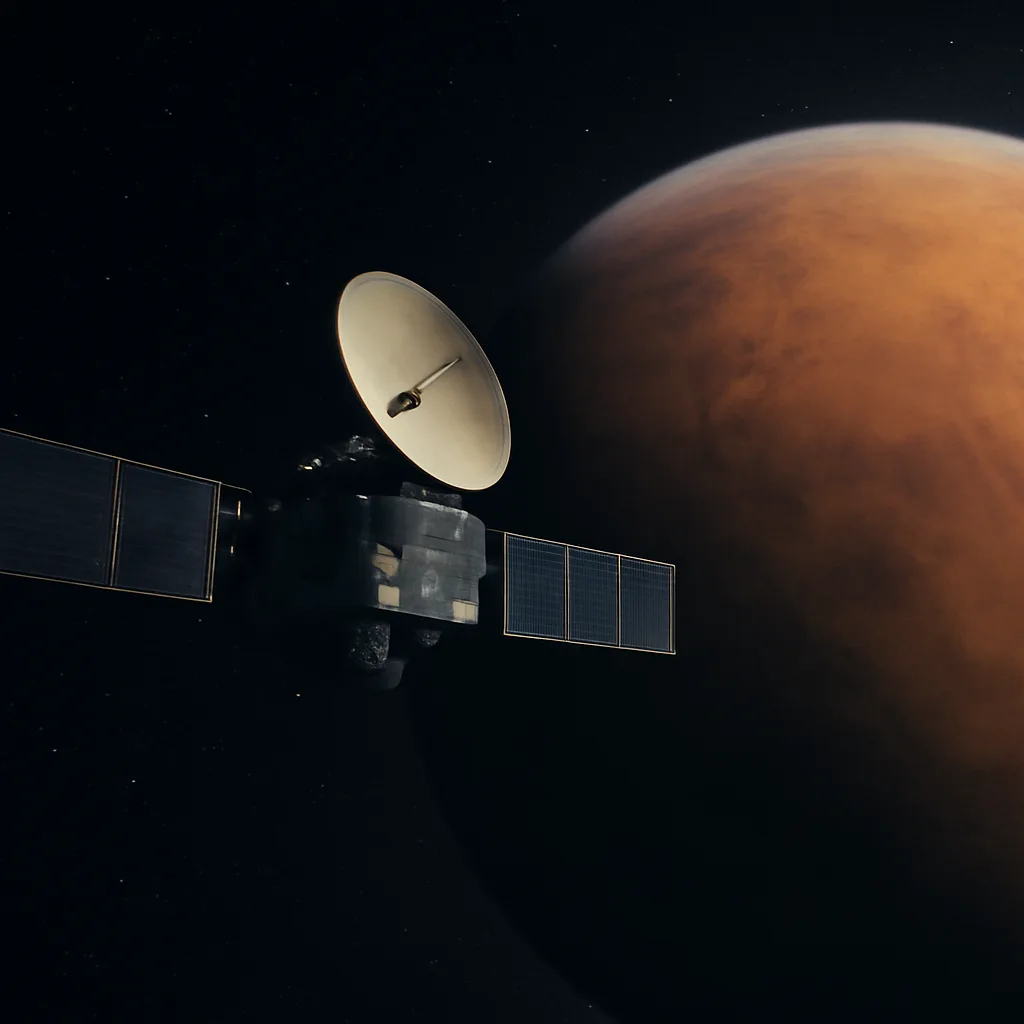
The Mars Climate Orbiter against a starfield with Mars in the background, showing the spacecraft’s antenna and solar arrays but not focusing on identifiable people.

On Sept. 13, 1999, NASA lost communication with the Mars Climate Orbiter after a units conversion error caused a trajectory miscalculation; the spacecraft likely entered the Martian atmosphere and broke apart.


On September 13, 1999, NASA acknowledged loss of contact with the Mars Climate Orbiter, a mission designed to study Martian climate and serve as a communications relay. Investigations concluded the spacecraft was lost after a navigation error stemming from a units conversion mismatch between mission teams.

Background
The Mars Climate Orbiter was launched in December 1998 as part of NASA’s Mars Surveyor program. Its primary goals were to study Martian weather, atmospheric structure and dust distribution, and to act as a relay for the Mars Polar Lander. The spacecraft arrived at Mars for orbital insertion in September 1999.

What went wrong
Post-loss reviews found that one piece of ground software produced thrust data in pound-force seconds (lbf·s) while the navigation team’s calculations expected the same data in newton-seconds (N·s). The mismatch—imperial versus metric units—meant the spacecraft’s trajectory corrections were calculated incorrectly. As a result, the Orbiter approached Mars at a lower altitude than planned.

Probable outcome
Engineers concluded the Orbiter likely passed too close to Mars and entered the upper atmosphere, where it would have experienced heating and aerodynamic stresses beyond design limits. Although no definitive imaging confirmed the final breakup, trajectory analysis and telemetry gaps led NASA to conclude the vehicle was lost, probably disintegrating in the atmosphere or impacting the surface.

Responsibility and findings
An internal mishap investigation identified the source of the error as a failure to convert units consistently between a contractor-supplied software module and the navigation team's expectations. The report emphasized shortcomings in systems engineering, interface definitions, and verification procedures that allowed the inconsistency to propagate into flight operations.

Aftermath and changes
The loss of the Mars Climate Orbiter prompted NASA to review and tighten engineering standards, verification processes, and contractor oversight for inter-team interfaces. NASA implemented stricter requirements for unit testing, interface control documentation, and end-to-end validation to reduce the risk of similar errors in future missions. Lessons from the mishap informed subsequent Mars missions’ design and operational practices.

Context and significance
The incident became a widely cited example in engineering and project management of how small, human-scale errors—here, a units conversion oversight—can result in mission failure. While the scientific objectives of the Mars Climate Orbiter were not realized, the episode contributed to procedural reforms that have influenced later planetary exploration efforts.

Uncertainties
Although trajectory reconstructions strongly indicate the Orbiter was lost during atmospheric passage or impact, the absence of recovered hardware or direct imaging means the exact final moments remain unobserved. Reports and findings are based on post-failure telemetry analysis, software review, and engineering reconstruction carried out after contact was lost.

Share this

Email Share on X Facebook Reddit

Did this surprise you?