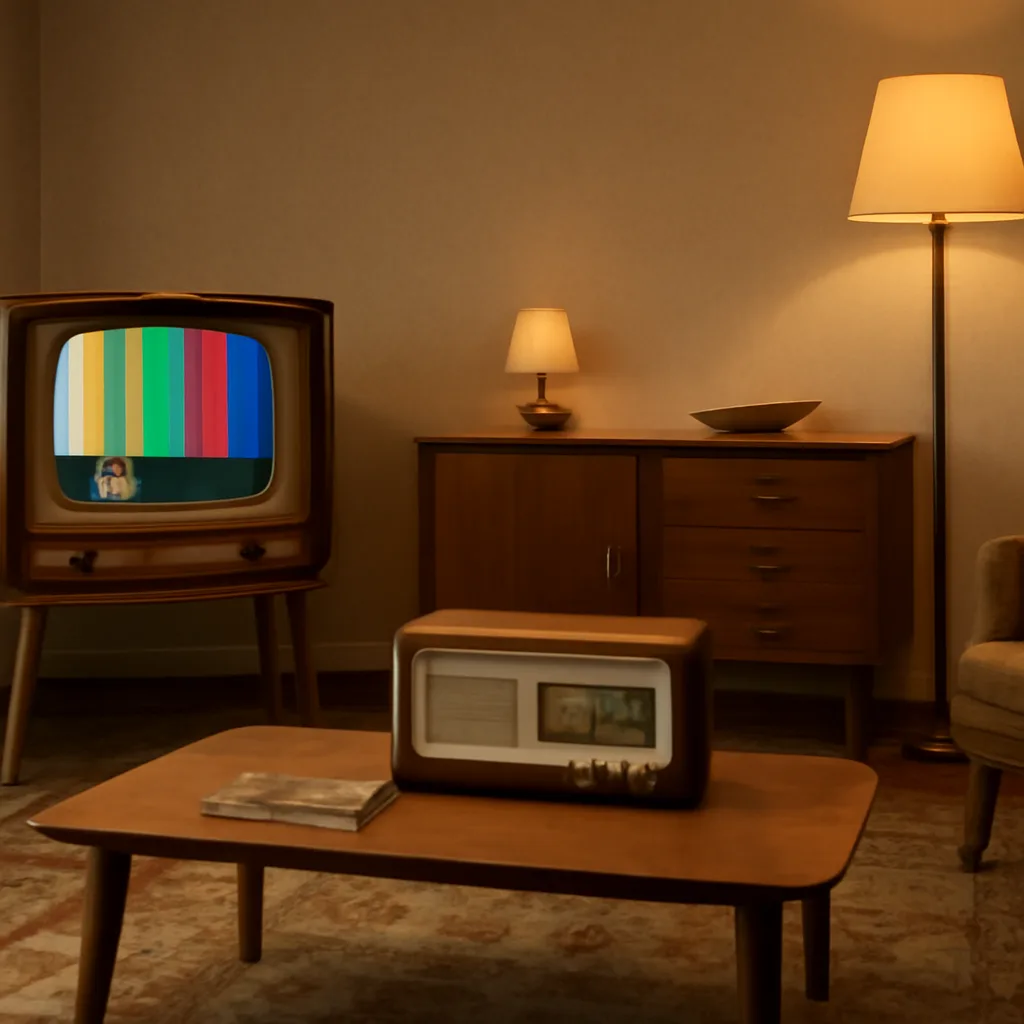
RCA Announces First Mass‑Produced Color Television, 1954
On May 20, 1954, RCA unveiled the CT-100, its first mass-produced color television set based on the NTSC standard, marking a pivotal step from experimental broadcasts to consumer color TV—though early models were costly and technically imperfect.
On May 20, 1954, RCA introduced the CT-100, widely regarded as the first mass‑produced color television set built to receive broadcasts using the NTSC color standard adopted in the United States. The set followed years of experimental color work by multiple companies and governmental coordination to create a compatible system that preserved black‑and‑white reception while adding color information. RCA’s announcement represented the transition from laboratory demonstrations and limited, noncommercial receivers to a commercially manufactured product intended for sale to consumers and broadcasters.
Technical context
The CT-100 used a 15‑inch color cathode‑ray tube developed for the NTSC (National Television System Committee) color system, officially standardized in December 1953. The NTSC standard encoded color information in a way that allowed existing black‑and‑white receivers to display the luminance signal while color receivers decoded the chrominance; this backward compatibility was a central engineering and regulatory goal. Early color sets such as the CT-100 were complex, containing multiple signal‑processing circuits and three electron guns within the picture tube to reproduce red, green, and blue. The engineering challenges produced sets that were large, fragile, and prone to technical issues by later standards.
Commercial and cultural impact
RCA’s mass production announcement signaled confidence that color broadcasting could expand beyond special events and laboratory tests into regular programming, stimulating manufacturers, broadcasters, and advertisers to invest in color equipment. Initially, adoption was limited: the CT-100 and contemporary color sets were expensive—costing several hundred to over a thousand dollars in 1954—and color broadcasts were not yet widespread. Early purchasers were often enthusiasts, businesses, or demonstration sites. Nonetheless, the commercial availability of a standardized color receiver helped accelerate production of color programming and the gradual rollout of color broadcasts during the 1950s and 1960s.
Market realities and limitations
Although called “mass‑produced,” early production runs were relatively modest compared with later consumer electronics. The CT-100 had reliability and manufacturing issues; the picture tubes were delicate and some batches suffered from short lifespans or color purity problems. Many early sets required frequent service and adjustments. These limitations, combined with high prices and limited color transmission, meant that color television did not become commonplace in American households until the 1960s.
Legacy
The 1954 introduction of a commercially manufactured NTSC‑compatible color set stands as a milestone in television history: it demonstrated that a practical, consumer‑oriented color television system had been achieved and laid the groundwork for eventual mass adoption. RCA’s role in promoting the NTSC standard and producing early color receivers influenced broadcasters’ equipment choices and the evolution of television production practices. While the CT‑100 itself is now a collector’s item and relatively rare—partly due to the fragility of its early tubes—its arrival marks the moment when color moved from experiment to market reality.
Notes on sources and certainty
This summary synthesizes widely documented historical facts about RCA’s 1954 color television introduction and the NTSC standard. Specific production numbers and detailed technical failure rates for the CT‑100 vary among sources; where figures are disputed or imprecise, this account avoids asserting exact totals.