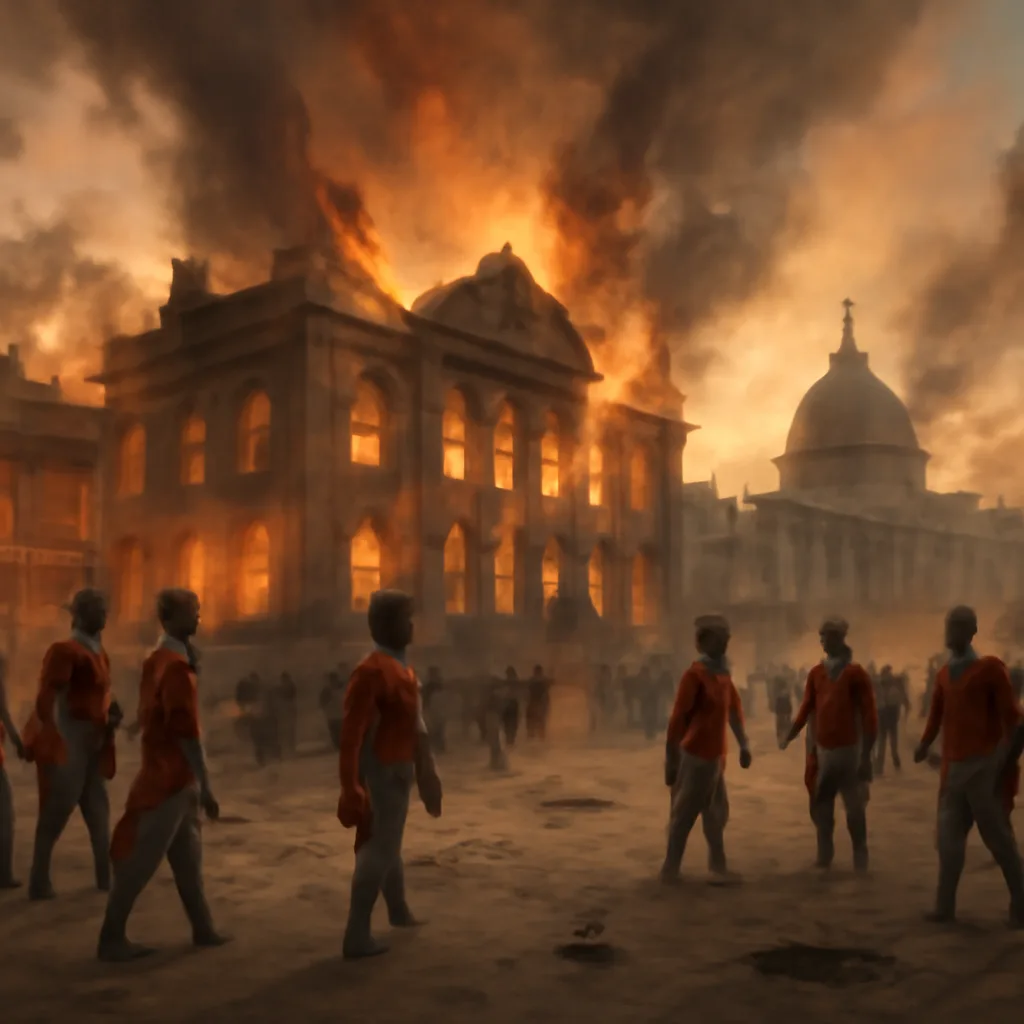
British Troops Burn Washington: The White House Set Ablaze, 1814
On August 24, 1814, during the War of 1812, British forces captured Washington, D.C., and set fire to the President’s House (later called the White House) and other public buildings, in retaliation for American actions in Canada and attacks on British territories.
On the afternoon and evening of August 24, 1814, British forces under Major General Robert Ross and Rear Admiral Sir George Cockburn entered and occupied Washington, D.C., after defeating American militia at the Battle of Bladensburg. The British troops proceeded to burn several public buildings, including the Presidential Mansion (then commonly called the President’s House), the Capitol’s Senate and House chambers, the Treasury building, and other government facilities. The attack was part of a wider British campaign along the Atlantic coast during the War of 1812.
Background: By 1814 the war had stalemated in several theaters. The British, distracted earlier by the Napoleonic wars, were able to redeploy forces to North America after Napoleon’s initial abdication in 1814. Seeking to punish American incursions into Canada and to divert American attention, British commanders conducted raids along the Chesapeake Bay and launched an advance on the U.S. capital.
Capture of Washington: On August 24, British troops routed a largely inexperienced American force at Bladensburg, Maryland. The collapse of American resistance opened the road to Washington. With low local defenses and many officers absent, the city’s leaders fled or prepared to surrender. British troops entered the capital and methodically targeted public buildings associated with U.S. government authority.
The Burnings: British officers ordered the destruction of government property. Fires were set in the President’s House and the north and south wings of the Capitol; the main Capitol building’s interior also suffered severe damage. Contemporary accounts report the removal or destruction of furnishings and public records in some buildings; other materials were looted or salvaged by Americans and British alike. The executive mansion was gutted by fire and left in ruins; its exterior and basic structure survived, allowing later reconstruction. Some private residences and businesses in Washington escaped damage, and many citizens had evacuated before the occupation.
Motives and Context: British commanders framed the operation as retaliation for American attacks in British North America and for the burning of government buildings in Canadian towns during earlier raids. The Chesapeake campaign also aimed to demonstrate British naval and military reach and to pressure American officials. Historians note that vandalism and looting accompanied the burning in some instances, though the operation primarily targeted federal public buildings rather than private homes.
Consequences: The immediate consequence was the destruction of key federal buildings and loss of government records and furnishings. The symbolic impact was large: the sacking of the capital shocked the young republic and exposed vulnerabilities in national defense and militia organization. The event contributed to political and military reforms, spurred rebuilding efforts, and entered American memory as a moment of national humiliation and resilience. Reconstruction of the President’s House began under President James Madison and continued under his successor; the building was repaired and later renovated, eventually becoming known widely as the White House.
Historical Notes and Disputes: The commonly cited date for the burning is August 24, 1814; accounts vary in detail about the extent of looting, what specific items were destroyed or removed, and the precise orders given by British commanders. Some contemporary American observers accused British troops of wanton destruction; British official correspondence framed the action as legitimate military retaliation. Modern historians rely on a range of primary sources—military dispatches, newspapers, diaries, and government records—to reconstruct events, and interpretations emphasize both the strategic motives and the symbolic dimensions of the attack.
Legacy: The burning of Washington remains a pivotal episode in U.S. history, emblematic of wartime vulnerability and subsequent recovery. The restored President’s House and Capitol stand today as products of the reconstruction that followed, and August 24, 1814, remains the widely recorded date of the burning of the White House.