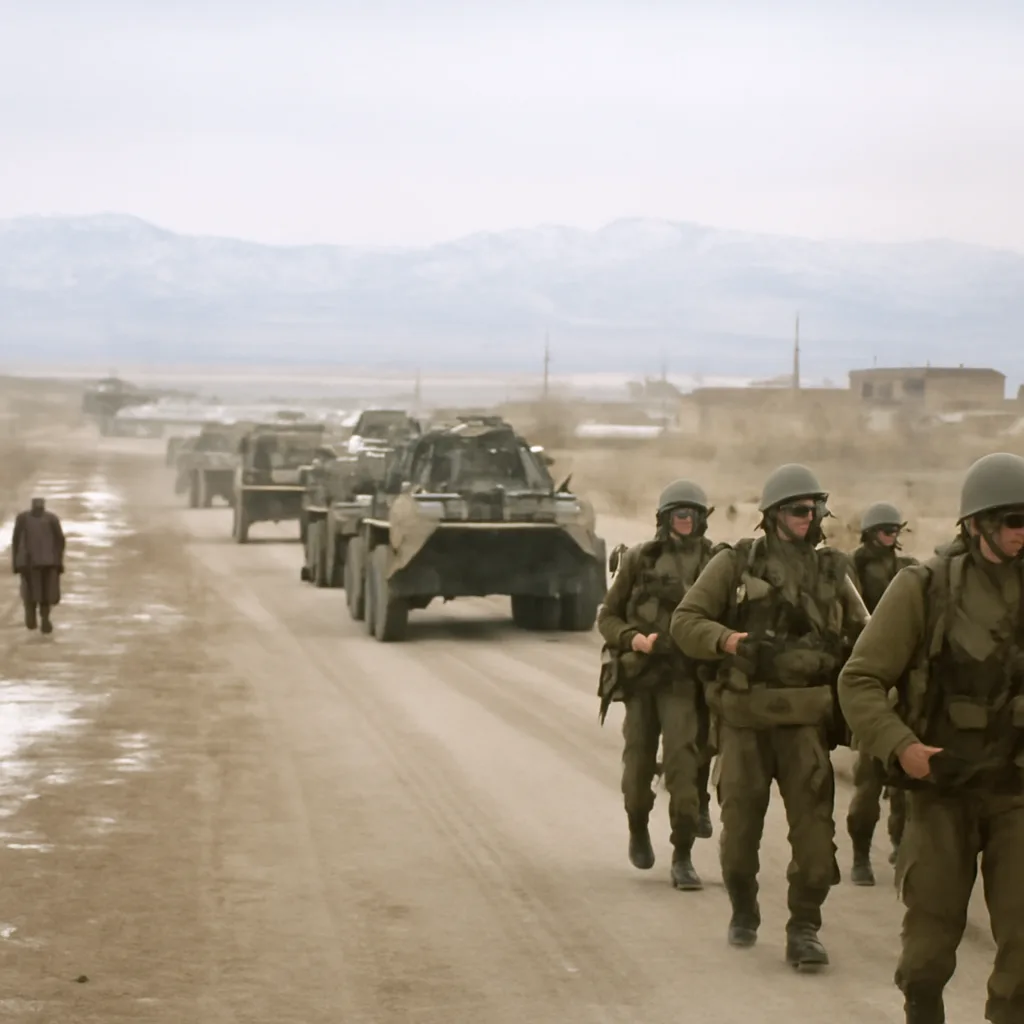
Soviet Troops Enter Afghanistan, Dramatically Raising Cold War Tensions
On 24 December 1979 Soviet forces intervened in Afghanistan to support the communist government, triggering global condemnation, a U.S.-led boycott of the 1980 Moscow Olympics, and a decade-long insurgency that intensified Cold War rivalry.
On 24 December 1979, units of the Soviet Armed Forces crossed into Afghanistan and began an intervention aimed at bolstering the faltering Democratic Republic of Afghanistan government. The decision followed months of political instability in Kabul, internal purges, and a series of coups within the Afghan communist leadership. Soviet leaders framed the operation as a limited deployment to stabilize an allied regime facing internal collapse and hostile forces, while Western governments and many Muslim-majority states viewed the move as a major external invasion.
The immediate military intervention included airborne landings and mechanized columns moving toward Kabul and other strategic locations. The operation quickly secured key government buildings and suppressed opposition elements in urban centers, but it also catalyzed widespread resistance in rural regions. Various Afghan groups—ranging from tribal militias to Islamist guerrillas—mobilized against the Soviet presence, receiving material, financial, and training support from regional neighbors and covert backing from the United States, Pakistan, Saudi Arabia, and others. Over the following months and years, the fighting expanded into a protracted insurgency that imposed heavy costs in lives, infrastructure damage, and displacement.
International reaction was swift and predominantly condemnatory in the West. The United States denounced the intervention as an aggressive expansion of Soviet influence and responded with diplomatic measures, economic sanctions, and increased military assistance to Afghan resistance groups through regional partners. The United Nations General Assembly passed resolutions calling for withdrawal, and the crisis contributed to a further deterioration of détente between Washington and Moscow. One prominent visible consequence was the U.S.-led boycott of the 1980 Summer Olympics in Moscow, a symbolic measure reflecting broader geopolitical hostility.
For the Soviet Union, the Afghanistan intervention became increasingly costly and controversial. Soviet policymakers initially anticipated a relatively quick stabilization, but they faced an entrenched insurgency, difficult terrain, and complex tribal and political dynamics that complicated counterinsurgency efforts. Over time the human toll—Soviet combat fatalities and large numbers of Afghan civilian and combatant casualties—along with financial burdens and international isolation, turned the intervention into a quagmire that eroded domestic and elite support in Moscow.
Regionally, the invasion reshaped South and Central Asian politics. Pakistan became a primary conduit for weapons and refugees, deepening its security concerns and involvement in Afghan affairs. Iran, recently transformed by the 1979 Islamic Revolution, watched the situation warily; other neighboring countries adjusted policies in response to refugee flows and shifting alliances. The conflict also facilitated the rise of foreign fighters and transnational networks that would have longer-term security implications for the region and beyond.
Diplomatically, the Soviet presence in Afghanistan hardened Cold War alignments through the early 1980s and complicated superpower arms-control and cooperation efforts. The war continued throughout the 1980s until Soviet leadership, under mounting domestic pressure and diplomatic negotiation, agreed to a timetable for withdrawal. Soviet forces completed their departure in February 1989, but the conflict left Afghanistan profoundly destabilized and had lasting effects on Soviet domestic politics and international standing.
Historians and analysts continue to debate the Soviet leadership’s motives and calculations, the extent to which a swift victory was ever feasible, and how different policy choices might have altered outcomes. What is widely agreed is that the 1979 intervention marked a decisive escalation in Cold War confrontation and set in motion complex regional consequences that endured long after Soviet troops withdrew.