
← Back
05/15/1952 • 9 views

Television’s First Political Scandal: The 1952 Kefauver Hearings’ On-Air Revelation
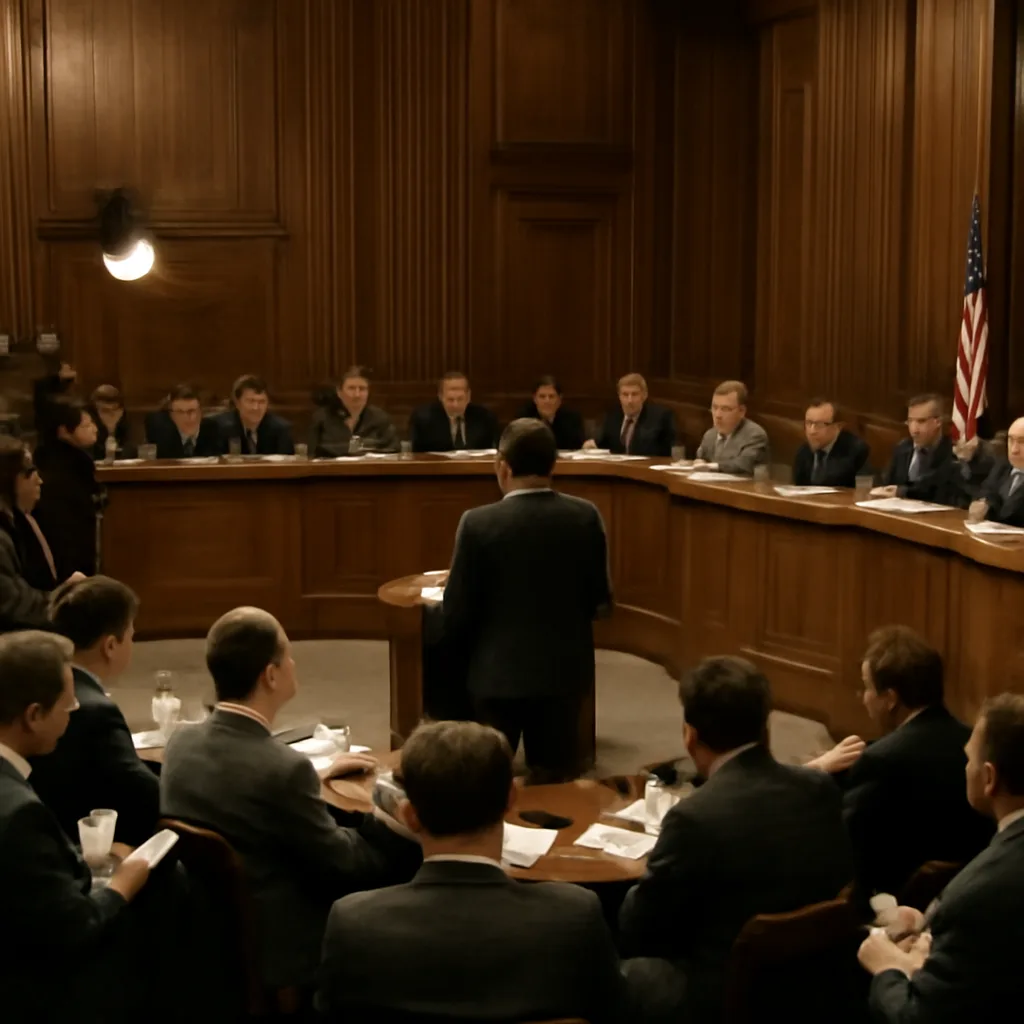
A 1950s congressional hearing room seen from the gallery: long table with microphones, committee members seated, reporters and cameras positioned in aisles; period clothing and studio television camera visible under bright lighting.

On May 15, 1952, national television broadcast played a decisive role in political scandal when Senator Estes Kefauver’s televised hearings exposed interstate organized crime links and prompted the first time such revelations reached millions via live TV, reshaping public expectations about media and political accountability.


On May 15, 1952, the Senate Special Committee to Investigate Crime in Interstate Commerce, chaired by Tennessee Democrat Estes Kefauver, held hearings that became among the earliest and most consequential examples of political scandal transmitted to a mass television audience. While the committee’s work began in 1950 and included earlier televised sessions, the spring of 1952 featured testimony and exchanges that crystallized public awareness of organized crime’s reach and of elected officials’ possible entanglements.

Context: Postwar America, rising television
By the early 1950s television ownership in the United States was expanding rapidly. Where earlier congressional and judicial inquiries had reached the public mainly through newspapers and radio, nationally televised congressional hearings now brought live images and faces into living rooms. The Kefauver committee, which investigated organized crime across state lines, was among the first major federal probes to be routinely carried on television, turning investigatory spectacle into daily news.

What happened on May 15, 1952
On that date the committee aired testimony and questioning that drew public attention to allegations about mob influence in business and politics. Televised segments included witness testimony about racketeering practices, the naming of alleged figures in organized crime networks, and pointed interrogation of witnesses and officials. The cumulative effect of seeing witnesses confronted on camera intensified the public impression of scandal: accusations once confined to print took on greater urgency when viewers could watch facial expressions, pauses, and confrontations in real time.

Impact and significance
The televised hearings amplified several effects. First, they heightened public concern about corruption and organized crime by making the investigative process visible and immediate. Second, they contributed to the development of television as a venue for political accountability; lawmakers and prosecutors now faced a media environment in which their actions and statements were subject to instant national scrutiny. Third, the broadcasts helped create precedents for later, more politically consequential televised inquiries, including the Army–McCarthy hearings (1954) and, much later, Watergate-related media coverage.

Limitations and historical nuance
Scholars caution against treating May 15, 1952 as a single definitive “first” political scandal on television. The Kefauver committee’s televised sessions in 1950–1951 already reached wide audiences, and other local and national broadcasts had earlier brought political controversies to viewers. What makes the May 15, 1952 date notable is that it occurred during a sustained period when the committee’s televised work was reaching a mature, expanding television audience, producing resonance that historians identify as an early instance of televised parliamentary inquiry shaping public opinion.

Legacy
The hearings helped normalize live TV coverage of congressional investigations and influenced how future scandals would be perceived and prosecuted. They illustrate the transition from print-dominated reportage to a visual, immediate form of political scrutiny that would define much of late 20th-century American public life. The Kefauver hearings therefore occupy an important place in media and political history as an early example of how television could turn investigatory proceedings into broadly shared political drama.

Sources and verification
This summary synthesizes contemporary press coverage, congressional records of the Senate Special Committee to Investigate Crime in Interstate Commerce, and secondary historical analyses of 1950s television and political media. Where details or attributions are contested in the historiography, this account notes uncertainty rather than asserting disputed specifics.

Share this

Email Share on X Facebook Reddit

Did this surprise you?