
← Back
06/22/1518 • 4 views

The 1518 Strasbourg Dancing Plague: the first well-documented outbreak
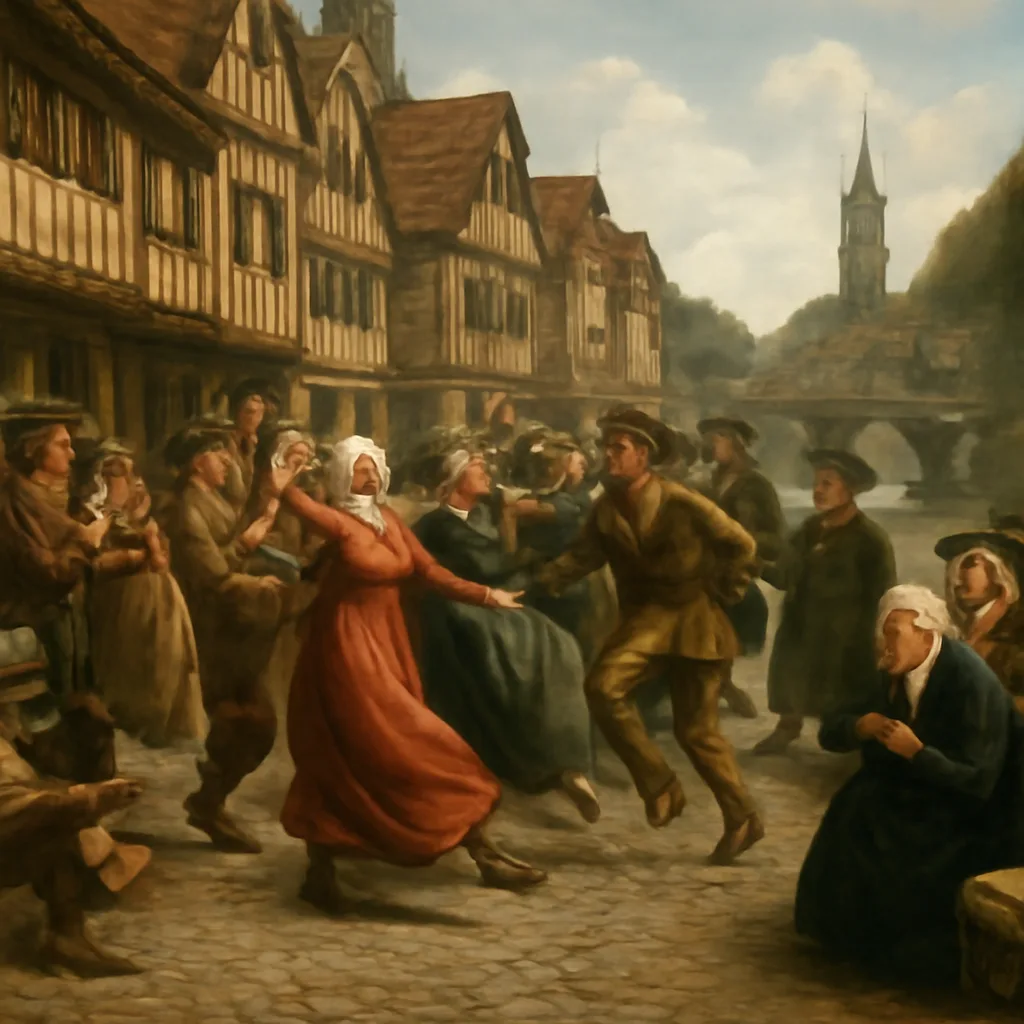
A crowded early 16th-century Strasbourg street scene with people dancing and onlookers gathered; musicians nearby; period buildings and clothing; no identifiable faces.

On 22 June 1518 a woman in Strasbourg began dancing in the street; within days dozens joined in a phenomenon later called dancing mania. Contemporary records and civic documents make this the earliest well-documented outbreak of contagious dancing in late medieval Europe.


On 22 June 1518 a woman known from contemporary accounts as Frau Troffea (name recorded in town documents and chronicles) began to dance in a street of Strasbourg, then part of the Holy Roman Empire. Over the following days and weeks, more people — estimates in sources range from a few dozen to several hundred depending on how broadly later chroniclers interpreted the events — joined in prolonged episodes of involuntary, sometimes exhausting, dancing. Municipal records from Strasbourg’s Council and notes by local physicians and chroniclers provide most of the surviving documentation, making this episode the earliest outbreak of so-called dancing mania that is sufficiently recorded for modern historical study.

The medical and civic responses are unusually well attested. Town authorities initially arranged for priests and clergy to pray for the afflicted. When that proved insufficient, the Council hired musicians and opened a stage in a public hall and later on the riverbank to direct the dancers’ movements, reasoning that controlled dancing might relieve the condition; this measure was later criticized in contemporary sources as counterproductive. The Council also eventually expelled some of the dancers from the city and prescribed other remedies consistent with early sixteenth-century medical practice.

Descriptions in municipal documents and later chronicles emphasize the involuntary and prolonged nature of the dancing, with sufferers reportedly continuing for hours or days, sometimes until collapsing from exhaustion. Some contemporary observers attributed the phenomenon to natural causes such as overheating, poor diet, or medical imbalance (humoral theory), while others invoked religious explanations, including divine judgment or saintly intercession. Modern scholars have debated those accounts, noting that primary sources reflect the concerns and language of their time and that precise details (such as exact numbers of participants and causes of death, if any) can be difficult to verify.

Historians and scholars of medicine, social history, and cultural studies have offered a range of interpretations. Explanations proposed over the past century include mass psychogenic illness (collective stress-related behavior), social contagion or imitation under conditions of extreme social strain, ergot poisoning of grain (a hypothesis largely discounted by specialists because it does not fit many features of the recorded events), and ritual or ecstatic practices embedded in late medieval popular piety. Recent scholarship tends to emphasize social and cultural contexts: Strasbourg in the early 1500s experienced crop failures, famine, disease, and religious tensions, factors that could have amplified communal stress and contributed to outbreak dynamics.

The 1518 outbreak remains important to historians because it is unusually well-documented for its period and because it illuminates the interactions among civic authorities, medical practitioners, religious beliefs, and popular behavior in late medieval and early modern Europe. While later episodes of dancing mania are recorded across Europe from the 14th to the 17th centuries, the Strasbourg case is often treated as a key reference point in debates about causation, response, and meaning.

Scholars emphasize caution in interpreting the sources: contemporary accounts are shaped by the vocabulary and explanatory frameworks of their authors, and numbers and medical details can be exaggerated or imprecise. No single modern explanation is universally accepted; instead, many researchers favor multi-causal readings that combine social stress, cultural practices, and psychological and physiological factors. The event continues to be studied as an example of collective behavior in historical contexts and as a reminder of how communities interpret and attempt to manage sudden, poorly understood maladies.

Share this

Email Share on X Facebook Reddit

Did this surprise you?