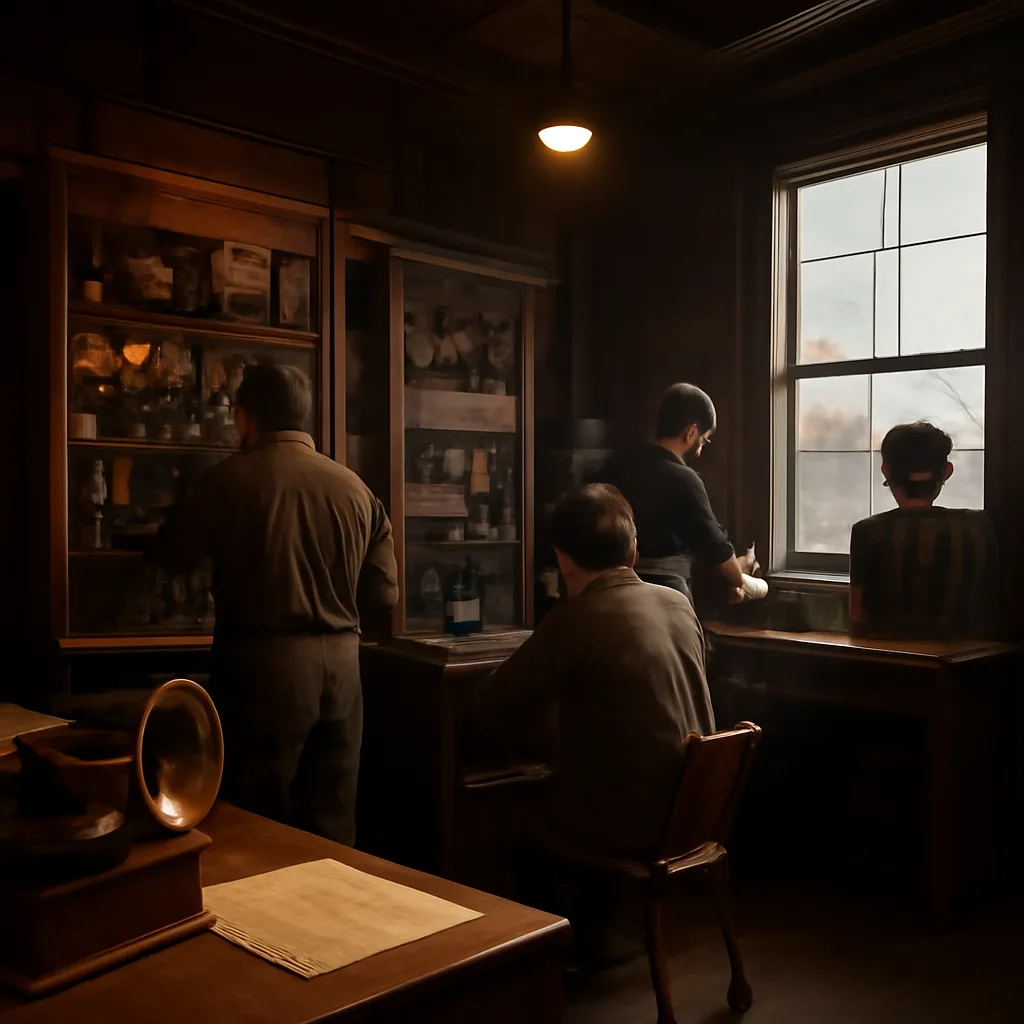
The First Commercial Radio Broadcast Transmits Music and News, March 21, 1920
On March 21, 1920, station 8MK in Detroit—operated by the engineering department of the Detroit News—aired what is widely regarded as the first scheduled commercial radio broadcast, transmitting music and news to a public audience and marking a key step toward mass radio service.
On March 21, 1920, the Detroit News’ radio station 8MK began scheduled broadcasts of music and news that are widely cited as the first regular commercial radio transmissions in the United States. The broadcasts were produced by the newspaper’s engineering department and transmitted from the newspaper’s facilities; they reached audiences using home-built receivers and early crystal sets. Programming typically included phonograph music, live musical performances from local musicians, and news bulletins drawn from the newspaper’s reporting.
The 8MK broadcasts grew out of earlier experimental transmissions. Radio technology had been advancing rapidly during the 1910s, propelled by developments in vacuum-tube amplification and by the wartime expansion of radio for military use. After World War I, engineers and entrepreneurs repurposed equipment and frequency allocations for civilian broadcasting. Newspapers, music companies, and radio experimenters all explored the potential of broadcasting to reach mass audiences.
The Detroit News’s initiative combined journalistic content with the technical capability to transmit to the public. The station’s schedule and programming aimed at regular listeners rather than isolated experimental tests, which helps explain why historians and contemporaries have identified the March 21 transmissions as an important early instance of commercial broadcasting. 8MK continued to broadcast intermittently through the early 1920s as regulation and technology evolved; it later became WWJ, one of the first formal commercial radio stations licensed under new federal rules.
Context and significance: The period immediately following World War I saw several stations and organizations beginning regular broadcasts. Other early claimants include stations such as KDKA in Pittsburgh, which held its famous election-night broadcast in November 1920 and later received recognition as the first commercially licensed station under federal regulation established in 1927. The exact designation of “first” depends on criteria—whether one emphasizes the date of initial scheduled broadcasts, formal licensing, continuous operation, or the scope and intent of the programming. Because of these differing standards, historians note multiple significant early milestones rather than a single uncontested origin.
Technically, early commercial broadcasts were modest in range and quality compared with later standards. Transmitters used low-power spark or vacuum-tube equipment, and listeners relied on simple receivers with limited selectivity. Programming was local and often experimental in format. Nonetheless, these broadcasts demonstrated radio’s potential as a medium for real-time entertainment and information, prompting rapid growth in stations, manufacturers, and audience interest during the 1920s.
Regulatory and commercial developments followed swiftly. The U.S. Department of Commerce initially oversaw broadcasting until the Radio Act of 1927 created the Federal Radio Commission (later the Federal Communications Commission) to manage spectrum allocation. Commercial sponsorship and advertising soon became integral to many stations’ business models, shaping programming and national networks.
Legacy: The March 21, 1920, 8MK broadcasts are remembered as a foundational moment in the transition from experimental radio to scheduled, public-oriented broadcasting. While other dates and stations also claim early precedence depending on criteria, the Detroit News broadcasts exemplify how newspapers and local organizations helped pioneer radio as a mass medium. These early efforts set the stage for radio’s central cultural and informational role in the decades that followed.