01/12/1967 • 9 views
The First "Ice Man"
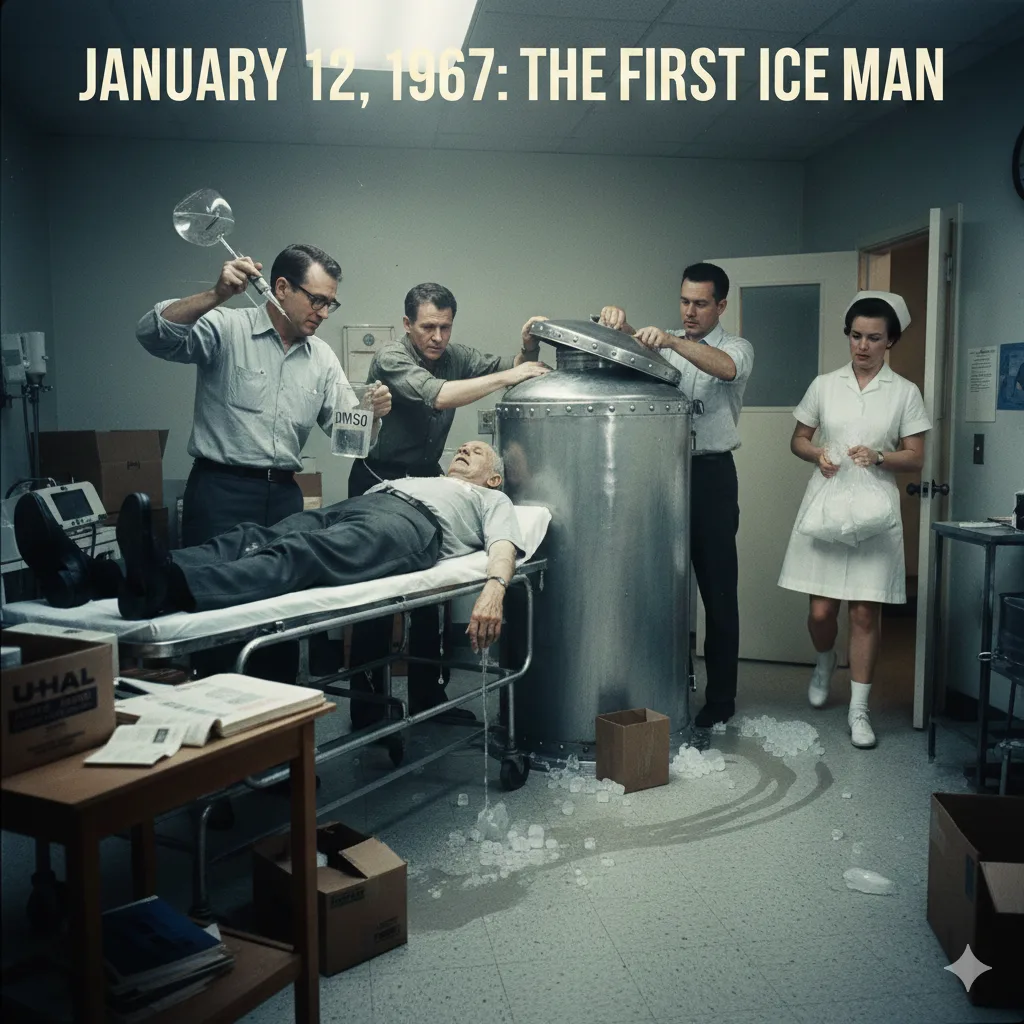
On this day, Dr. James Bedford became the first person to be cryonically preserved after his death.

The "Primitive" Procedure
When Bedford died of kidney cancer in a California nursing home, the cryonics industry didn't actually exist yet. The team tasked with "freezing" him—which included a TV repairman named Robert Nelson—was caught completely off guard.
Because they didn't have the proper equipment ready, the scene was chaotic:
The Ice Run: A nurse reportedly had to run around the neighborhood knocking on doors to borrow ice from neighbors' freezers to keep Bedford’s body cool while the team scrambled to arrive.
The Chemicals: They injected him with dimethyl sulfoxide (DMSO), a primitive "antifreeze" intended to protect his organs. By modern standards, this was highly experimental and likely caused significant damage to his brain tissue.
The Wigmaker's Tank: His first "cryonic capsule" (a dewar) was actually built by a local wigmaker named Edward Hope.
A Body on the Move
For the next two decades, Bedford’s body became a bit of a nomad. Cryonics companies kept going bankrupt or facing legal battles.
The Garage Phase: At one point, his capsule was stored in a private garage in Topanga Canyon.
The U-Haul Trip: His son, Norman, eventually took custody of the frozen remains. In 1976, he reportedly moved his father’s 500-pound capsule across California in the back of a U-Haul truck.
Self-Storage: For several years, the family maintained the body themselves in a self-storage facility, personally "topping off" the liquid nitrogen to keep him frozen.
The 1991 Reveal
In 1982, Bedford was finally moved to the Alcor Life Extension Foundation in Arizona. In 1991, they decided to transfer him to a new, modern tank. This was the first time anyone had seen him in 24 years.
To the team’s shock, he was remarkably well-preserved. Despite the crude 1960s methods and the years in self-storage, the report noted he looked "younger than his 73 years," though his nose was slightly flattened from a slab of dry ice used in the initial freezing.
Where is he now?
Today, Dr. James Bedford remains at Alcor in Scottsdale, Arizona. While mainstream science is highly skeptical that he could ever be revived (especially given the damage from the initial 1967 freezing process), he is celebrated as a pioneer. Every January 12th, cryonics enthusiasts celebrate "Bedford Day" in his honor.