
← Back
11/20/1989 • 4 views

U.S. Military Action in Panama Aimed at Ousting Manuel Noriega
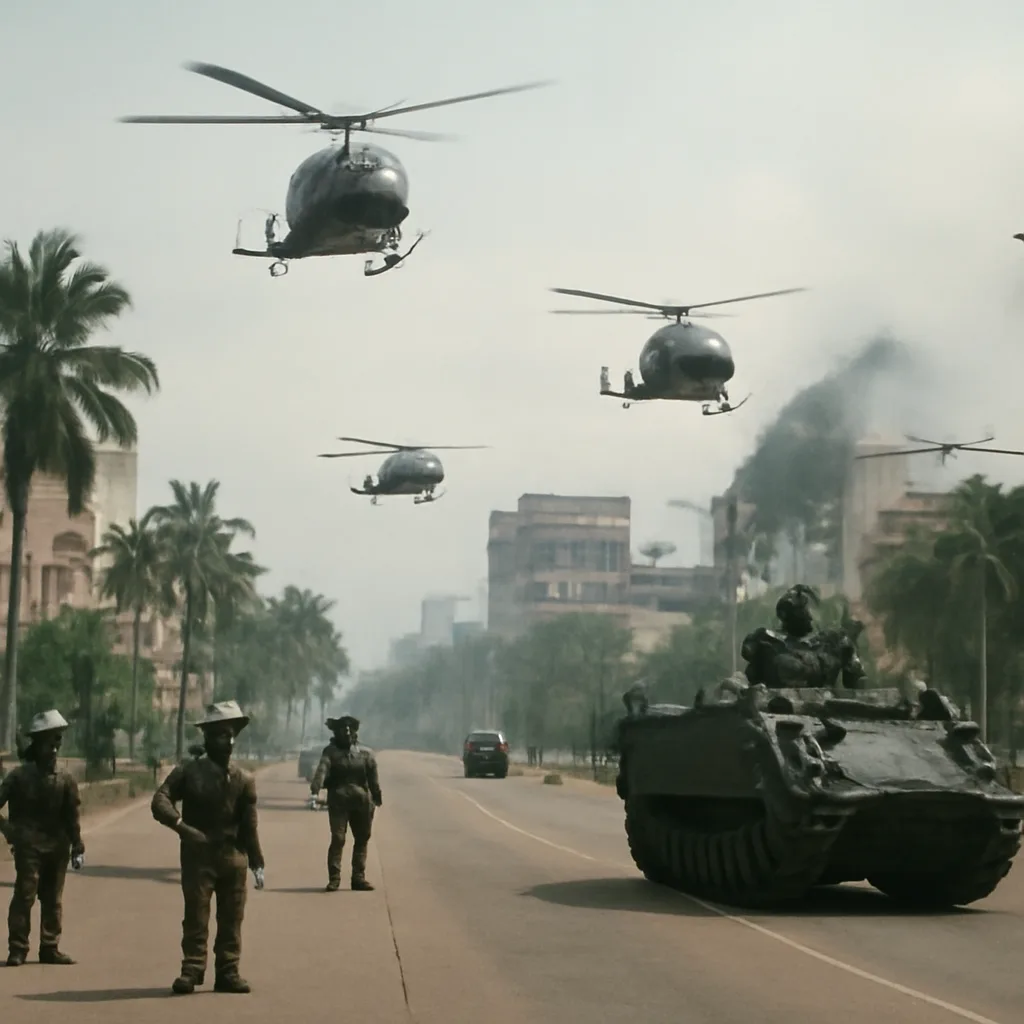
U.S. military vehicles and helicopters near urban buildings in Panama City during the 1989 invasion; smoke and damaged structures visible without identifiable faces.

On 20 November 1989, U.S. forces launched Operation Just Cause, a large-scale invasion of Panama designed to remove military leader Manuel Noriega, protect U.S. citizens, and restore democratic governance after months of escalating tensions.


Background
By the late 1980s, Panama was governed effectively by General Manuel Noriega, commander of the Panama Defense Forces (PDF) and a central figure in the country’s politics since the mid-1980s. Noriega’s rule followed contested elections in 1989 in which opposition candidate Guillermo Endara claimed victory; the results were annulled under pressure from the PDF. Noriega was also under increasing international scrutiny for authoritarian practices and his involvement in drug trafficking, which the United States government publicly cited as justification for strong measures.

Immediate causes
Tensions between the U.S. and Panama escalated over several issues: the annulled elections, harassment and attacks on U.S. servicemembers and civilians (including incidents in the months preceding the invasion), and Noriega’s resistance to U.S. demands to restore democratic processes. The U.S. government, led by President George H. W. Bush, also expressed concern about regional stability and the security of the Panama Canal, which remained a strategic interest until full Panamanian control in 1999.

The invasion
On 20 November 1989, the United States initiated Operation Just Cause. The operation involved tens of thousands of U.S. troops from multiple service branches, airborne and amphibious elements, special operations forces, and substantial air and artillery support. Objectives announced by U.S. officials included safeguarding U.S. citizens in Panama, defending the integrity of the Torrijos–Carter Treaties governing the canal, capturing Noriega to face U.S. criminal charges, and facilitating the installation of a government acceptable to democratic and diplomatic norms.

Course and outcomes
U.S. forces seized key military and governmental installations, secured the Tocumen and Howard (later U.S. Southern Command) airfields, and carried out targeted actions against PDF units. Fighting occurred in urban areas, including Panama City, producing civilian casualties and significant displacement. The PDF’s capacity was degraded rapidly, and by late December Noriega sought refuge in the Vatican diplomatic mission in Panama City; he surrendered to U.S. authorities in January 1990 after leaving the embassy. Guillermo Endara, sworn in as president during the invasion, assumed office amid the security transition.

Legal and political aftermath
Noriega was flown to the United States, tried on charges including drug trafficking, and convicted in federal court in 1992. The invasion prompted international debate: the United Nations General Assembly condemned the action as a breach of international law, while the U.S. argued it had legitimate security and humanitarian grounds. Domestically, the operation raised questions about U.S. interventionism and the legal basis for using military force to effect regime change.

Human cost and legacy
Estimates of civilian deaths and property damage vary; Panamanian and independent organizations reported hundreds of civilian casualties and widescale displacement in the immediate aftermath. The invasion left a lasting imprint on Panamanian society and politics, influencing subsequent U.S.–Panama relations and debates over U.S. foreign policy in Latin America. The Panama Canal’s transition to Panamanian control proceeded, and comparative assessments of the invasion continue to weigh its stated objectives against its human and diplomatic costs.

Notes on sources and disputes
Details such as precise casualty figures and assessments of legality remain contested among scholars, governments, and human rights organizations. This summary synthesizes widely reported, verifiable facts about the operation’s dates, principal actors, and principal outcomes while noting areas of dispute.

Share this

Email Share on X Facebook Reddit

Did this surprise you?