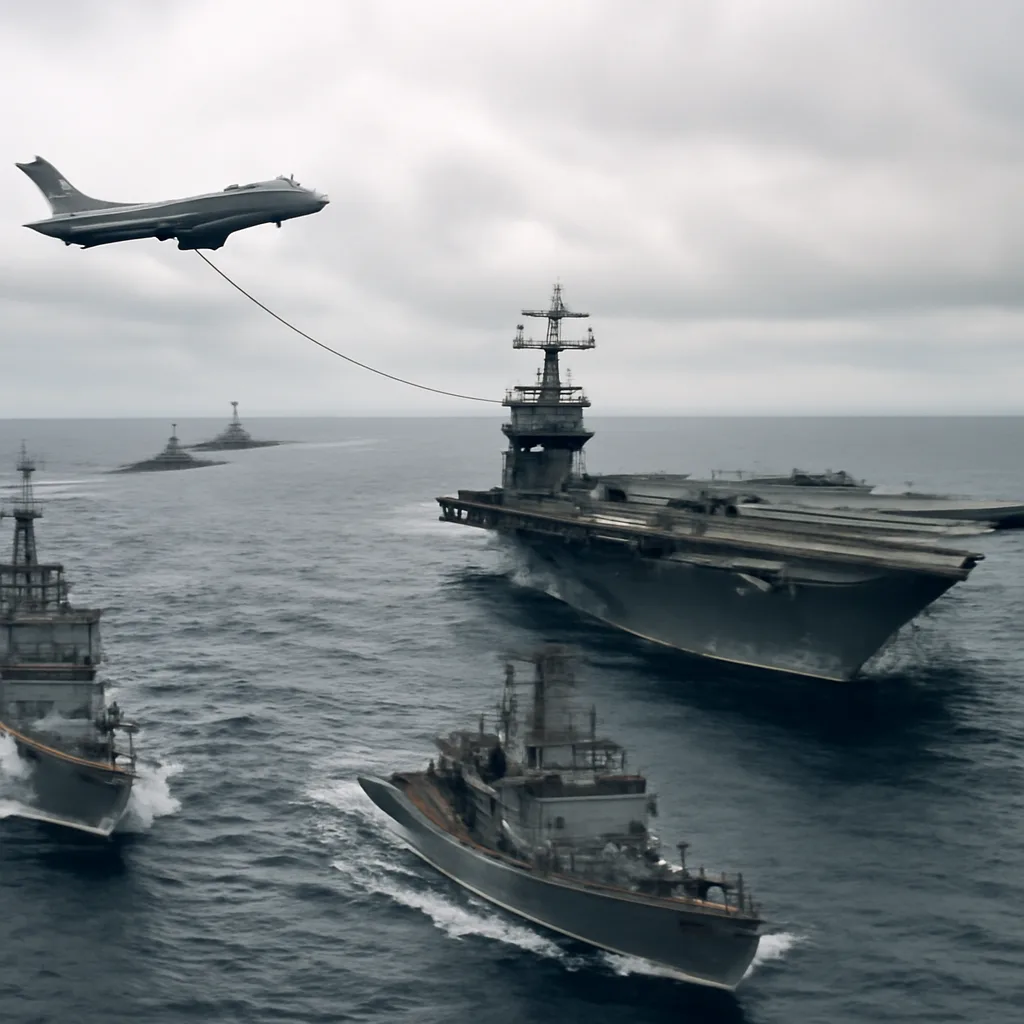
U.S. stages its largest peacetime military exercise on June 14, 1982
On June 14, 1982, the United States launched what was reported as its largest peacetime military exercise, involving tens of thousands of personnel, extensive naval and air components, and multinational participation intended to test readiness and strategic coordination during the Cold War.
On June 14, 1982, the United States conducted what contemporary reports described as its largest peacetime military exercise. Occurring during a period of heightened Cold War tensions, the exercise emphasized large-scale mobilization, joint operations across services, and interoperability with allied forces. Exact participant counts vary by source, but the operation involved substantial numbers of personnel, ships, aircraft and other assets to simulate high-intensity conflict scenarios while remaining outside declared wartime footing.
Context
The early 1980s saw renewed emphasis in U.S. defense policy on readiness, forward presence and alliance coordination. In that environment, large-scale training events were used to test concepts of joint command and control, sustainment under prolonged operations, and rapid deployment of forces. Exercises in this period also sought to reassure NATO allies and demonstrate deterrence to the Soviet Union by showing the capability to operate large combined forces over extended distances.
Scope and components
Public summaries and press accounts at the time described multi-branch participation, combining elements from the U.S. Army, Navy, Air Force and Marine Corps. Naval task groups and carrier air wings played visible roles in projecting power at sea and practicing carrier operations. Air exercises included long-range strategic and tactical flights, aerial refueling, and air defense drills. Ground components focused on maneuver, logistics and command-post exercises to coordinate forces across echelons. Reports also noted participation or observation by allied militaries, reflecting the exercise’s role in enhancing coalition interoperability.
Objectives and activities
Planners used the exercise to evaluate rapid mobilization processes, sustainment of maritime and air operations, logistics throughput, and combined-arms coordination. Scenarios commonly employed in such exercises included simulated amphibious assaults, convoy protection, anti-submarine warfare, maritime air strikes, and defense against airborne threats. Command-post and communications drills tested the resilience of control networks and the ability to integrate intelligence and operational planning in real time.
Public reception and strategic significance
Domestic media coverage described the exercise as a demonstration of U.S. military capability and preparedness. Allied officials framed participation as reinforcement of collective defense ties. Soviet and other observers often characterized large Western exercises as provocative, a reflection of the adversarial context of the Cold War. Military analysts of the era assessed such events as valuable opportunities to identify logistical bottlenecks, improve doctrine, and validate procurement priorities.
Limitations and sources
Contemporary reporting and official summaries provide the basis for understanding the June 14, 1982 exercise, but precise figures and full operational details remain fragmented across declassified documents, press accounts and later historical analyses. As with many Cold War-era military activities, some specifics—exact unit compositions, classified mission parameters and after-action assessments—are not fully public or are variously reported. This summary relies on publicly available descriptions from the period and subsequent historical reviews rather than unpublished or classified sources.
Legacy
Large peacetime exercises of the early 1980s influenced later training doctrine by underscoring the need for jointness, rapid logistics and allied interoperability. Lessons learned from such events contributed to doctrinal updates, procurement decisions and the planning assumptions that shaped U.S. and NATO readiness into the late Cold War and beyond.