Argentina’s Military Junta Falls After Mass Protests and Election Defeat
On June 15, 1983, Argentina’s ruling military junta resigned amid mass public protests, economic collapse, and defeat in a key election, paving the way for restoration of civilian rule after seven years of dictatorship.
Background and context
By 1983 Argentina was emerging from nearly a decade of military rule marked by severe human-rights abuses, enforced disappearances, and economic dislocation. The ruling junta—composed of the heads of the army, navy and air force—had seized power in 1976 and governed through a campaign they called the National Reorganization Process. That period saw systematic repression of political opponents and civilians suspected of subversion. International condemnation and domestic dissent grew through the late 1970s and early 1980s.
Triggering factors
The junta’s position weakened dramatically after the 1982 Falklands/Malvinas War against the United Kingdom. Argentina’s defeat exposed military miscalculation and eroded the regime’s legitimacy among both the public and factions within the armed forces. Concurrently, the economy suffered from high inflation, debt, and unemployment, heightening public discontent.
Political opening and elections
Facing mounting pressure, the military government initiated a controlled political transition in 1983. Elections were scheduled for October 1983 to select a civilian president and legislature—an opening many Argentines saw as an opportunity to end military rule. Political parties that had been repressed under the junta reconstituted themselves, and a vigorous campaign unfolded, with themes of human rights, economic recovery, and democratic restoration dominating public debate.
Mass mobilization and the junta’s collapse
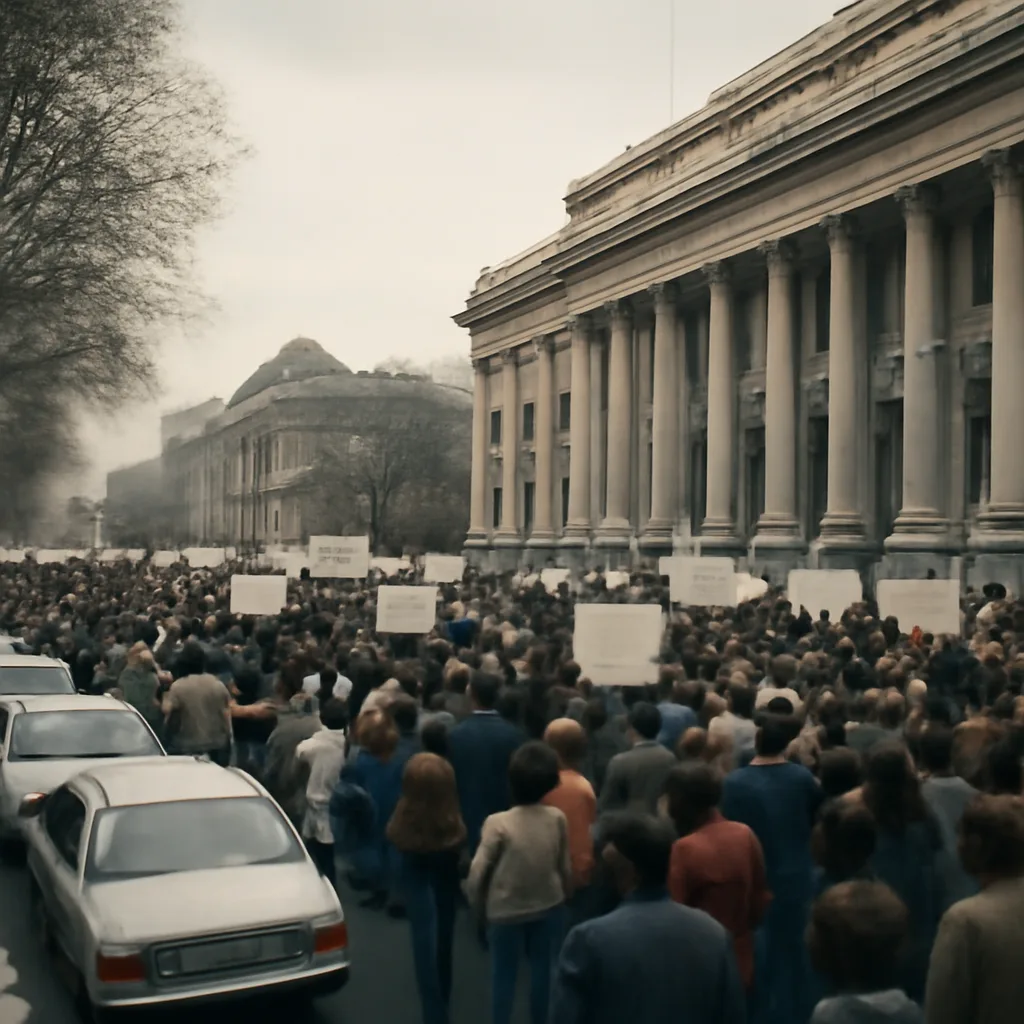
Between early and mid-1983, large-scale demonstrations, labor strikes and civic actions signaled broad popular rejection of the junta. Human-rights groups, relatives of the disappeared, labor unions, student organizations and political parties mobilized in coordinated protests demanding accountability and a full return to democracy. The combination of sustained street pressure, economic paralysis, and the army’s loss of credibility after the Falklands defeat left the junta politically isolated.
On June 15, 1983, key leaders of the ruling military council announced they would relinquish effective control and proceed with the transition to civilian government. The announcement reflected both internal fractures within the armed forces and recognition that continued military rule risked greater unrest or a deeper crisis. The junta’s withdrawal did not immediately resolve questions of justice or memory; many human-rights activists continued to press for investigations into disappearances and state violence.
Aftermath and significance
The junta’s collapse set Argentina on a path back to constitutional government. Raúl Alfonsín, leader of the Radical Civic Union (UCR), won the October 1983 presidential election and took office in December, marking the formal end of the military regime. Alfonsín’s administration prioritized human-rights trials and attempts to address the legacy of the dictatorship, although those processes proved contested and uneven over subsequent years.
Long-term implications
The transition in 1983 was a crucial turning point for Argentina: it reopened democratic institutions, empowered civil society actors who had resisted repression, and initiated a fraught process of reckoning with state violence. The fall of the junta also reverberated across Latin America, where other countries were observing the possibilities and limits of transitions from authoritarian rule. Debates over accountability, amnesty, and economic reform that began in this period continued to shape Argentine politics and society for decades.
Notes on sources and certainty
This account summarizes widely documented events surrounding Argentina’s return to civilian rule in 1983. Specific dates and sequences—such as the June 15 announcement by junta leaders and the October election of Raúl Alfonsín—are established in historical records. Details about internal military deliberations and the full scope of public mobilization involve complex, sometimes contested narratives; where disputes exist, historians and human-rights organizations remain primary reference points.