
← Back
06/15/1967 • 5 views

First Public Announcement of a Human Cryonics Preservation, June 15, 1967
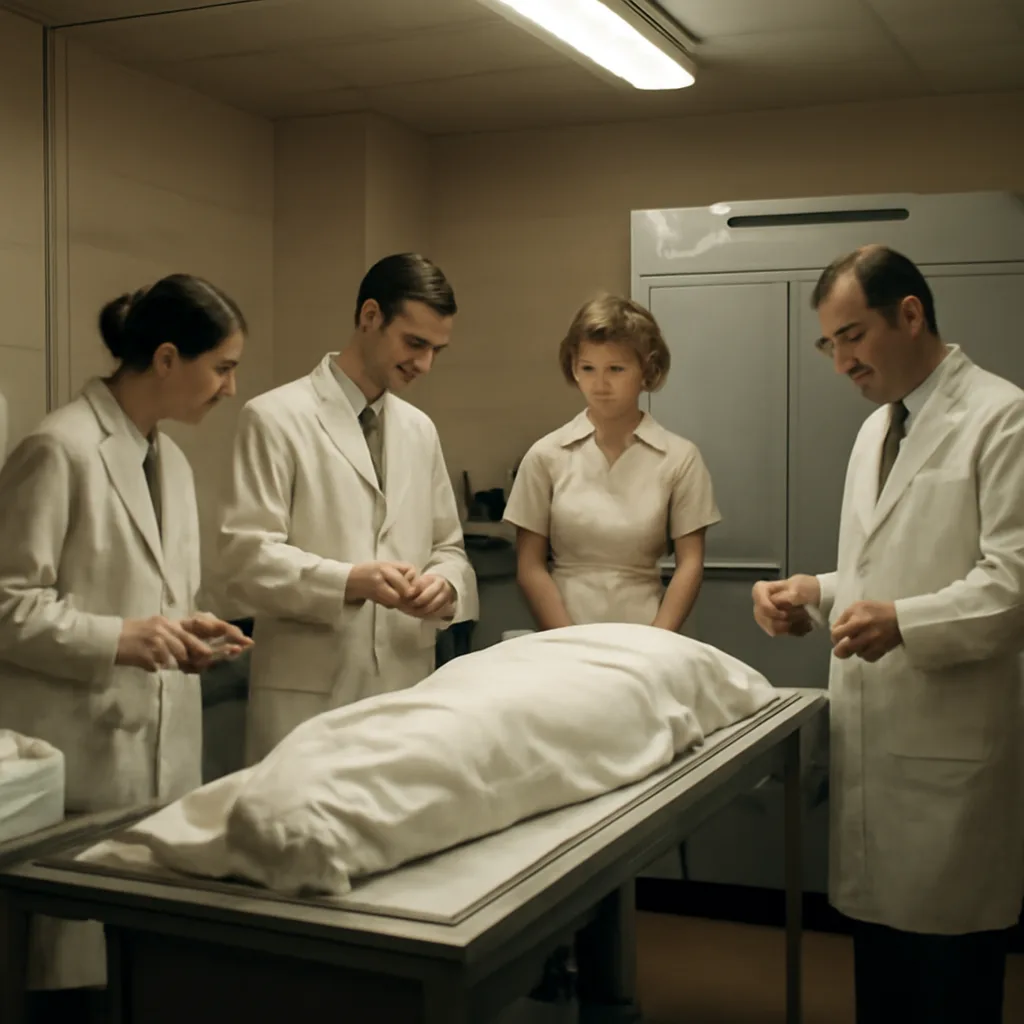
A 1960s-era hospital or laboratory room with medical equipment, an embalming table or cooled storage area, and people in period-appropriate clothing preparing a body for low-temperature preservation.

On June 15, 1967, the first widely reported case of human cryonics preservation was announced, marking an early public instance of a body preserved at low temperatures with the hope of future revival—an event that sparked ethical debate and scientific curiosity.


On June 15, 1967, newspapers and scientific outlets reported what has been described as the first publicly announced case of human cryonics preservation. The case involved the placement of a recently deceased person's body into a low-temperature environment with the intention of slowing biological decay in hopes that future medical advances might permit restoration of life or repair of damage. The event occurred amid a small but growing subculture of proponents who advocated for cryopreservation as a speculative form of life-extension.

Background: Cryonics emerged in the 1960s from discussions at the intersection of cryobiology, medical ethics and futurist thinking. Cryobiology—the study of biological responses to low temperatures—had established that cooling tissues could slow decay, and some researchers had experimentally preserved small tissues or simple organisms at low temperatures. Cryonics as proposed practice, however, went beyond laboratory experiments to apply low-temperature preservation to whole human bodies or brains after legal death, with the explicit hope of future resuscitation. Early advocates framed the procedure as an experimental, last-resort option rather than established medical therapy.

The 1967 announcement: Contemporary reports described the preservation as a deliberate effort to cool and store a human body following legal pronouncement of death. Technical details available in contemporaneous reporting were often limited. Early cryonics practitioners used rudimentary methods compared with later standards—placing the body in ice, using dry ice or liquid nitrogen for cooling, and in some cases attempting to perfuse tissues with cryoprotective solutions intended to reduce freezing damage. Many of these procedures were improvised in the 1960s, and their effectiveness remains highly uncertain.

Public and scientific reaction: The announcement drew a mix of curiosity, skepticism and ethical concern. Medical professionals and bioethicists emphasized that cryonics was speculative and unproven: cooling does not equate to a reversible state of death under contemporary medical understanding, and substantial biological damage can occur during freezing and thawing. Religious and legal commentators raised questions about definition of death, consent, and the disposition of bodies. At the same time, the story attracted futurists and some members of the public intrigued by the possibility—however remote—that future science could repair or regenerate damaged tissues and reverse death.

Legacy and significance: The 1967 case is significant historically as an early, public example of cryonics applied to a human being. It helped catalyze further organization among proponents, contributed to public debate about end-of-life choices and emerging technologies, and influenced later developments in cryonics practice and regulation. Over subsequent decades, cryonics has remained controversial: it has not produced a scientifically verified case of revival, and major technical challenges—such as ice-crystal formation, cryoprotectant toxicity, and repair of cellular and molecular damage—persist. Research in related areas (cryobiology, organ preservation, vitrification techniques) has advanced, but the core claim of reversible human preservation after legal death remains unproven.

Historical caveats: Sources from the 1960s vary in detail and terminology, and some contemporary accounts conflated scientific cryobiology with the speculative aspirations of cryonics advocates. Exact technical protocols used in the 1967 case are not comprehensively documented in peer-reviewed literature, and retrospective accounts sometimes differ. The event is best understood as an early, public instance of a practice that drew on emerging scientific ideas but was—and remains—highly experimental and disputed.

Today, the 1967 announcement stands as a marker in the history of attempts to extend or restore life through technological means, illustrating both the enduring human interest in overcoming mortality and the persistent scientific and ethical questions such efforts raise.

Share this

Email Share on X Facebook Reddit

Did this surprise you?