
← Back
06/15/1999 • 4 views

NASA Loses Contact with Mars Polar Lander
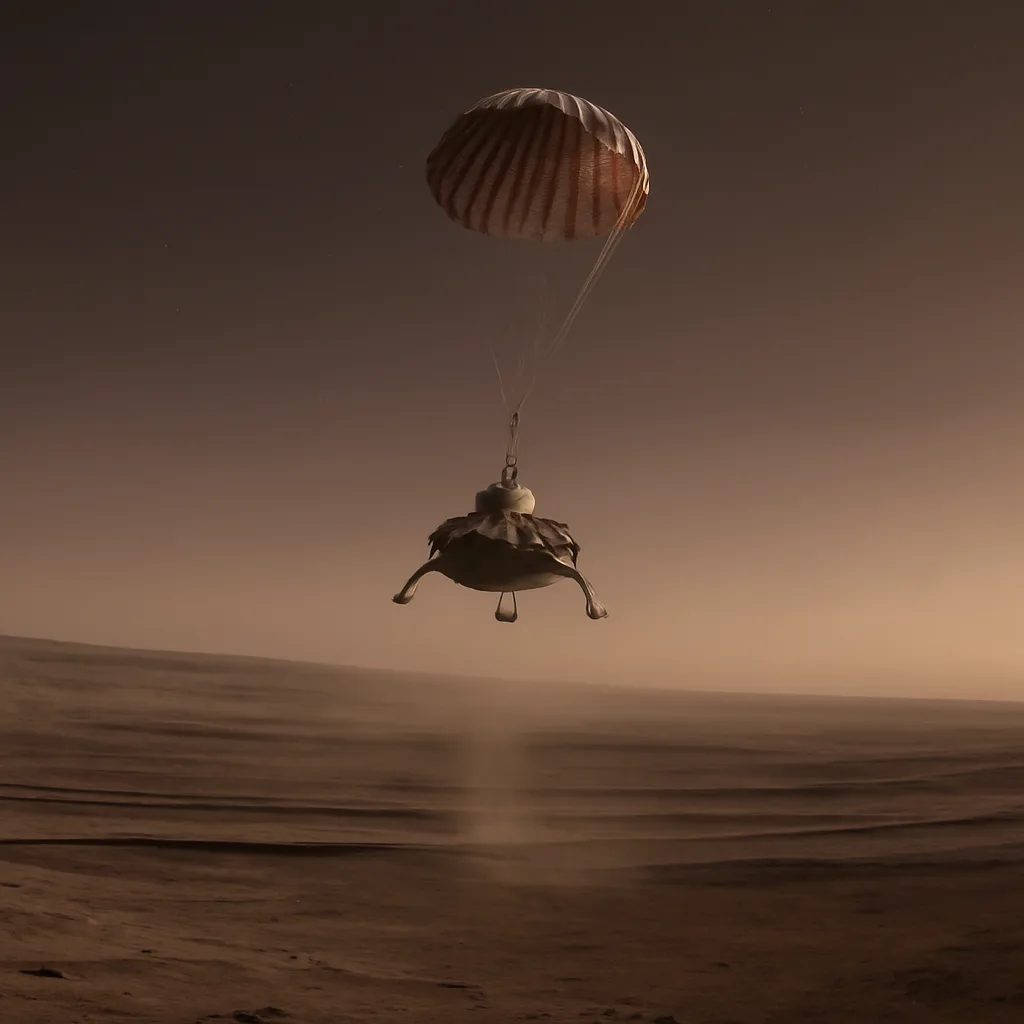
Artist-style depiction of a spacecraft descending through the thin, dusty atmosphere above Mars’s polar region, with a parachute and lander elements visible against a reddish horizon.

On June 15, 1999, NASA announced it had lost contact with the Mars Polar Lander during its descent to the Martian surface; recovery attempts and investigations began as teams worked to determine what went wrong.


On June 15, 1999, NASA announced that it had lost contact with the Mars Polar Lander (MPL) during the spacecraft's descent to the surface of Mars. MPL, part of NASA’s Mars Surveyor '98 program, was launched in January 1999 with the goal of studying the planet’s polar region and searching for signs of water and layered climate records. The vehicle carried a lander and an atmospheric probe; the lander was scheduled to touch down near the south polar layered deposits in December 1999.

According to NASA statements at the time, the mission team received telemetry indicating that the lander had begun its entry, descent and landing sequence. However, the expected signals confirming a successful touchdown never arrived. Immediately after the loss of contact, engineers at NASA’s Jet Propulsion Laboratory (JPL) and other centers initiated attempts to reestablish communication, reviewed telemetry and flight-data records, and began a fault-tree analysis to identify possible failure modes.

Initial public statements emphasized that the spacecraft had undergone the high-risk phases of entry and descent and that multiple possibilities could account for the silence. These included anomalies during the atmospheric entry, parachute deployment, descent engine operation, or problems with the lander’s onboard systems or communications antenna. NASA officials also noted that ground-based listening remained an option; the Mars Global Surveyor spacecraft and Earth-based antennas were tasked to search for any faint or intermittent signals from the lander.

The loss of contact triggered a formal anomaly investigation. Investigators examined engineering telemetry from the cruise phase and the early portion of the entry sequence, reviewed software and hardware designs, and sought to reconstruct the landing timeline. Over the following months, NASA released preliminary findings and assessments but did not reach a definitive public conclusion about the exact cause of the mission’s failure during that period.

MPL’s disappearance prompted wider review inside the agency of procedures, testing, and program management practices for Mars missions. The mission’s loss, together with the earlier failure of the Mars Climate Orbiter in 1999, led NASA to reassess engineering and verification processes for future interplanetary missions. These reviews influenced changes in testing rigor, systems engineering, and cross-checks intended to reduce the risk of repeat failures.

Public and scientific reaction included disappointment and concern about the setbacks to Mars exploration plans. The scientific objectives of the Mars Polar Lander—to study the polar layered deposits and search for water ice—remained high priorities, and NASA continued to pursue those goals in subsequent missions. The agency eventually returned to the Martian polar regions with future spacecraft and instruments designed with lessons learned from late-1990s missions.

While later assessments and analyses produced hypotheses about potential failure modes, no single, universally accepted, conclusive public explanation was established in the immediate aftermath. Some internal reviews and independent analyses suggested scenarios such as premature engine shutdown, issues with landing-sequence software, or loss of communications due to antenna orientation. Because MPL did not transmit post-landing telemetry, the absence of definitive, contemporaneous data limited investigators’ ability to confirm a single root cause publicly.

The loss of the Mars Polar Lander remains a documented chapter in the history of Mars exploration. It served as a catalyst for procedural and technical improvements at NASA and informed the design and testing of subsequent successful missions to Mars, contributing to the agency’s evolving approach to planetary landings and interplanetary mission assurance.

Share this

Email Share on X Facebook Reddit

Did this surprise you?