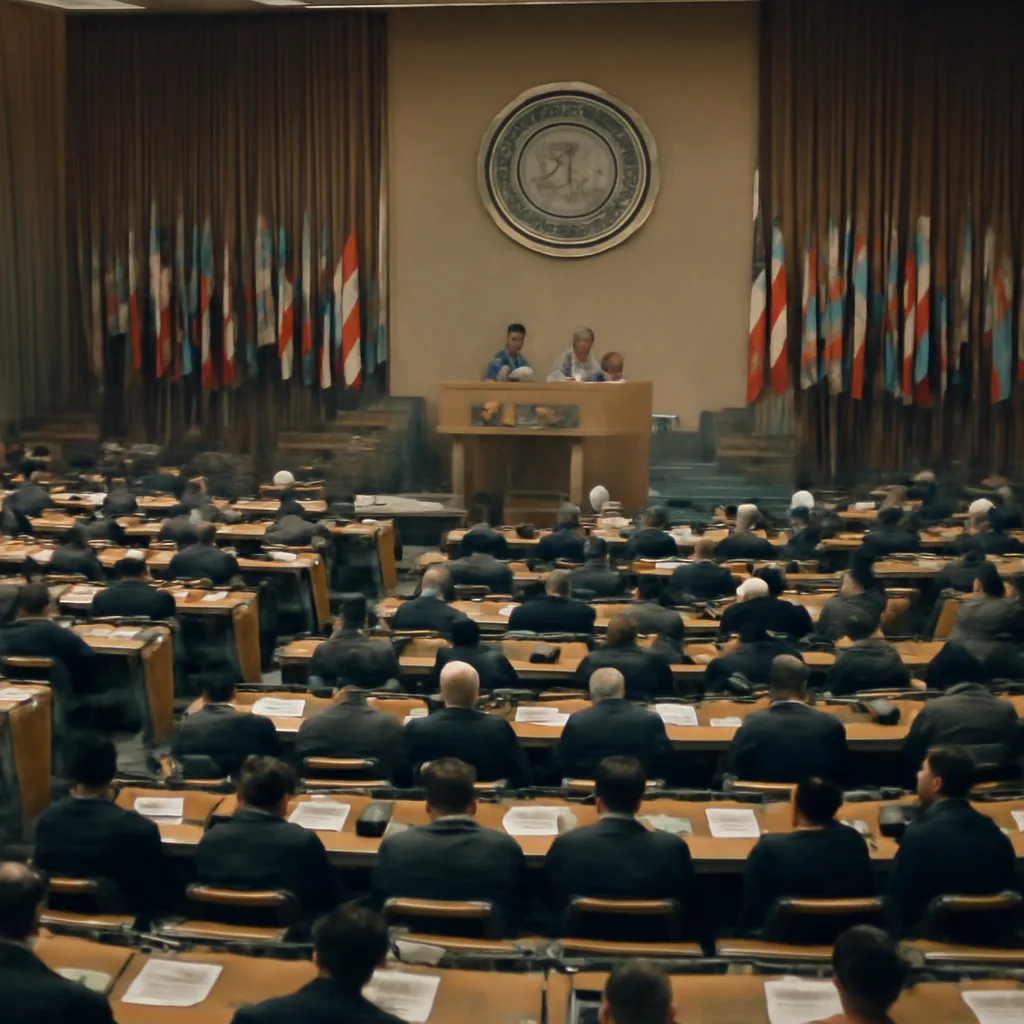
UN General Assembly Opens in New York Amid Intensifying Cold War Standoff
On September 20, 1960, the UN General Assembly convened in New York against a backdrop of Cold War rivalry, decolonization debates, and recent crises that heightened tensions between the United States and the Soviet Union.
On September 20, 1960, the United Nations General Assembly opened its fifteenth regular session at UN Headquarters in New York amid pronounced Cold War tensions and a wave of newly independent states joining the organization. The session took place in a global atmosphere marked by ideological rivalry, recent crises, and accelerating decolonization that would reshape the Assembly’s composition and agenda.
Context and immediate background
The summer of 1960 had been eventful: the U-2 spy plane incident in May, when the Soviet Union disclosed the downing of an American reconnaissance aircraft and the capture of pilot Francis Gary Powers, had derailed an expected summit between U.S. President Dwight D. Eisenhower and Soviet Premier Nikita Khrushchev. Across Africa and Asia, a large number of colonies had achieved independence in 1959–1960, prompting many new delegations to seek seats at the UN and to press issues of racial discrimination, self-determination, and economic development. These changes intensified debates over representation, Cold War alliances, and the UN’s role in conflict resolution.
Key themes and divisions
The Assembly’s agenda reflected three interlocking strains: superpower confrontation, decolonization and the demands of newly independent states, and the search for mechanisms to reduce the risk of nuclear confrontation. The United States and its Western allies emphasized containment of communism, support for economic development through institutions like the UN, and noninterference in certain internal affairs of sovereign states. The Soviet bloc and its allies criticized Western policies they saw as neo-colonial and promoted a narrative of anti-imperialist solidarity with newly independent countries.
Newly independent states, many from Africa, pressed for attention to apartheid in South Africa, colonial conflicts, economic inequality, and a greater voice for the Global South in international institutions. These delegations often found common cause with the Soviet Union and its allies on specific issues, even as they sought to maintain nonaligned positions. The presence of more postcolonial delegations complicated traditional east–west voting patterns and made consensus more elusive.
Diplomatic developments and notable moments
The session followed the aborted Paris summit and the high-profile U-2 affair, which left superpower relations strained and public rhetoric sharpened. Debates in the Assembly included discussions of disarmament—particularly nuclear weapons—regional conflicts, and management of the trusteeship system. The question of South Africa and apartheid became an especially prominent matter for many African and Asian delegations.
While formal outcomes at the opening were procedural—election of officers for the session and adoption of the provisional agenda—the deliberations signaled the Assembly’s shifting priorities. The influx of new delegations increased pressure for structural changes within UN bodies, such as calls for expanded Security Council representation and reforms to reflect the altered global balance.
Significance and longer-term effects
The fifteenth session exemplified the UN’s evolving role during a critical phase of the Cold War. It demonstrated how decolonization changed the political dynamics at the UN, enabling coalitions that could influence debates on development, human rights, and anti-colonial measures. At the same time, the superpower rivalry limited the Assembly’s capacity to resolve major crises when Security Council vetoes were likely.
This session presaged ongoing tensions throughout the 1960s: polarization over ideological influence in newly independent states, repeated contestation of colonial and racial injustices, and persistent efforts—often stymied—to achieve meaningful arms control. The September 1960 opening thus reflected both the UN’s expanding membership and the constraints imposed by Cold War geopolitics.
Sources and verification
Details in this summary are drawn from established historical records of the United Nations and contemporary reporting of 1960. Specific quotes and documents from delegates are not cited here; for archival primary sources, consult UN records of the fifteenth General Assembly and contemporaneous diplomatic correspondence held in national archives and the UN Archives.