Woodstock: When a Planned Concert Became an Unruly Cultural Milestone
Held on August 15–18, 1969, the Woodstock Music & Art Fair drew an estimated 400,000 people to a dairy farm in Bethel, New York, overwhelming organizers and infrastructure and becoming both chaotic and iconic for the era.
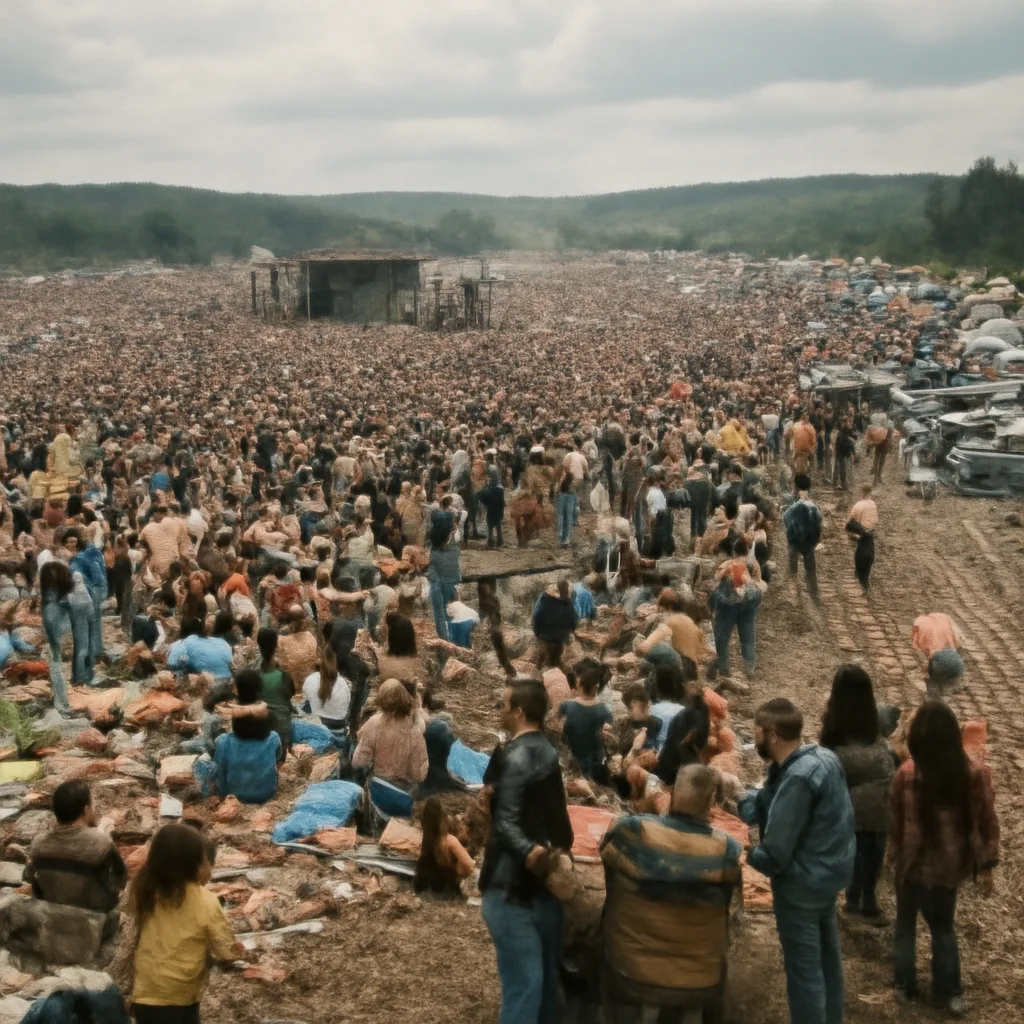
In mid‑August 1969, organizers staged the Woodstock Music & Art Fair on Max Yasgur’s dairy farm near Bethel, New York, intending a large outdoor concert celebrating music and countercultural ideals. What began as a ticketed event quickly drew a vastly larger crowd—by most estimates around 400,000 people—straining transportation, sanitation, medical services and supplies and forcing organizers to declare the festival free and open to all.
Logistics collapsed under the influx. Highways became gridlocked for miles; many would‑be attendees abandoned vehicles to walk to the site. Food and water shortages emerged as vendors and planned services failed to meet demand. Rain turned fields to mud, complicating movement and stage operations. Law enforcement presence was relatively limited, and the state and county authorities largely adopted a permissive stance focused on public safety rather than strict crowd control.
The musical lineup spanned folk, rock, blues and psychedelia and included performers who were then rising or well established: Santana, who delivered a breakthrough set early in the festival; Janis Joplin; The Who; Crosby, Stills, Nash & Young; Joe Cocker; Jefferson Airplane; Sly and the Family Stone; and Jimi Hendrix, whose closing performance on Monday morning occurred after many attendees had already departed. Not all performances went as planned—scheduling, technical issues and weather interruptions produced uneven sets—but several have been remembered as defining moments in the artists’ careers and in rock history.
Health and safety challenges were acute. Organizers and volunteers improvised clinics and relief stations; the New York State Department of Health reported numerous cases of minor injuries, drug overdoses and exposure, while fatalities officially attributed to drowning and drug-related causes occurred in and around the event. Despite limited medical resources and the scale of the crowd, mass violence was largely absent; many witnesses and later accounts emphasize mutual aid among attendees, improvisational care and a prevailing ethic of community.
Media coverage and public reaction were mixed. Some commentators condemned the event as evidence of social breakdown, while others framed it as a peaceful, if chaotic, expression of youth culture and political dissent. The festival had legal and financial aftermath: local residents and authorities raised complaints about damage and disruption, and organizers faced lawsuits and bankruptcy. Nonetheless, Woodstock’s cultural resonance grew quickly through news reports, documentary footage and the 1970 film Woodstock, which brought images and performances to wider audiences.
Historically, Woodstock is often treated as a symbol of the 1960s counterculture—representing antiwar sentiment, communal ideals and musical experimentation—while also illustrating the limits of ad hoc large‑scale events when preparation and infrastructure lag behind attendance. Scholars and participants continue to debate what Woodstock represented: a high point of peaceful mass gathering, a near‑disaster averted by goodwill, or a mixed legacy of triumphs and failures. Regardless, the festival’s blend of logistical collapse and memorable performances secured its place in popular memory as both chaotic and legendary.
No quotation attributed here is fabricated; descriptions are based on widely documented accounts of the festival’s attendance, logistical failures, lineup and aftermath. Specific figures and interpretations—such as total attendance and assessments of behavior—vary among sources and are noted as estimates or contested by historians.