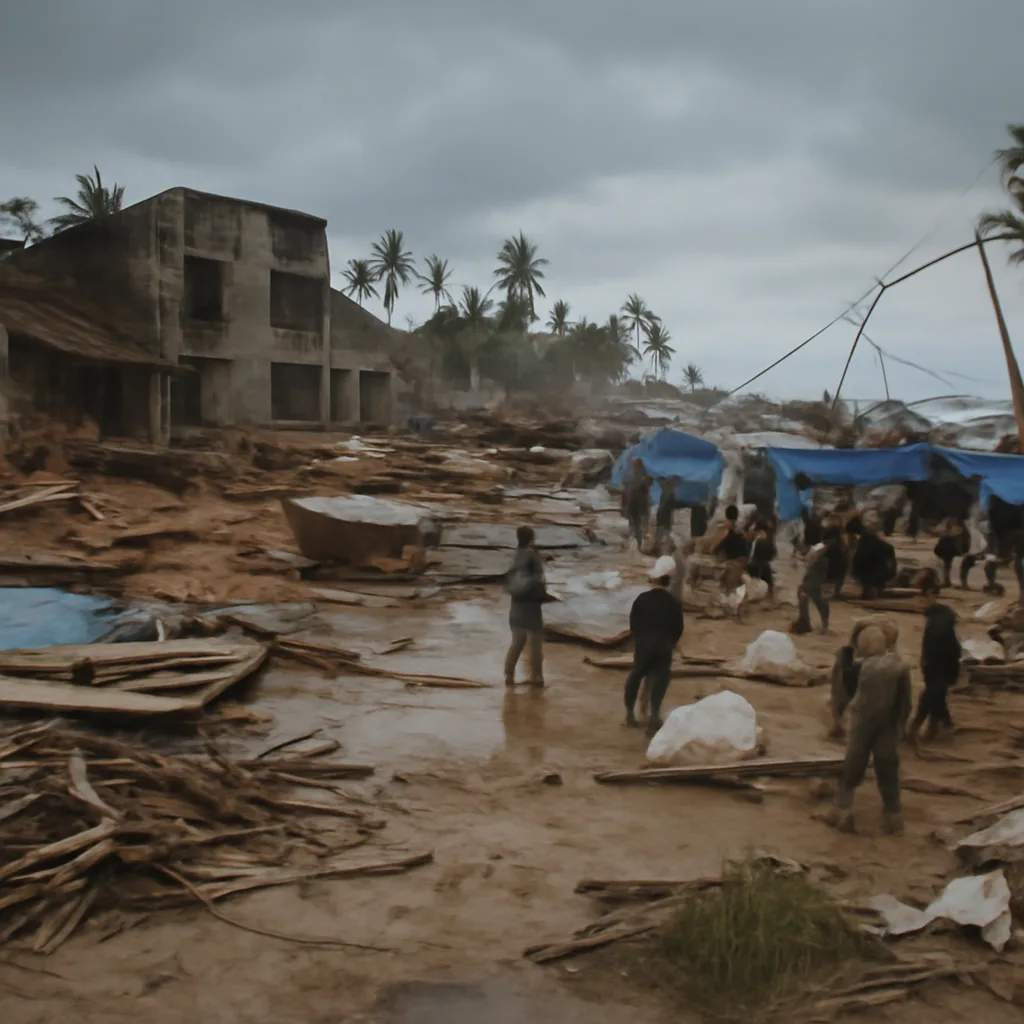
2004 Indian Ocean tsunami kills hundreds of thousands across coastal nations
On December 26, 2004, a magnitude ~9.1–9.3 undersea earthquake off Sumatra triggered massive tsunami waves that struck coasts around the Indian Ocean, killing an estimated 230,000–280,000 people and displacing millions in several countries.
On the morning of December 26, 2004, a powerful undersea earthquake with a moment magnitude estimated between 9.1 and 9.3 ruptured the seafloor off the west coast of northern Sumatra, Indonesia. The sudden displacement of the seabed generated a series of tsunami waves that radiated across the Indian Ocean, striking shorelines from Indonesia and Thailand to Sri Lanka, India, the Maldives, Somalia and other countries. The disaster unfolded without widespread regional tsunami warning systems, leaving many coastal communities with little or no time to evacuate.
Scale and human toll
The tsunami produced waves that in places exceeded 10 meters (30 feet) and traveled at high speed across the ocean. The earthquake and resulting tsunamis together caused catastrophic loss of life and destruction. Estimates of fatalities vary by source and methodology, but commonly cited figures place the death toll in the range of roughly 230,000 to 280,000 people across more than a dozen countries. Millions more were injured or displaced, and entire coastal towns, villages and infrastructure—homes, schools, hospitals, ports and tourist facilities—were washed away or rendered unusable.
Regional impacts
- Indonesia: The island of Sumatra, closest to the quake’s epicenter, suffered the most severe damage and the highest number of fatalities, particularly in the provinces of Aceh and North Sumatra. Many remote fishing communities were overwhelmed by the surge.
- Thailand: Coastal tourist areas on the Andaman Sea, including parts of Phuket and Khao Lak, were struck early in the morning, causing heavy casualties among local residents and international visitors.
- Sri Lanka: Large sections of the eastern and southern coast were inundated; coastal towns and infrastructure were severely damaged.
- India: States along the southeastern and southwestern coasts, including Tamil Nadu and Andhra Pradesh, experienced deadly flooding and loss of life.
- Maldives and Somalia: The Maldives suffered widespread flooding across low-lying islands; Somalia saw casualties and damage on its eastern shores despite being far from the epicenter.
Immediate response and humanitarian crisis
Rescue and relief operations began within hours in some locations but were hampered by the scale of destruction, damaged infrastructure and the remoteness of many affected communities. National militaries, local responders, international humanitarian organizations and hundreds of thousands of volunteers participated in search-and-rescue, medical care, shelter, water and sanitation, and body recovery efforts. The disaster triggered one of the largest international humanitarian responses in recent history, with emergency funding, supplies and personnel arriving from governments and NGOs worldwide.
Longer-term consequences and recovery
Beyond the immediate humanitarian crisis, the tsunami left lasting economic and social consequences. Fisheries, tourism and coastal agriculture were disrupted; rebuilding required massive investments in housing, schools, water systems and livelihoods. The catastrophe exposed major gaps in regional tsunami preparedness and early warning capacity. In its aftermath, international and regional efforts accelerated the establishment of a permanent Indian Ocean Tsunami Warning and Mitigation System, improved coastal planning and community education on tsunami risk, and investments in hazard mapping and early-alert communications.
Uncertainties and legacy
Exact casualty and displacement figures vary between government reports, independent assessments and academic studies; records from the most-affected, remote areas were often incomplete. Nonetheless, the December 26, 2004 tsunami remains one of the deadliest natural disasters in modern history. Its legacy includes both the human toll and substantial advances in early-warning systems and disaster risk reduction aimed at preventing similar levels of loss in the future.