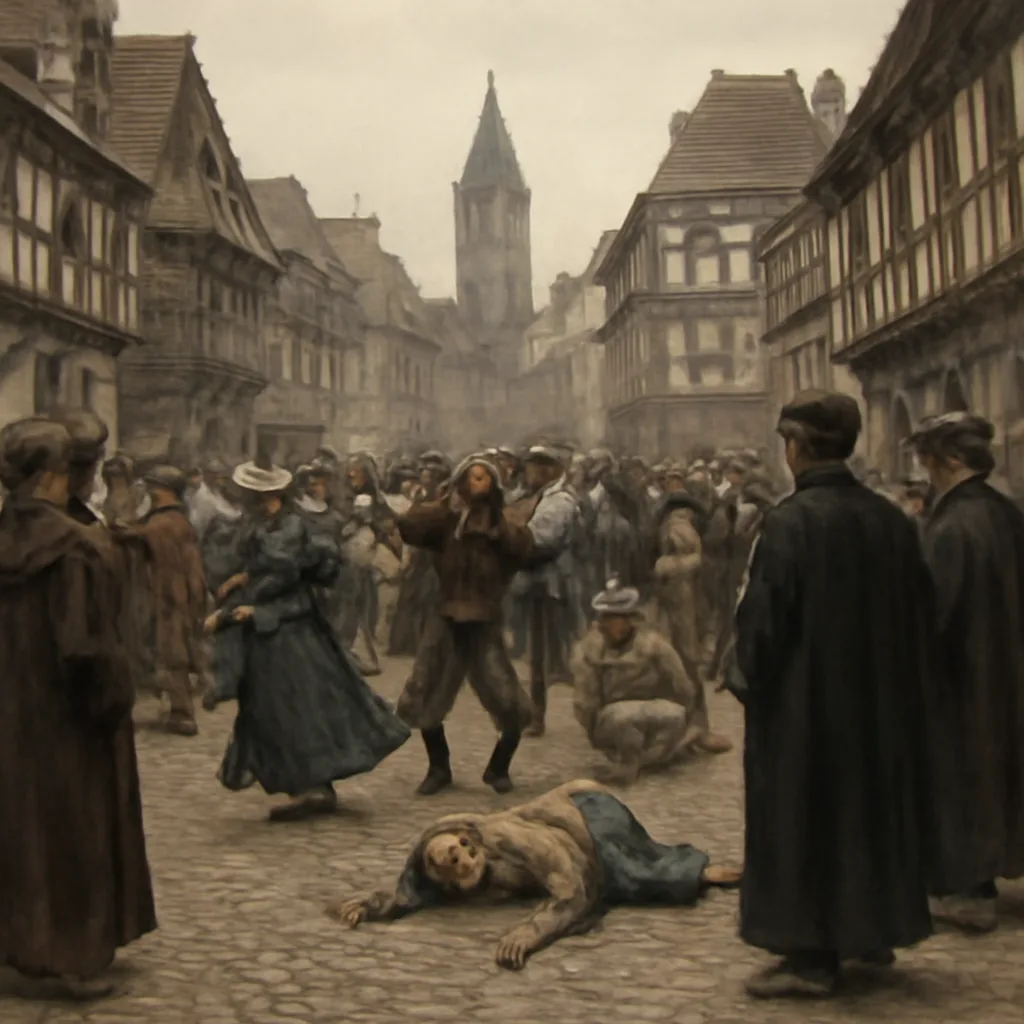
In July 1518, hundreds of residents of Strasbourg reportedly began dancing uncontrollably for days; contemporaneous records describe a spreading, involuntary movement disorder that baffled civic and clerical authorities and produced lasting historical curiosity.
On 14 July 1518 a woman identified in contemporary records as Frau Troffea began dancing in the streets of Strasbourg (then part of the Holy Roman Empire). Within a week dozens, and within a month perhaps hundreds, of people were reported to be dancing in a similarly compulsive manner. Municipal documents, notarial records and chronicles from the period record efforts by city authorities and physicians to respond to what they termed a contagion of dancing.
Primary sources indicate the city’s council and guilds took extraordinary measures. Some authorities organized spaces where those affected could dance under supervision, believing physical exertion or communal rituals might relieve them. Other responses included appeals to clergy, processions, and, according to city records, recommendation of treatments common to early 16th-century medical thinking: bloodletting, herbal remedies and other humoral therapies. Several contemporaneous accounts mention that some victims collapsed from exhaustion or illness; a small number are said to have died, though precise mortality figures are disputed and not well documented.
Modern historians and medical researchers have proposed multiple, sometimes overlapping explanations. One cluster of interpretations sees the event as a case of mass psychogenic illness (historically called mass hysteria), where intense social stress, fasting, impoverishment or grief produced involuntary motor behavior shared within a community. Strasbourg had suffered crop failures, disease and economic hardship in the years before 1518, conditions that could raise communal stress.
Another hypothesis invokes neurological or toxic causes. Some scholars have suggested ergotism (poisoning from Claviceps purpurea, a fungus that infects rye and produces psychoactive and convulsant alkaloids) because ergot outbreaks were known in the medieval and early modern periods. Critics of the ergot theory note that ergotism typically produces convulsions, gangrene and other symptoms not consistently reported in the 1518 accounts, and that seasonal and dietary patterns do not neatly match the episode.
Researchers have also considered cultural and religious contexts: ritualized dance, saints’ cults (notably St. Vitus, invoked against dancing ailments), and performative behaviors could shape how individuals and spectators understood and enacted symptoms. Contemporary observers sometimes framed the phenomenon as divine punishment or demonic affliction, influencing how authorities reacted and how records were written.
Source material is uneven. The most frequently cited contemporaneous evidence comes from civic registers and chronicles in Strasbourg. Later retellings—both scholarly and popular—have sometimes exaggerated numbers or simplified causes. Because surviving documents are limited and interpreted through later historians’ lenses, many details remain uncertain: precise counts of the affected, exact duration for each individual, and clear clinical descriptions are lacking.
Today the 1518 dancing episode is studied as a window into early modern public health, social stress, and the interaction of medical and religious authorities. It is significant less as a single settled diagnosis than as an event revealing how communities interpret and attempt to manage unexplained mass illnesses. Historians caution against reducing it to a single cause; the most plausible accounts combine social, cultural and possibly physiological factors.
The dancing plague remains an enduring historical curiosity because it illustrates how human bodies and communities can respond to extreme pressure in ways that confound contemporaneous understanding. While modern medicine and historical scholarship have narrowed plausible explanations, aspects of the episode—exact numbers, personal experiences of sufferers, and the immediate chain of contagion—remain contested or unknowable from surviving records.