
← Back
06/04/1989 • 5 views

Beijing moves to suppress pro-democracy protests after weeks of demonstrations
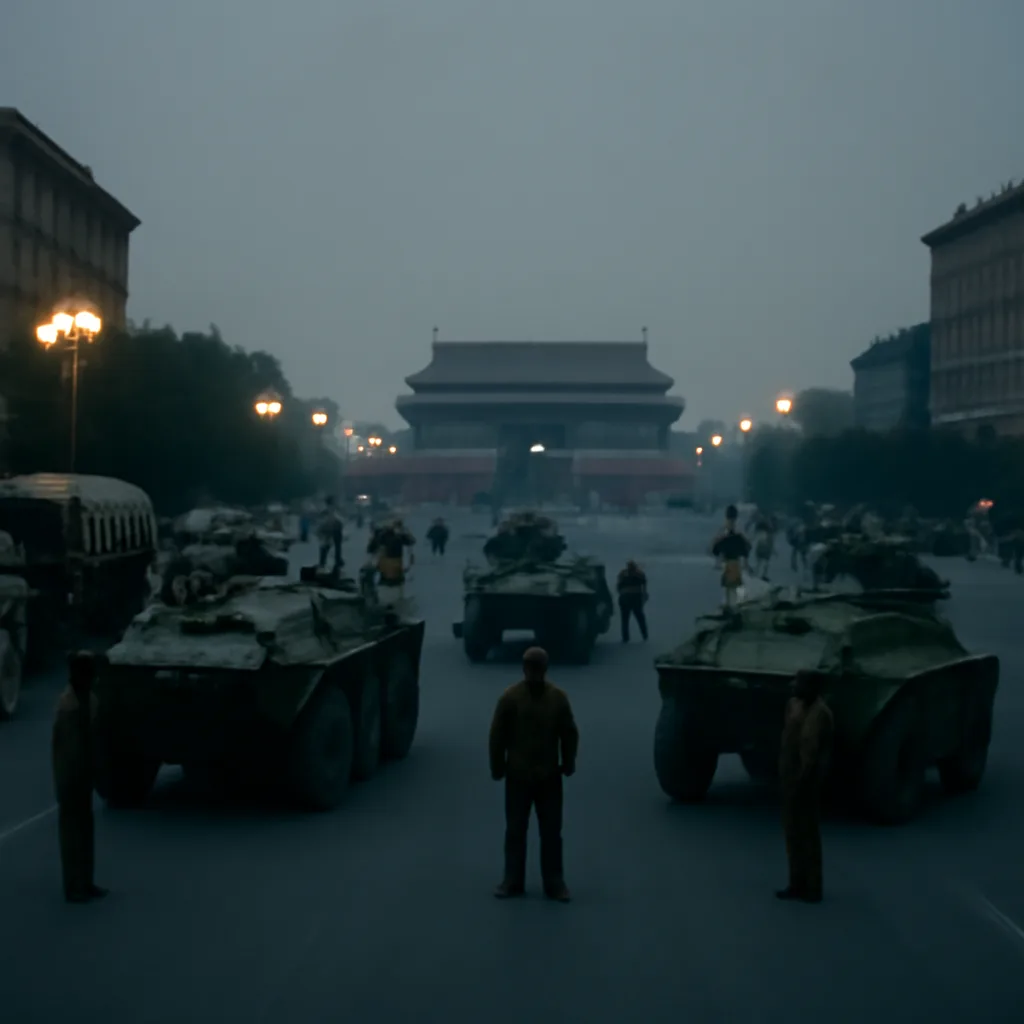
Tiananmen Square area blocked by military vehicles and troops on wide city streets with crowds dispersed; banners and flags absent, evening lighting, no identifiable faces.

On June 4, 1989, Chinese authorities launched a large-scale military operation to clear pro-democracy protesters from central Beijing, following weeks of demonstrations centered on Tiananmen Square and other cities across China.


From mid-April to early June 1989, mass demonstrations led primarily by students and intellectuals filled Tiananmen Square and other urban centers in China, calling for political reform, greater transparency, and an end to corruption. The movement grew after the death in April of Communist Party elder Hu Yaobang, whose sympathetic reputation among reform-minded citizens catalyzed public mourning and political expression. Over subsequent weeks, demonstrators camped in the square, organized hunger strikes, and drew domestic and international media attention.

In late May and into early June, Chinese leaders declared martial law in parts of Beijing. On the night of June 3–4, and into the early hours of June 4, the People’s Liberation Army (PLA) moved into central Beijing with infantry, armored vehicles and other forces to disperse the crowd and reassert control. Soldiers used live ammunition and armored vehicles to clear roads leading to Tiananmen Square and surrounding areas. Urban checkpoints and cordons were established, and military patrols increased throughout the city. Communications and transportation were disrupted as authorities sought to prevent further mobilization.

The exact number of people killed and injured during the clearance remains disputed. Chinese government figures have never published a comprehensive casualty list; independent estimates from journalists, diplomats and human rights organizations have varied widely, ranging from several hundred to several thousand casualties. Arrests and detentions followed the operation: protesters, activists, and others alleged to have been involved were rounded up in the immediate aftermath and in subsequent months. Many were tried by military or civilian courts; some received long prison sentences, and a number were later executed, according to human rights reports.

The crackdown had broad domestic and international repercussions. Within China, the government consolidated control, curtailed public political dissent, and tightened media controls and surveillance. Internationally, the events provoked widespread condemnation, led to economic sanctions and arms embargoes by several Western governments, and shifted diplomatic relations. The Chinese leadership defended their actions as necessary to restore order and stability and to protect the state from what they characterized as chaos and counterrevolutionary activity.

Memory and official discourse about the events have been tightly regulated inside China since 1989. Public commemorations and open discussion of the crackdown are restricted, and references to the events are censored in official media and online platforms. Outside China, the crackdown remains a focal point for human rights advocacy and for debates over political reform and state power in the PRC.

Historical assessment recognizes the protests as a major challenge to the Chinese Communist Party’s authority at the time and the ensuing military response as a decisive moment that shaped China’s political trajectory in the following decades. While the broad outlines of the military operation and its immediate effects are well documented, precise casualty figures and many individual fates remain contested or incompletely documented, and researchers continue to rely on a mix of eyewitness accounts, diplomatic cables, contemporaneous journalism and later scholarship to interpret the events.

Share this

Email Share on X Facebook Reddit

Did this surprise you?