
06/04/1989 • 6 views
Chinese government crushes pro-democracy demonstrations in Beijing’s Tiananmen Square, June 4, 1989
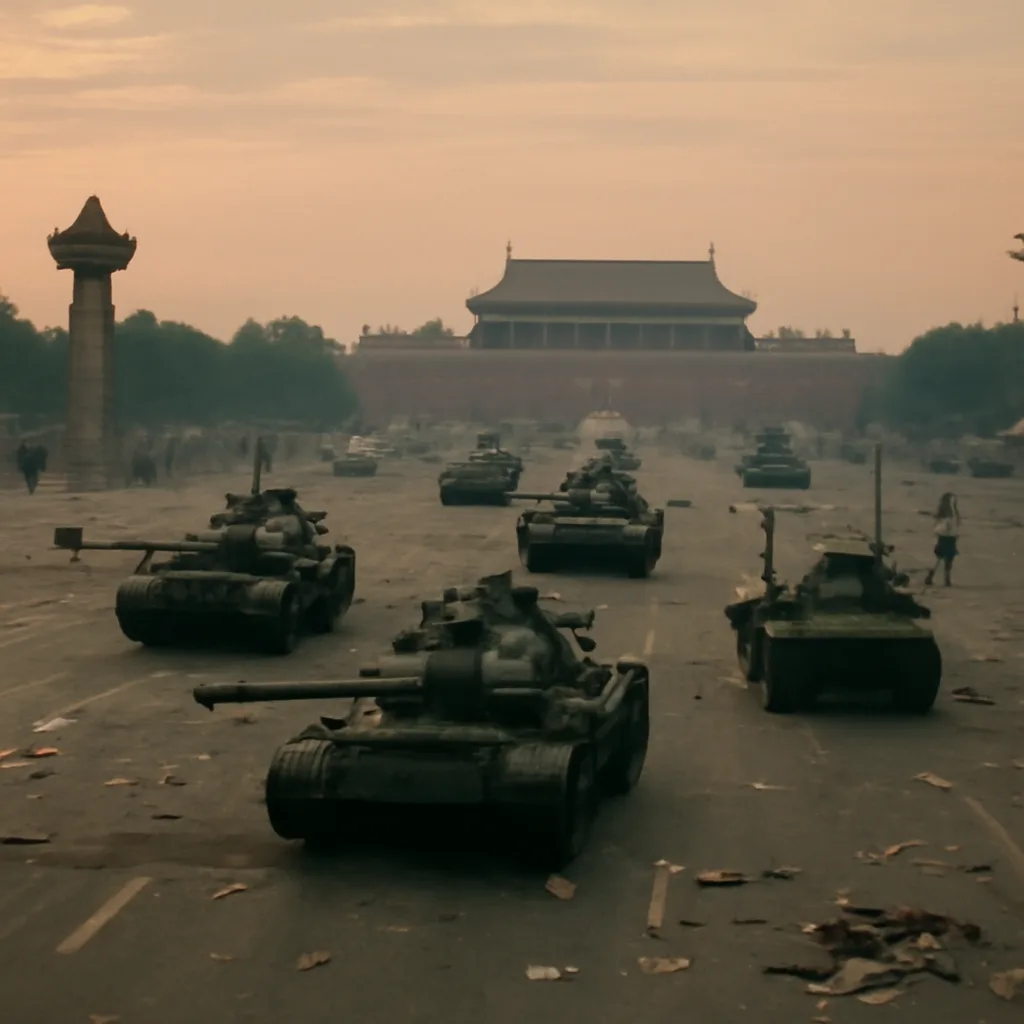
On June 4, 1989, Chinese armed forces moved into Beijing to clear Tiananmen Square and surrounding areas, using lethal force against pro-democracy protesters and bystanders—an event that resulted in a disputed but significant number of deaths and a nationwide crackdown.
On the night of June 3 into the morning of June 4, 1989, the Chinese government ordered the People’s Liberation Army (PLA) to advance into central Beijing to clear the square and suppress the protests. Military units, including troops and armored vehicles, moved along major arteries toward the city center. Confrontations occurred between soldiers and civilians; troops opened fire in several locations, and tanks and armored personnel carriers were used to disperse crowds and remove barricades.
The exact number of deaths and injuries has never been officially established and remains disputed. Chinese officials have offered limited and varying figures; independent researchers, diplomats and human rights organizations have produced widely differing estimates, ranging from several hundred to several thousand killed. Many protest participants, pedestrians and residents were detained in the aftermath; thousands were arrested in a nationwide security operation. Reports documented summary trials, long prison sentences for protest leaders and a sustained campaign to remove dissenting voices from public life.
The Chinese government framed the operation as necessary to restore order and stability, characterizing the demonstrations as a threat to public order and socialist governance. International reactions were swift and mostly condemnatory: many governments imposed sanctions, arms embargoes or temporary diplomatic measures, and numerous international institutions criticized the Chinese authorities for the use of force and for restrictions on press freedom and political expression.
Domestically, the crackdown was followed by tightened political controls, stricter censorship of domestic and foreign media, and an intensified security presence across major cities. The Chinese leadership prioritized economic development while limiting political liberalization, a trajectory that shaped China’s governance and policy choices in the following decades.
The events of June 4, 1989, remain sensitive and heavily censored within mainland China. Commemorations, open discussion and public access to contemporaneous information are restricted. Outside China, June 4 is widely remembered as a pivotal moment in late 20th-century Chinese history, emblematic of the tension between demands for political reform and an authoritarian state’s determination to maintain control.
Scholars continue to study the protests and the crackdown using archival materials, eyewitness testimony, diplomatic cables and photographic and video evidence. Because primary-source access inside China is constrained and the authorities have not released a comprehensive official account, key details—particularly casualty figures and internal decision-making processes—remain subjects of ongoing research and debate.