
← Back
11/28/1968 • 5 views

Fog Forces Delay of College Football Game in Late 1968
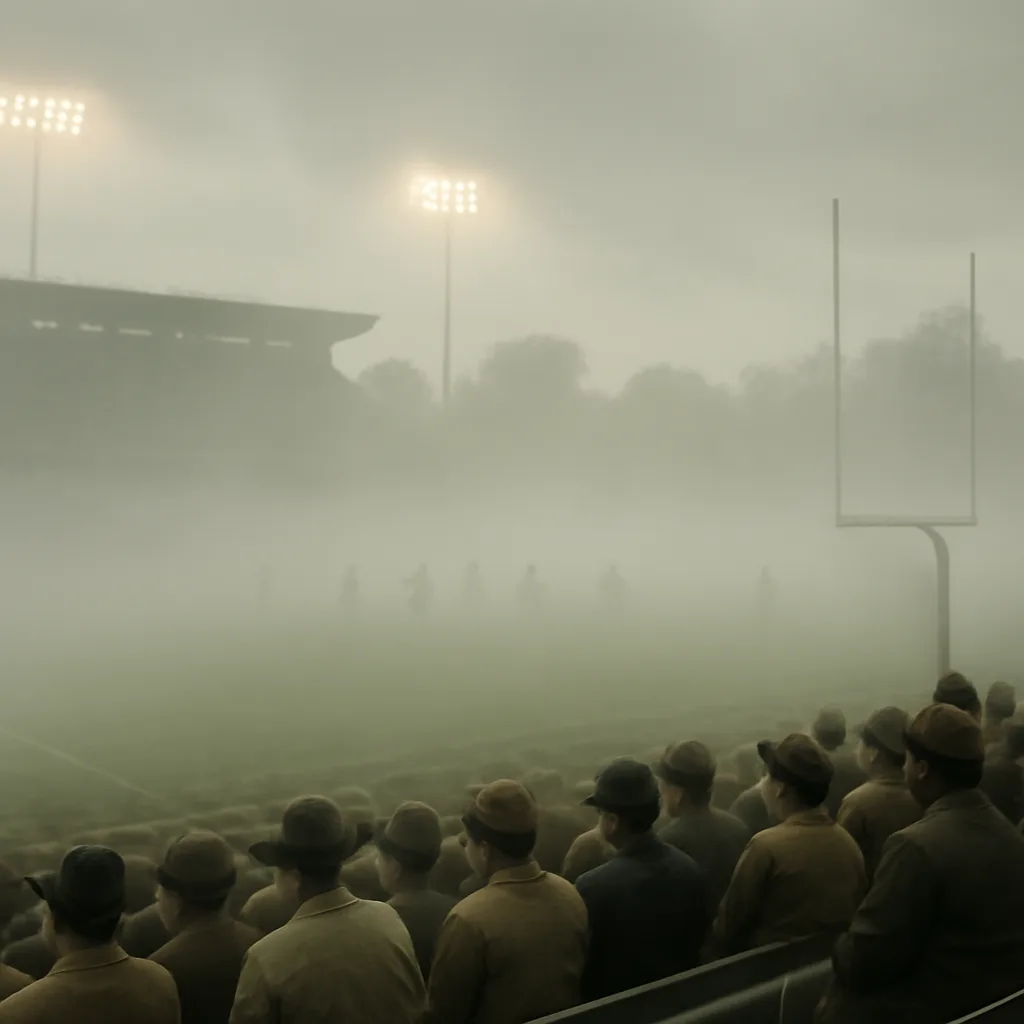
Stadium field shrouded in dense fog on an autumn day in 1968, with blurred goalposts and indistinct players and spectators visible through the mist.

A college football game on November 28, 1968, was postponed after dense fog reduced visibility on the field, making play unsafe and prompting officials to suspend the contest until conditions improved.


On November 28, 1968, a scheduled college football game was delayed when an unusually dense fog rolled into the stadium, drastically reducing visibility and making play impracticable. Officials, citing player safety and the difficulty of officiating when players and the ball could not be seen clearly, halted the game until conditions improved. Such weather disruptions were uncommon but not unprecedented in outdoor sports; fog has intermittently affected contests from high school to professional levels when localized atmospheric conditions create thick, low-lying clouds.

Eyewitness reports and contemporary newspaper accounts from that period note that the fog was thick enough that players on opposite sides of the line of scrimmage often could not see one another, and referees had trouble observing routine plays and potential infractions. Stadium lighting did little to penetrate the moisture-laden air, and announcements to spectators emphasized that the delay was for safety rather than any disciplinary matter. Spectators remained in the stands during the pause, as organizers expected the fog to lift rather than the game to be abandoned.

In 1968, game postponements for weather generally followed practices that prioritized completion of the scheduled contest when feasible. Depending on conference rules and the specific institutions involved, officials could delay briefly, resume when conditions allowed, or, if necessary, suspend play and reschedule or declare the game final based on the length completed. Records from the era show a range of outcomes for weather-interrupted games: some resumed the same day after short delays, others were continued on later dates, and a few were called if conditions did not permit safe continuation.

Fog-related delays highlight how natural weather phenomena could disrupt sporting events before the advent of modern forecasting and communications technologies. In 1968, stadiums lacked the sophisticated public-address adaptations and instant meteorological data common today; decisions were made on-site by game officials, stadium managers, and the participating teams. Photographs and press coverage from similar incidents in that era often show hazy, diffuse lighting and spectators peering through the mist, underscoring the visual challenge posed by such conditions.

While fog rarely causes mass cancellation of outdoor events in many climates, it can be particularly impactful in locales with temperature inversions or proximity to large bodies of water, where moisture and still air combine to create low visibility. For players and officials, the immediate concerns are safe execution of plays, accurate officiating, and preventing avoidable collisions. For spectators and broadcasters, the priority is clear sightlines; historically, limited visibility has sometimes led broadcasters to suspend live coverage or switch to studio commentary until the situation improved.

This November 1968 delay is part of the broader history of weather interruptions in sport, showing how organizers balanced safety, competitive integrity, and logistical constraints. Contemporary sources describe the pause as temporary and primarily precautionary; available records do not indicate unusual controversy surrounding the decision to delay. The incident serves as a reminder of the ways natural conditions have long played a role in the conduct of outdoor athletics, even as technology and procedures have evolved to manage such interruptions more predictably.

Share this

Email Share on X Facebook Reddit

Did this surprise you?