
← Back
08/10/1962 • 5 views

Cold War prisoner exchange on Berlin's Glienicke Bridge, 10 August 1962
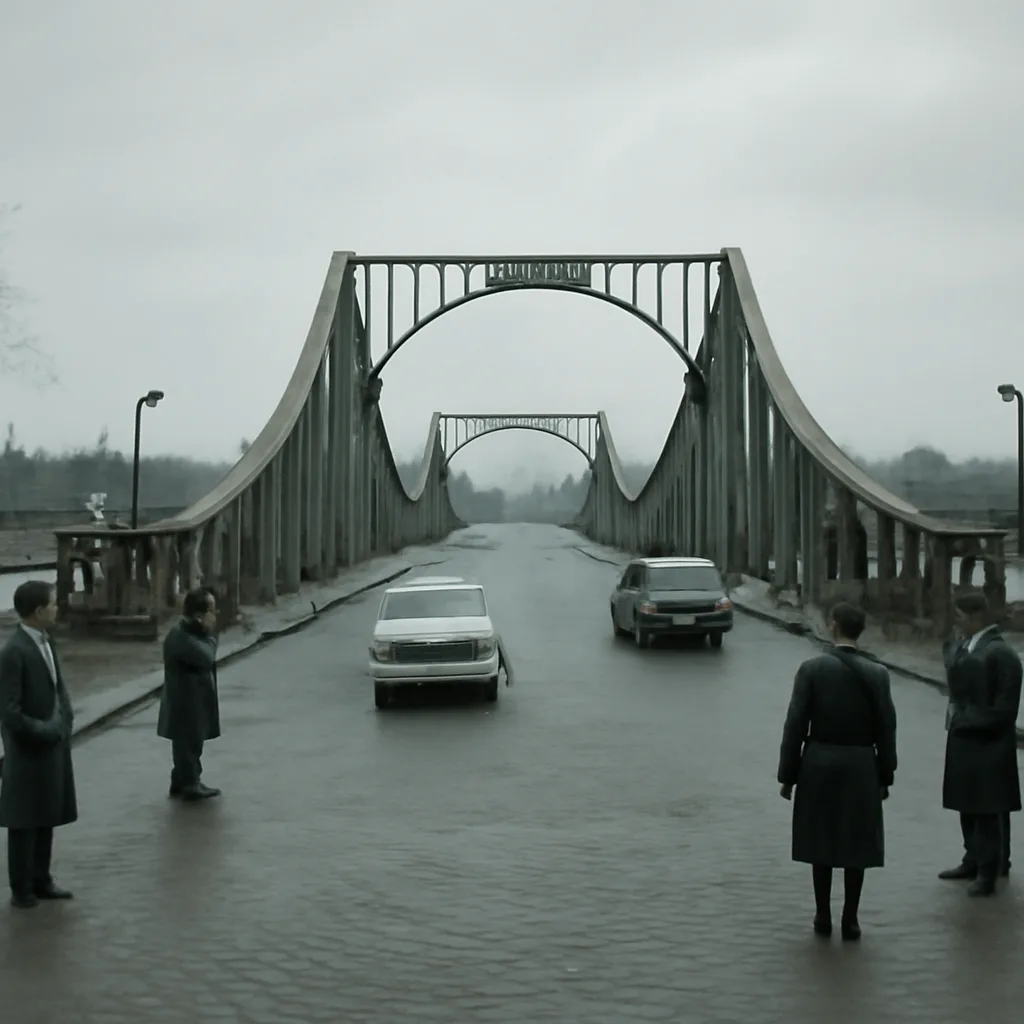
Glienicke Bridge spanning the Havel River with surrounding winter-bare trees and a line of vehicles and uniformed escorts at the bridge approaches, seen from a low riverside vantage point.

On 10 August 1962, Western and Eastern authorities carried out a high-profile exchange of detainees on the Glienicke Bridge linking West Berlin and Potsdam, a rare public event in the Cold War behind-the-scenes struggle for intelligence and political leverage.


On 10 August 1962, a prisoner exchange took place on the Glienicke Bridge (officially the Bridge of Spies) spanning the Havel River between West Berlin and Potsdam, then in East Germany. The bridge had become an established site for exchanges between Western and Eastern bloc services because of its clear geographic division and heavy symbolic value. Such swaps were tangible, if uneasy, moments of cooperation amid the wider Cold War confrontation.

Background

During the Cold War intelligence services on both sides detained foreign nationals, defectors, and suspected spies. Exchanges were negotiated intermittently to recover agents, free high-profile detainees, or secure diplomatic concessions. By 1962 the exchange practice had precedent: earlier swaps, including those involving aircraft crews and prisoners, had taken place at the same site and other neutral locations. The Glienicke Bridge was chosen for its direct border crossing, short neutral zone, and familiarity to negotiators from both sides.

The exchange

On the appointed day, convoys and personnel from Western and Eastern authorities arrived under prearranged security measures. Each side transferred custody of detainees and escorted them across the bridge in carefully choreographed movements designed to avoid violence or public disorder. The event was tightly controlled; journalists and cameras were sometimes present or kept at a distance depending on the agreement. The exchange typically concluded after verification of identities and formal turnover procedures.

Significance

Exchanges such as the one on 10 August 1962 served several functions. Practically, they returned individuals to their home governments or removed persons whose continued detention had diplomatic costs. Politically, they offered the appearance of negotiated order and a limited channel of communication between adversaries. For intelligence services, these swaps could recover agents whose continued captivity risked exposure of operations, or they could be used to extract concessions and bargaining capital.

Broader context

The summer of 1962 fell between major Cold War milestones: after the 1961 construction of the Berlin Wall and before the Cuban Missile Crisis in October 1962. Tensions over Berlin remained acute; the Wall had sharply limited movement between East and West and increased the stakes of any incident. Exchanges on the bridge were thus both practical and highly symbolic, underscoring the division of Europe while providing a rare, visible moment of direct contact.

Limitations of the record

Contemporary reporting and later historical accounts sometimes disagree on specific details of individual swaps—such as the names of all participants or the precise sequence of administrative steps—because intelligence services habitually restricted documentation and public disclosure. Where names, negotiation transcripts, or intelligence assessments remain classified or contested, historians rely on contemporary press accounts, memoirs, and declassified records, which can leave gaps or differing emphases in the narrative.

Legacy

The Glienicke Bridge retained its association with Cold War espionage into later decades and is frequently referenced in histories of the period. Its role in prisoner exchanges has made it a focal point for public memory about the intelligence rivalry between East and West. Today the bridge is recognized for that history, rather than as the site of a single exchange, representing the era's mixture of confrontation, clandestine operations, and occasional negotiated settlements.

Share this

Email Share on X Facebook Reddit

Did this surprise you?