
← Back
02/06/1937 • 5 views

Inquiry Opens into the Hindenburg Disaster
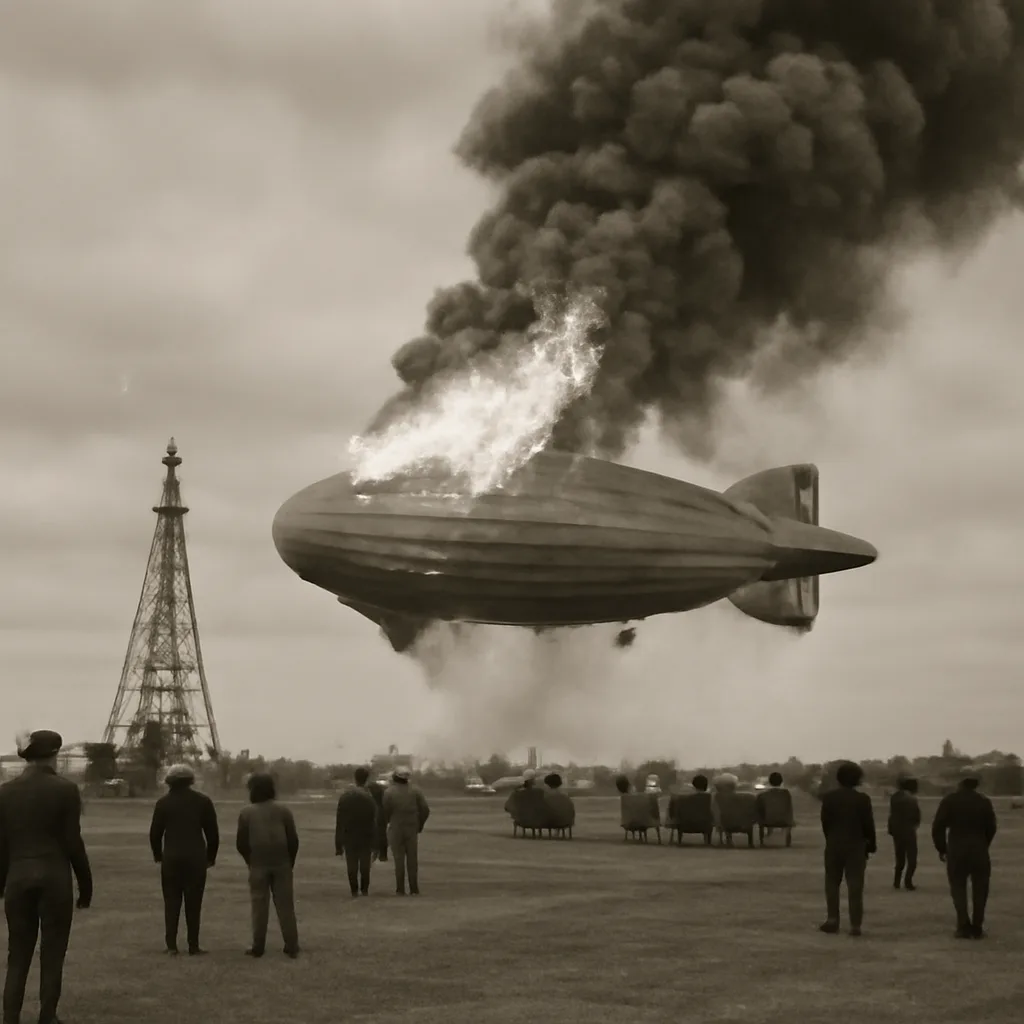
The burning Hindenburg moored near Lakehurst mast as it collapses to the ground with smoke and flames; rescue crews and onlookers at a distance, circa 1937.

On Feb. 6, 1937, investigators convened to determine how the German passenger airship LZ 129 Hindenburg caught fire while landing in Lakehurst, New Jersey, killing 36 people and ending the era of passenger airships.


On the afternoon of May 6, 1937 — the date of the accident — the German passenger airship LZ 129 Hindenburg attempted to dock at the Naval Air Station Lakehurst, New Jersey, when it suddenly caught fire and was destroyed within minutes. In the weeks that followed, public outcry and official concern prompted formal investigations to determine the cause of the blaze and to assess responsibility for the catastrophe that killed 36 people (13 passengers, 22 crew, and one ground crewman) and injured many others.

The inquiry process opened on February 6, 1937, as both U.S. and German authorities and representatives of aviation interests sought to examine technical, operational and environmental factors. Multiple forums — including U.S. federal and naval inquiries and German internal reviews — pursued overlapping questions: whether a structural or design flaw, a maintenance lapse, ground-handling procedures, static electricity, or sabotage had initiated the fire; and whether the use of hydrogen as the ship’s lifting gas made the disaster inevitable once ignition occurred.

Investigators reviewed the Hindenburg’s design and construction, including its duralumin frame, gas cells, and outer skin. Attention focused on the fabric covering, which contemporary tests suggested had been treated with aluminum powder and iron oxide pigments bound in cellulose acetate butyrate dope; some witnesses and later commentators proposed that the skin could have been flammable or contributed to rapid flame spread. Inquiry teams also examined hydrogen handling and the ship’s gas cells for leaks, and evaluated the ship’s electrical systems, engines, and engines’ spark potential.

Operational factors were scrutinized: Lakehurst’s mooring procedures, the use of mooring masts, the decision to attempt landing in the weather conditions that afternoon, and communications between the ship’s crew and ground handlers. Several survivors reported unusual movements and noises before the fire, prompting investigators to reconstruct the timeline of the landing approach and the moment ignition occurred.

Sabotage was considered early, both because of the dramatic nature of the loss and because the Hindenburg was a German vessel operating in the politically charged 1930s. Investigators sought evidence of incendiary devices or tampering but found no definitive proof. While some contemporaries and later writers have advanced various sabotage theories, official inquiries did not conclude that sabotage was the cause.

Testing and analysis proceeded amid competing hypotheses. U.S. Naval investigators and the Department of Commerce conducted technical studies; German representatives and airship engineers defended the Zeppelin design and emphasized operational explanations. In the months after the disaster, prevailing official conclusions leaned toward accidental causes related to a hydrogen leak that was ignited by an electrical discharge or static spark during the landing maneuver, followed by rapid combustion aided by materials and structural arrangements that allowed fire to spread.

The Hindenburg inquiry had immediate and long-term consequences. In the short term, it provided explanations that shaped public understanding and helped close legal and insurance matters. In the longer term, the disaster and its investigation effectively ended commercial passenger travel by hydrogen-filled rigid airships: public confidence evaporated, and investment and regulatory interest shifted toward heavier-than-air aircraft. Historians and engineers continue to debate specific technical details — for example, the precise ignition source and the role, if any, of the fabric covering — but the consensus view attributes the catastrophe to an accidental ignition of hydrogen with rapid propagation of fire.

Careful reading of inquiry records, contemporary technical reports, and later scholarship is required to trace which findings were based on direct evidence and which remained inferential. Where details remain disputed or unresolved, official reports often presented competing interpretations rather than definitive single causes.

Share this

Email Share on X Facebook Reddit

Did this surprise you?