
12/05/1952 • 4 views
London’s Deadly 1952 Smog: The City Choked by a Weeklong Fog
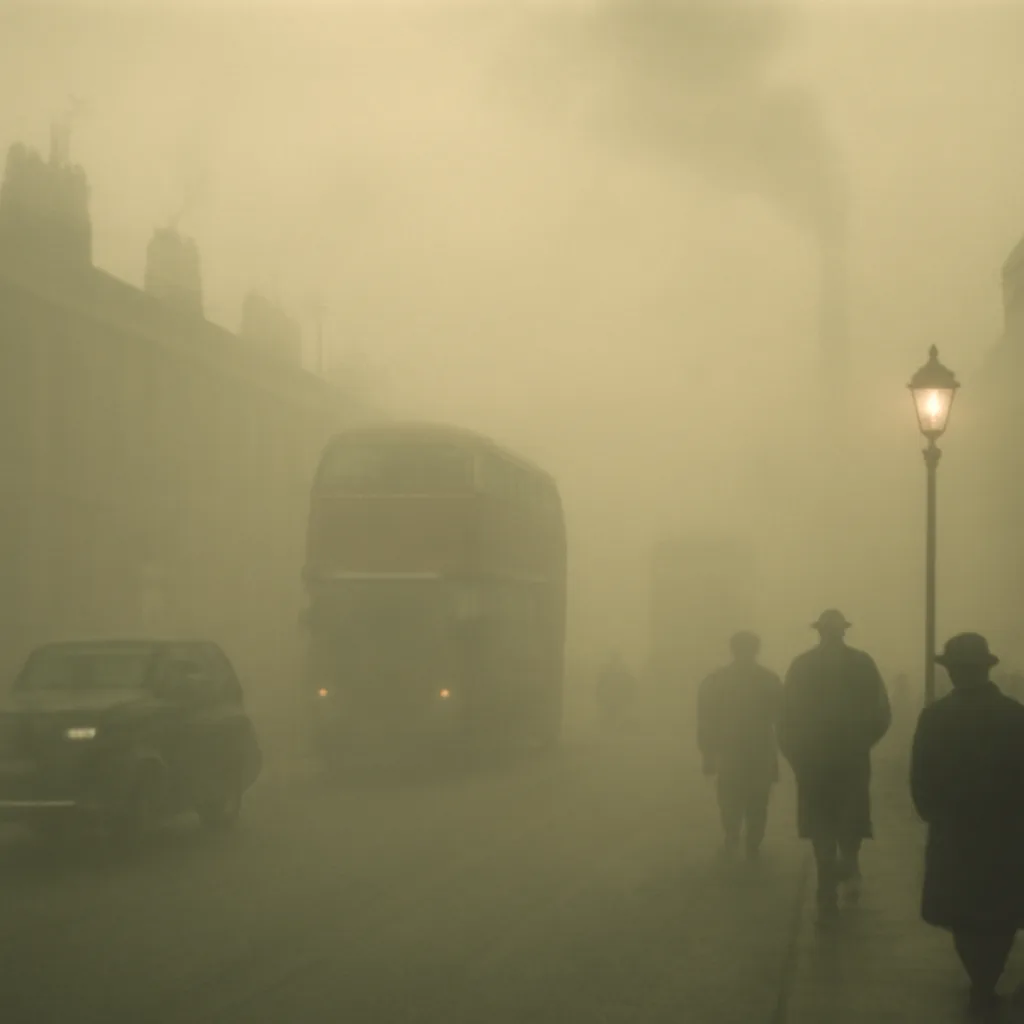
In mid-December 1952 London was engulfed by a dense, toxic smog that lasted several days and caused thousands of illnesses and deaths, prompting national outrage and major changes to air pollution policy.
Conditions and causes
The episode followed several days of cold weather when Londoners burned large quantities of low-quality, sulfur-rich coal for domestic heating and in power stations. A temperature inversion and very little wind prevented the normal dispersion of smoke and industrial emissions. The mixture of sulfur dioxide, smoke particulates (soot), and other combustion products combined with fog to form a dense, acidic smog. The visibility-reducing fog invaded offices, cinemas, theatres, hospitals and the underground, and reached concentrations that interfered with everyday activity and posed acute health risks.
Human impact and response
Hospitals reported increased admissions for bronchitis, pneumonia and other respiratory problems. Ambulance services and funeral directors were overtaxed. Contemporary reports and later research disagree on precise death tolls: an initial official estimate attributed roughly 4,000 excess deaths to the episode in the weeks that followed, while subsequent statistical analyses suggest the excess mortality may have been higher—often cited around 12,000 excess deaths when accounting for a longer window of related health effects. Thousands more suffered nonfatal illnesses and long-term health consequences.
The public reaction was swift and angry. Press coverage and medical testimony highlighted the links between coal smoke, industrial emissions and the crisis. The scale and visibility of the disaster helped galvanize political will for reform.
Policy aftermath
The Great Smog led directly to major legislative and regulatory changes in the United Kingdom. The most notable was the Clean Air Act of 1956, which introduced smokeless zones in urban areas, restricted the types of fuel that could be burned, and encouraged cleaner domestic and industrial heating. The episode also accelerated efforts to relocate polluting industries away from dense urban centres and to modernize household heating. Over subsequent decades these measures, alongside changes in fuel use and technology, contributed to substantial reductions in urban smoke and sulfur pollution in Britain.
Historiography and legacy
Scholars treating the 1952 smog note both its immediate human toll and its role as a turning point in public health and environmental policy. While numbers for deaths and illnesses vary by study and methodology, the consensus is that the smog was a severe public-health disaster that exposed the lethal risks of uncontrolled urban air pollution. The incident remains an important case study in environmental history, urban planning, and public-health policy, cited as a catalyst for modern air-quality regulation in the UK and elsewhere.
Caveats
Details such as the precise number of excess deaths attributed to the smog depend on the study period and statistical methods used; estimates in scholarship differ and are typically presented as ranges. This summary relies on the established historical record of the 1952 London smog and subsequent public-health and legislative responses.