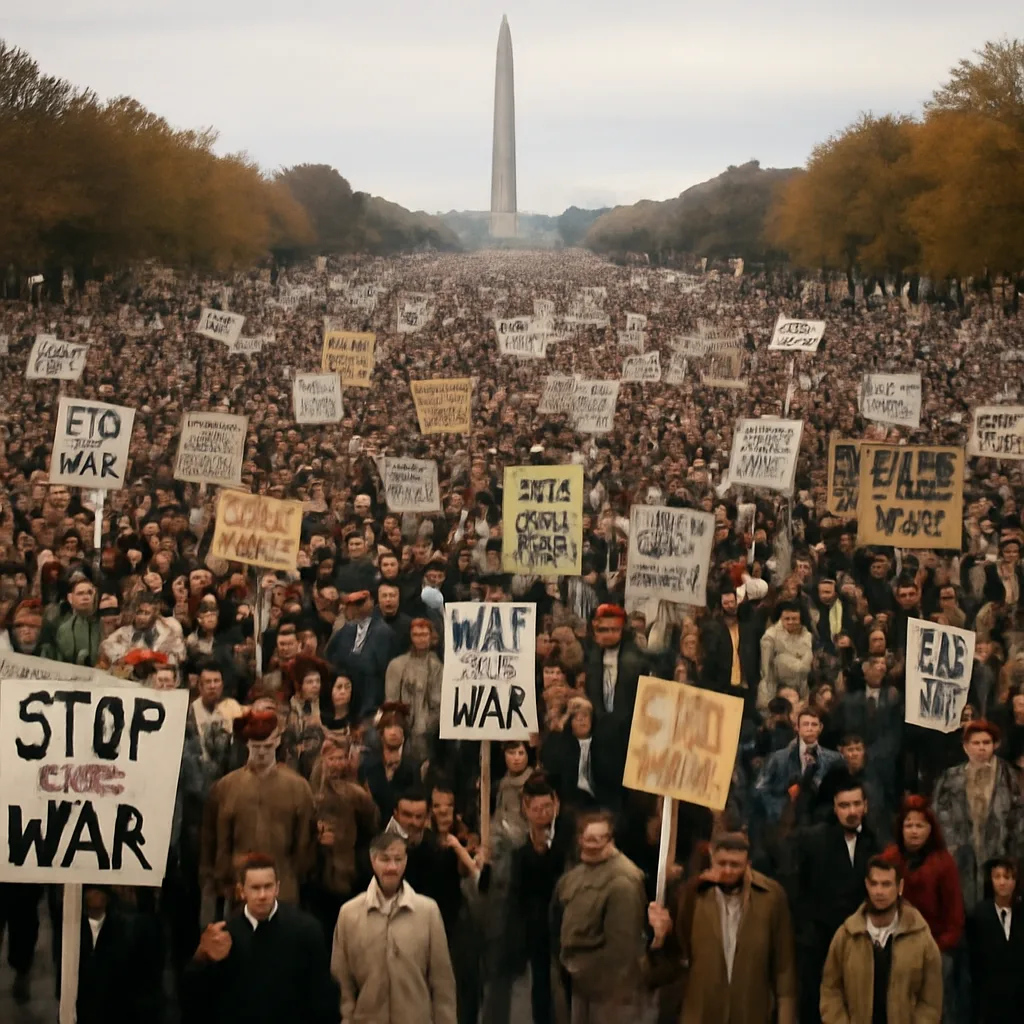
Mass Antiwar Demonstrations Bring Washington to a Standstill on October 21, 1967
On October 21, 1967, hundreds of thousands of protesters converged on Washington, D.C., staging one of the largest anti-Vietnam War demonstrations in U.S. history that disrupted traffic, closed government buildings and filled the National Mall with activists demanding an end to the conflict.
On October 21, 1967, Washington, D.C., was paralyzed by one of the largest antiwar demonstrations of the Vietnam era as hundreds of thousands of protesters—students, clergy, civil rights activists and other opponents of the war—marched, rallied and occupied key parts of the capital. Organized by a loose coalition of groups, including the Spring Mobilization Committee and the National Mobilization Committee to End the War in Vietnam, the demonstrations aimed to pressure the Johnson administration and Congress to halt U.S. escalation in Southeast Asia.
The day's events began with mass arrivals by bus, train and car from across the country. Demonstrators filled the National Mall, Pennsylvania Avenue and adjacent streets for a program of speeches, music and organized marches. Many marchers carried signs, chanted slogans and participated in civil disobedience designed to attract attention to the human and financial costs of the war. The sheer number of participants made ordinary movement through central Washington difficult: vehicular traffic was heavily congested or rerouted, some government offices experienced delays, and public transit was strained by the influx of visitors.
Organizers scheduled multiple demonstrations and gatherings, culminating in large sessions on the Mall and attempts to reach symbolic locations of political power. While most actions remained peaceful, arrests were made in some instances where demonstrators attempted to stage sit-ins or to cross police lines. News coverage at the time emphasized both the scale of public opposition and the logistical challenges posed to the city. For many participants, the demonstration was intended to signal a turning point in public sentiment and to galvanize further nationwide resistance to U.S. policy in Vietnam.
The October 21 mobilization built on months of growing antiwar activity and followed earlier mass protests in 1967. It took place amid widening public debate about the war’s objectives and costs, and at a moment when media coverage of combat and casualties was influencing public opinion. The demonstration did not immediately change official policy, but it contributed to a broader, sustained movement that increasingly shaped political discourse and electoral calculations in subsequent years.
Historical accounts emphasize that the scale of the mobilization was unprecedented for the capital at that time, and the event is frequently cited in histories of the antiwar movement as a key example of mass public protest influencing national conversation. Estimates of attendance vary among contemporaneous reports and later studies; differing counting methods and partisan perspectives led to a range of figures. Similarly, assessments of the demonstration’s direct impact on specific policy decisions differ among historians, who generally agree that the protest was one of several important factors that shifted public and political attitudes over the longer term.
Eyewitness reports and contemporary journalism from October 1967 document the mix of participants—college students, veterans, clergy, civil rights activists and others—and the mixture of tactics, from organized marches and speeches to local acts of civil disobedience. The event left a visible imprint on the capital’s public spaces for the day and reinforced the antiwar movement’s capacity to mobilize large numbers across regional and demographic lines. As with many mass demonstrations, the October 21 protest is remembered both for its scale and for its role within a sustained social movement rather than as a single decisive episode that abruptly ended U.S. engagement in Vietnam.
This summary relies on contemporary news reporting and later historical studies of the 1967 antiwar mobilizations; specific attendance figures and immediate policy effects remain subjects of scholarly discussion.