
← Back
12/21/1989 • 6 views

Mass Protests Topple Romania's Communist Regime
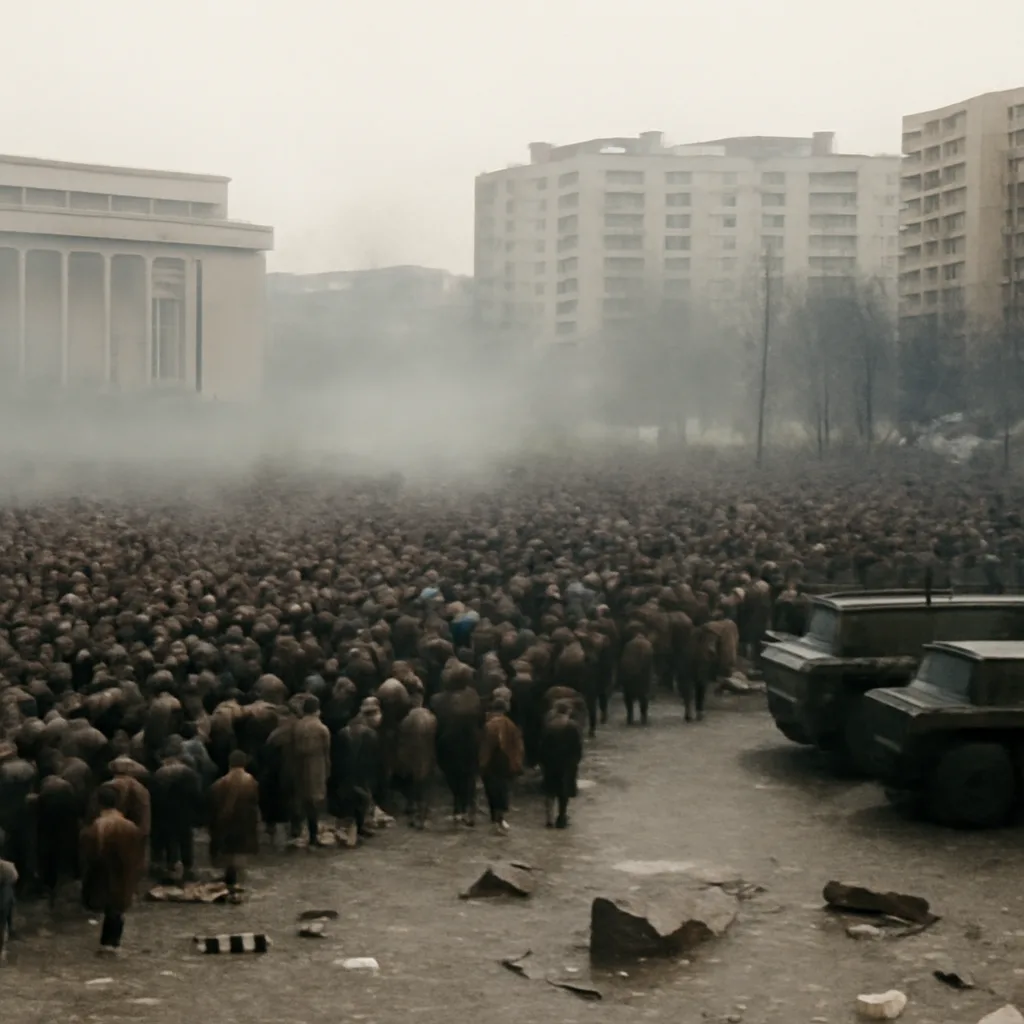
Crowds in a mid-1980s Eastern European city square with banners and flags, armored vehicles at the perimeter, and smoke or dust in the air from unrest; late afternoon light and a tense atmosphere.

Beginning 21 December 1989, mass protests in Romanian cities—most dramatically in Timișoara and Bucharest—escalated into a nationwide uprising that led to the collapse of Nicolae Ceaușescu's communist regime and his overthrow within days.


On 21 December 1989, a protest in Bucharest intended to demonstrate support for Romania's leader, Nicolae Ceaușescu, unexpectedly turned into a mass anti-government uprising that marked the climax of a week of unrest across the country. The unrest had been building since mid-December, when protests in Timișoara against the attempted eviction and arrest of a dissident pastor, László Tőkés, drew thousands into the streets. Security forces opened fire on demonstrators in Timișoara on 17–20 December, fueling outrage and prompting wider demonstrations.

The demonstration in Bucharest on 21 December began as a large, orchestrated rally organized by local authorities and the Romanian Communist Party to display popular support for Ceaușescu. Instead, the crowd turned hostile: chants and anti-regime slogans spread, and participants clashed with party-organized contingents. The rapidly deteriorating situation, combined with reports of killings and repression in other cities, transformed the protest into a full-scale rebellion.

As street fighting intensified, sections of the military and security forces either refused orders to fire on civilians or defected to the protesters. Ceaușescu and his wife, Elena, fled Bucharest by helicopter on 22 December. They were captured two days later after attempting to escape the country.

On 25 December 1989, following a swift show trial by the newly formed National Salvation Front, Nicolae and Elena Ceaușescu were executed. The executions and the events of the preceding days effectively ended four decades of communist rule in Romania. The National Salvation Front, composed of former Communist officials and dissidents, assumed control and promised political pluralism and reform. The transition was turbulent: there were further clashes, contested accounts of responsibility for violence during the revolution, and a heavy human toll. Official counts list hundreds of civilian deaths and thousands injured, though some estimates and later inquiries suggest higher numbers.

The Romanian Revolution differed from other 1989 Eastern European uprisings in its rapid escalation into violent confrontation and in the execution of the deposed leaders. It exposed deep grievances about repression, shortages, and the personality cult surrounding Ceaușescu. In the months and years that followed, Romania underwent political and economic transformations—marked by contested lustration, the slow development of democratic institutions, and a challenging economic transition away from central planning.

Historians continue to study the revolution's complex dynamics, including the roles of the Communist Party apparatus, the security services (Securitate), spontaneous civilian mobilization, and the international context of a collapsing Eastern Bloc. Certain aspects—such as the full chain of command for some shootings and the extent of organized provocations—remain subjects of debate and investigation. Nonetheless, the events of 21–25 December 1989 are widely recognized as the decisive days that ended Ceaușescu's rule and brought Romania into the post-communist era.

Share this

Email Share on X Facebook Reddit

Did this surprise you?