
← Back
07/30/2015 • 4 views

NASA Announces Evidence of Ancient Water Flow on Mars
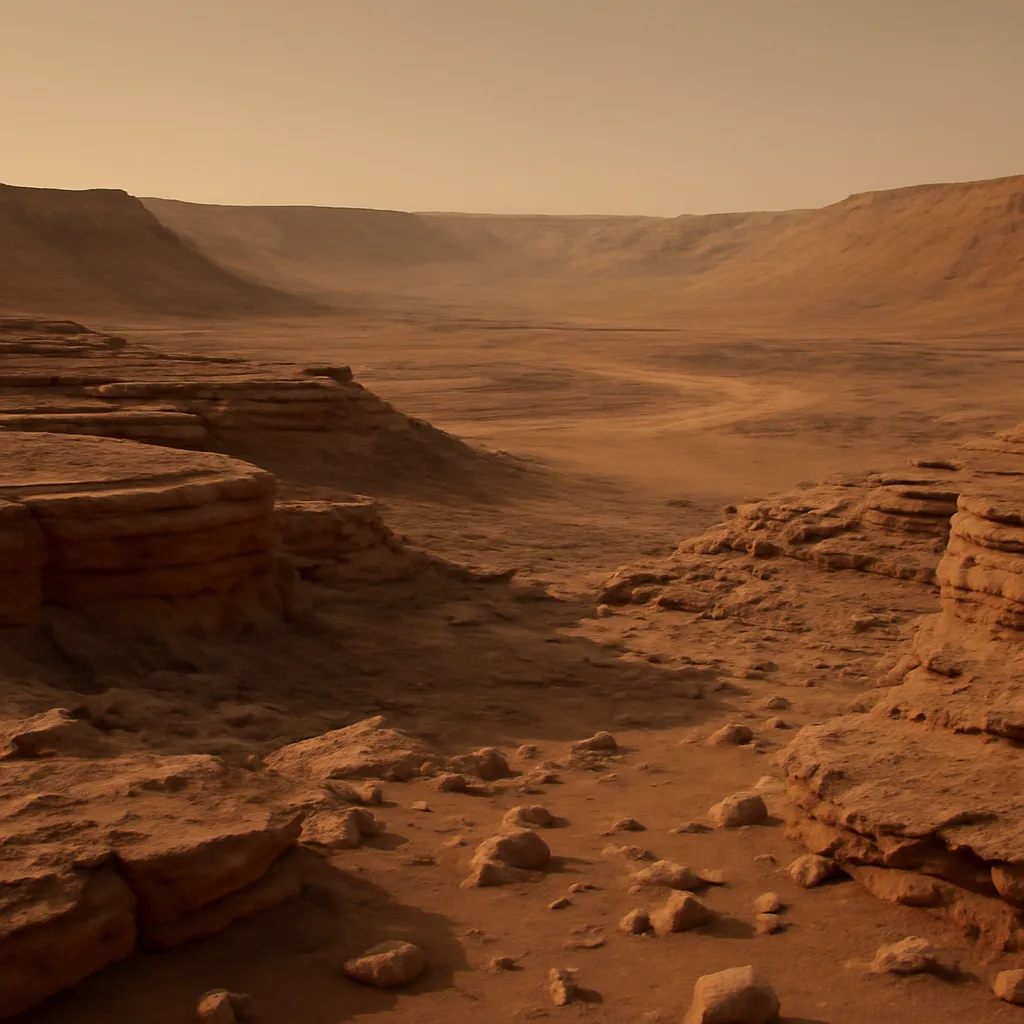
Rocky Martian landscape with layered sedimentary outcrops and a distant crater rim under a thin, dusty atmosphere, illustrating sites where ancient water-related minerals were found.

NASA reported findings indicating that Mars once hosted flowing surface water and wetter conditions in its past, based on mineral and geological evidence collected by orbiters and rovers.


On July 30, 2015, NASA announced evidence reinforcing the conclusion that Mars once experienced persistent surface water. The agency’s statement and accompanying scientific papers synthesized observations from multiple missions, notably orbital spectrometers and rover-based instruments, which together identified minerals and landforms consistent with past watery environments.

Key lines of evidence included detection of hydrated minerals—clays and sulfates—by orbiters such as the Mars Reconnaissance Orbiter (MRO). These minerals typically form in the presence of liquid water and their distribution mapped ancient terrains where water alteration likely occurred. High-resolution imagery from MRO also revealed valley networks, delta-like deposits, and layered sedimentary rocks that resemble deposits formed by flowing water and standing bodies of water on Earth.

Rover missions contributed ground-level confirmation. Curiosity, operating in Gale Crater, found sedimentary rocks and mineral assemblages indicating that conditions there once supported sustained freshwater environments. Analyses of rock chemistry and textures suggested long-lived lakes or streams that could have existed billions of years ago. Earlier rovers, including Opportunity and Spirit, had previously identified sulfates and sedimentary structures interpreted as evidence of past aqueous activity in other regions.

The 2015 announcement emphasized that Mars’ wetter past was not uniform in time or space. Geological evidence points to an early epoch—primarily the Noachian period, more than 3.5 billion years ago—when the planet’s climate was comparatively warmer and wetter, allowing more widespread surface water. Later periods saw a transition to colder, drier conditions, with water activity becoming more localized or transient.

Scientists stressed that while the findings strengthen the case for past habitable environments, they do not constitute proof of past life. Water is a critical ingredient for life as we know it, and the identification of ancient aqueous environments increases the astrobiological potential of certain Martian locales. However, detecting past life requires different types of evidence—biosignatures preserved in suitable rocks—that have not been demonstrated conclusively.

The 2015 synthesis also informed mission planning and target selection for future investigations. Regions with preserved hydrated minerals and sedimentary deposits have been prioritized for landing sites and sample collection because they offer the best prospects for preserving records of past environments. NASA and international partners continue to pursue missions to study Mars’ geology, climate history, and habitability, including sample-return campaigns and more capable rovers and landers.

Researchers acknowledged uncertainties and open questions: the precise duration and extent of wet conditions, mechanisms for transient versus sustained liquid water, and how surface water interacted with Mars’ atmosphere and subsurface. Ongoing and future observations aim to refine timelines of aqueous activity, characterize the chemistry of ancient waters, and search for any preserved organic or biosignature evidence within sedimentary contexts.

In sum, the July 30, 2015, NASA announcement consolidated growing, multi-mission evidence that Mars experienced significant water-related geological processes in its ancient past. The findings shaped scientific understanding of Martian environmental evolution and guided subsequent exploration focused on places where the rock record best preserves traces of that watery history.

Share this

Email Share on X Facebook Reddit

Did this surprise you?