
← Back
07/23/1999 • 4 views

NASA Loses Contact with Mars Climate Orbiter
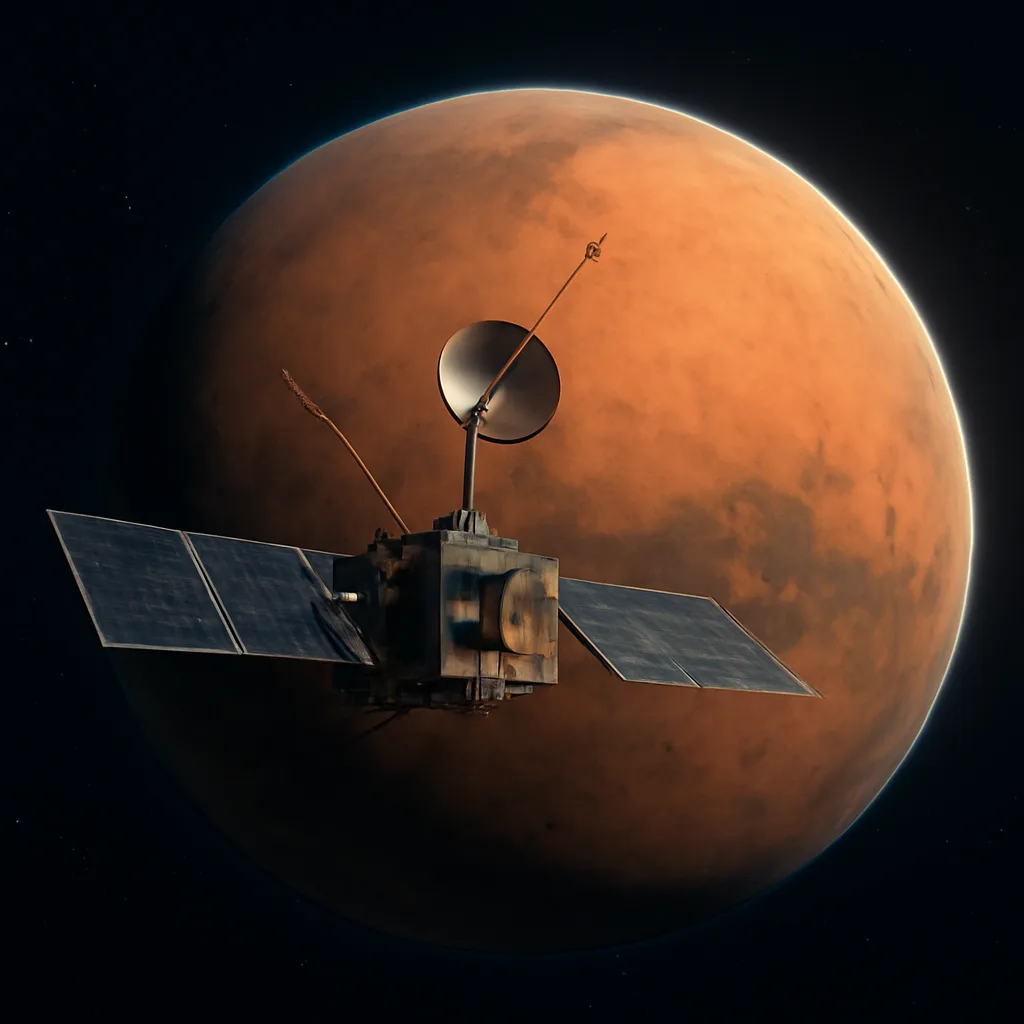
Artist-style depiction of the Mars Climate Orbiter approaching Mars against a dark background showing the red planet; no identifiable people, spacecraft labeled generically.

On July 23, 1999, NASA lost contact with the Mars Climate Orbiter during its approach to Mars, ending attempts to confirm the spacecraft’s status after an apparent navigation failure tied to a metric-imperial units mix-up.


What happened
On July 23, 1999, NASA engineers lost contact with the Mars Climate Orbiter as the spacecraft approached Mars for orbital insertion. The probe, launched in December 1998 as part of NASA’s Mars Surveyor '98 program, was intended to study Martian climate, monitor atmospheric conditions, and serve as a communications relay for landers.

Sequence and immediate response
Mars Climate Orbiter (MCO) performed a series of cruise-phase maneuvers and was scheduled to execute an orbital insertion burn on September 23, 1999 (note: mission timeline planned earlier), but loss of signal occurred during the approach phase. Ground teams initially attempted to re-establish two-way communications and to use the spacecraft’s last known telemetry to determine its orbit and status. When those efforts failed, mission controllers concluded the spacecraft was lost.

Cause and investigation
A subsequent investigation by NASA and an independent review board identified a critical mismatch in units as a primary factor: one software component produced thrust data in pound-force seconds while another expected newton-seconds. This inconsistency caused navigation calculations to be off by a scale factor, resulting in trajectory errors that placed the spacecraft on a lower-than-intended path toward Mars. Analyses concluded that the spacecraft likely entered the Martian atmosphere and either burned up or skipped out into a different trajectory that left it unrecoverable.

Impacts and lessons
The loss of MCO highlighted shortcomings in systems engineering, verification, and cross-team communication at NASA and its contractors. The review recommended organizational and technical changes, including standardized unit use, more rigorous end-to-end testing, clearer responsibility assignments between teams, and improved oversight of contractor-produced software. The failure influenced later NASA practices and contributed to strengthened engineering controls across subsequent Mars missions.

Context and legacy
MCO’s loss came amid broader 1990s-era challenges for Mars exploration; in 1999 NASA also lost the Mars Polar Lander and its Deep Space 2 probes. The MCO incident remains one of the most-cited examples of how unit-conversion errors and integration oversights can lead to mission failure. Lessons from the investigation were applied to later successful missions, such as the Mars Exploration Rovers and subsequent orbiters, improving mission assurance and cross-disciplinary verification.

Uncertainties
While the unit conversion error is widely accepted as the proximate technical cause, reconstructing the exact flight path after loss of contact involved uncertainty because of limited tracking data and the absence of returned telemetry after the critical approach phase. The final condition of the spacecraft—whether it burned up in the atmosphere or departed on an uncontrolled heliocentric orbit—cannot be known with certainty.

Sources and verification
The account above is based on NASA mission documentation and the findings of the formal investigation and review boards that examined the Mars Climate Orbiter failure. These reports detail the unit mismatch, organizational factors, and recommended reforms that followed the loss.

Share this

Email Share on X Facebook Reddit

Did this surprise you?