
← Back
08/23/1999 • 4 views

NASA loses contact with Mars Climate Orbiter after orbital insertion attempt
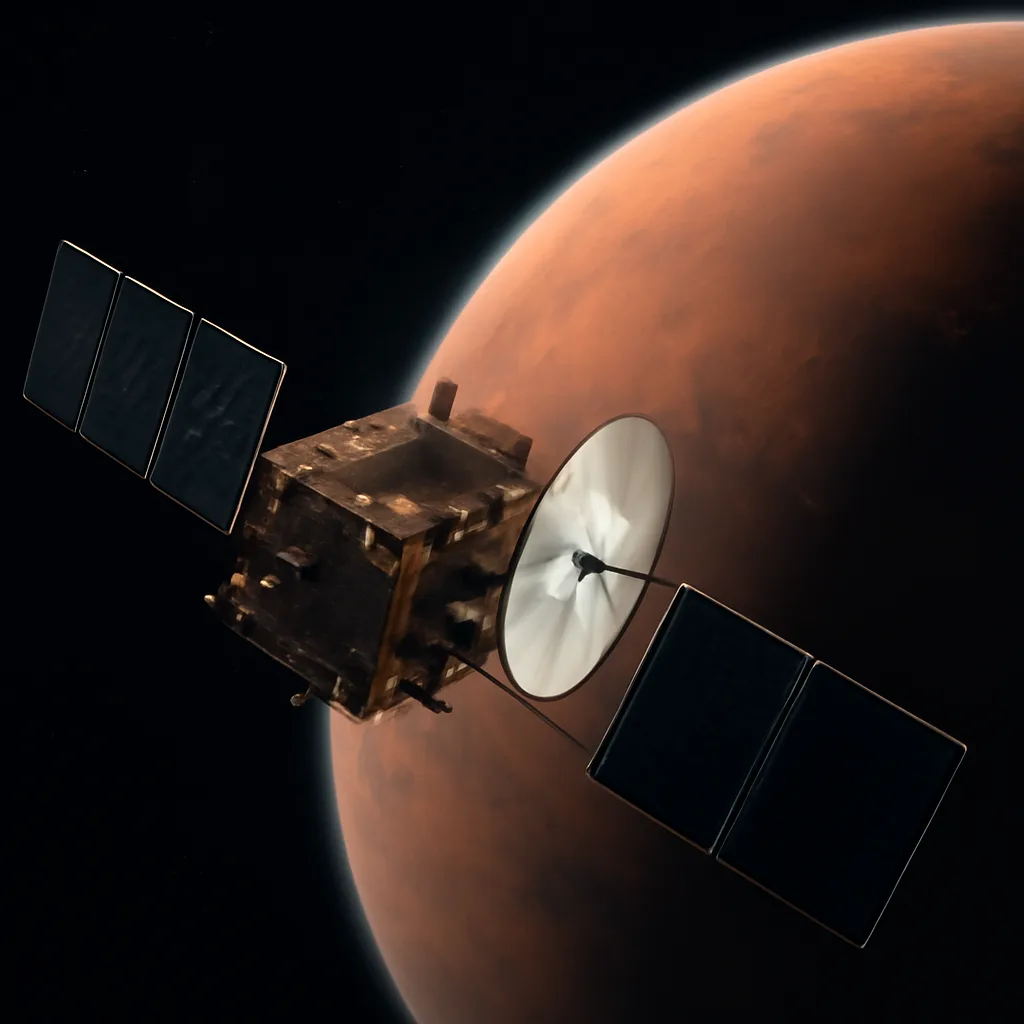
Artist concept of the Mars Climate Orbiter approaching Mars against a backdrop of space and the planet's limb, showing the spacecraft's main bus and high-gain antenna.

On August 23, 1999, NASA lost communication with the Mars Climate Orbiter during its planned transition to Mars orbit; subsequent analysis found the spacecraft was lost, later attributed to a metric-imperial units navigation error and inadequate end-to-end testing.


On August 23, 1999, NASA's Mars Climate Orbiter (MCO) ceased responding to ground commands during its planned Mars orbital insertion and was later declared lost. The spacecraft had launched on December 11, 1998, as part of NASA's Mars Surveyor '98 program, carrying instruments intended to study Martian climate, atmosphere, and to serve as a telecommunications relay for other missions.

Mission timeline and loss

MCO successfully cruised to Mars and began the sequence of maneuvers to place it into a 150-kilometer circular science orbit. During final approach in late August 1999, ground teams at Lockheed Martin and the Jet Propulsion Laboratory (JPL) prepared for orbital insertion and planned tracking passes. On August 23, as the spacecraft should have completed burn and entered orbit, it failed to respond to commands and did not appear in expected tracking data. Attempts to reestablish contact over subsequent days and weeks were unsuccessful, and NASA declared the spacecraft lost.

Investigation and findings

An interagency investigation convened by NASA and JPL examined telemetry, tracking data, mission operations procedures, and engineering practices. The investigation concluded that a failure to properly convert units between teams — a mismatch between imperial (pound-force seconds) and metric (newton-seconds) units in a piece of ground software developed by a contractor — led to incorrect calculations used in navigation. As a result, thruster firings and trajectory predictions were off, and the spacecraft likely entered the Martian atmosphere on an unintended trajectory, either burning up or skipping into space.

The report identified systemic issues beyond the unit conversion error: inadequate end-to-end system testing that would have revealed the discrepancy, shortcomings in configuration management and oversight of contractor software, and insufficient cross-checks between mission teams. The loss prompted scrutiny of how flight software, ground systems, and contractor deliverables were verified and integrated.

Consequences and legacy

The Mars Climate Orbiter failure had immediate and long-term impacts on NASA's Mars program and project management practices. Financially, the mission's loss represented a significant setback: the spacecraft itself and its instruments were destroyed or rendered unusable. Scientifically, the mission's intended atmospheric and climate measurements were never obtained, and planned relay support for future missions was affected.

Programmatically, NASA implemented reforms aimed at reducing similar risks: stricter standards for software and systems engineering, improved verification and validation procedures, enhanced contractor oversight, and clearer requirements for units and interfaces. The loss is frequently cited in engineering and project management discussions as a cautionary example of how seemingly small inconsistencies — such as unit systems — can have mission-ending consequences when not caught by comprehensive testing and verification.

Context within the Mars program

The late 1990s saw a renewal of planetary exploration efforts after earlier mission setbacks. Alongside MCO, NASA's Mars Surveyor program included other assets; another spacecraft from the same launch period, Mars Polar Lander, was also lost later in 1999. These consecutive losses prompted thorough reviews of NASA's approach to Mars missions and contributed to restructuring and more rigorous practices that benefited subsequent successful missions, including Mars Global Surveyor, Mars Odyssey, and the Mars Exploration Rovers.

Uncertainties and sources

While the investigation attributed the primary cause to a units conversion error compounded by process failures, exact details about the spacecraft's final trajectory and whether it burned up or was flung into heliocentric orbit remain based on reconstruction from available telemetry and tracking data rather than direct observation. The official investigation reports and subsequent NASA summaries provide the basis for the conclusions summarized here.

Share this

Email Share on X Facebook Reddit

Did this surprise you?