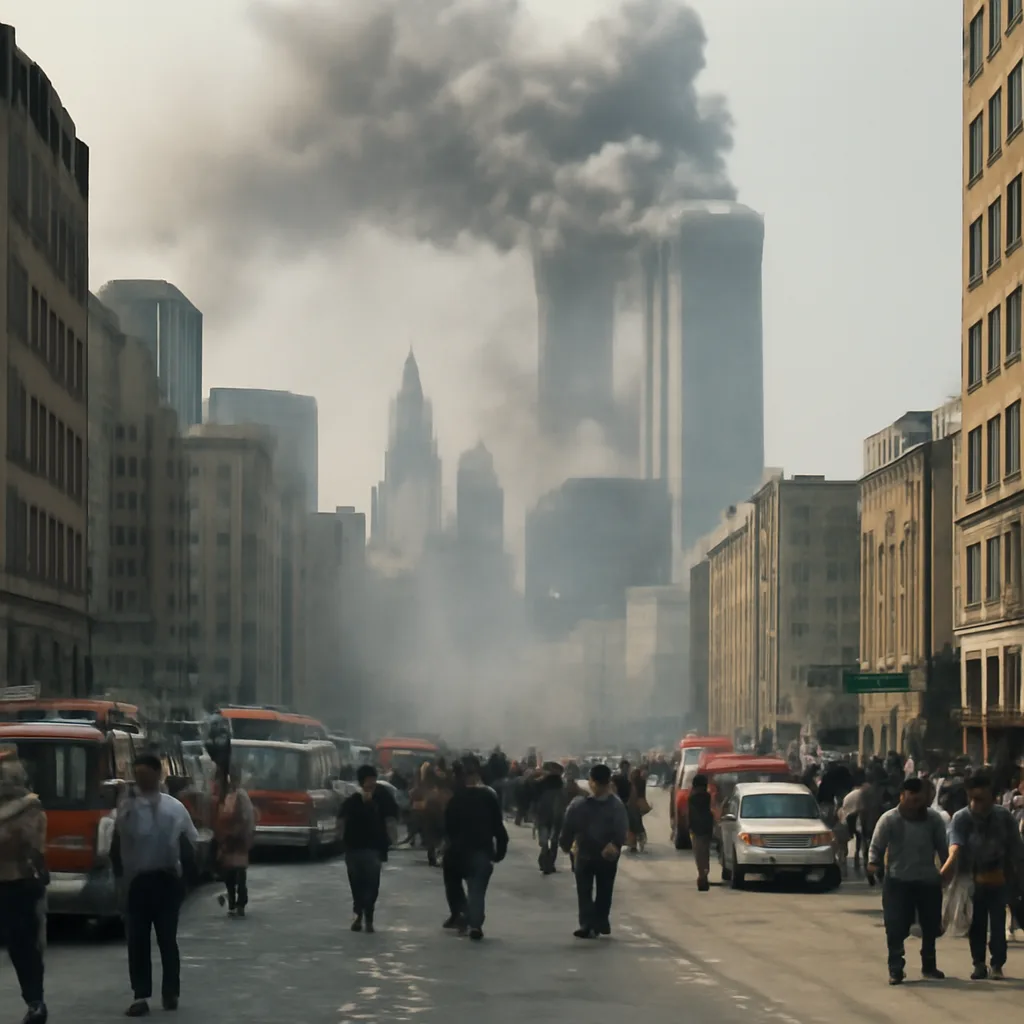
Nearly 3,000 killed as hijacked planes destroy New York’s World Trade Center
On September 11, 2001, two hijacked airliners were flown into the Twin Towers of the World Trade Center in Lower Manhattan; attacks that day, including a third plane strike and a fourth crash, killed nearly 3,000 people and reshaped U.S. security and foreign policy.
On the morning of September 11, 2001, coordinated terrorist attacks struck the United States, culminating in the destruction of the World Trade Center’s Twin Towers in Lower Manhattan. At 8:46 a.m., American Airlines Flight 11, hijacked after takeoff from Boston, was flown into the North Tower (1 WTC). At 9:03 a.m., United Airlines Flight 175 struck the South Tower (2 WTC). The impacts, fires and eventual collapses of both towers caused massive loss of life, widespread destruction in the surrounding neighborhood, and catastrophic damage to Lower Manhattan’s infrastructure.
Those attacks were part of a larger operation that morning: at 9:37 a.m. American Airlines Flight 77 struck the Pentagon in Arlington, Virginia, and at 10:03 a.m. United Airlines Flight 93 crashed in a field near Shanksville, Pennsylvania, after passengers attempted to retake control. In New York, emergency responders, building occupants and bystanders faced chaotic scenes of burning, falling debris and evacuation. The collapse of the South Tower at 9:59 a.m., followed by the North Tower at 10:28 a.m., generated enormous dust clouds that blanketed surrounding streets and other lower Manhattan buildings, including 7 World Trade Center, which later also collapsed.
Official counts and investigations put the total deaths from the four hijacked flights and related attacks at nearly 3,000 people, including civilians in the buildings and on the planes, first responders, and workers in and around the World Trade Center site. Thousands more were injured, and many survivors and rescue personnel later reported long-term health problems attributed to dust, smoke and demolition-related contaminants released at the site.
The attacks were carried out by 19 hijackers associated with the al-Qaida network, which U.S. investigators and intelligence agencies identified as responsible for planning and executing the operation. In the immediate aftermath, the U.S. government launched wide-ranging responses: rescue and recovery operations at Ground Zero continued for months; air travel was grounded nationwide temporarily; and the attacks led to significant changes in U.S. domestic and foreign policy, including the passage of the USA PATRIOT Act and the initiation of the U.S.-led wars in Afghanistan and later Iraq, as part of a global “war on terror.”
The World Trade Center site became a prolonged recovery and cleanup area, later the focus of debates over rebuilding, memorialization and compensation. A permanent memorial and museum opened at the site to honor the victims and document the events and aftermath. Federal programs, including the September 11th Victim Compensation Fund, provided financial assistance to victims’ families and to individuals who suffered health consequences traced to the attacks and cleanup.
The attacks on September 11, 2001, had immediate and enduring consequences: they prompted enhanced aviation and homeland-security measures worldwide, reshaped U.S. foreign policy priorities, and left lasting social and cultural impacts in the United States and beyond. The day remains one of the deadliest terrorist incidents in history and is commemorated annually to remember the victims and first responders who died or were harmed that day and in its aftermath.