
← Back
02/08/1967 • 5 views

Passenger Train Derails After Striking Frozen Cow Carcass, February 1967
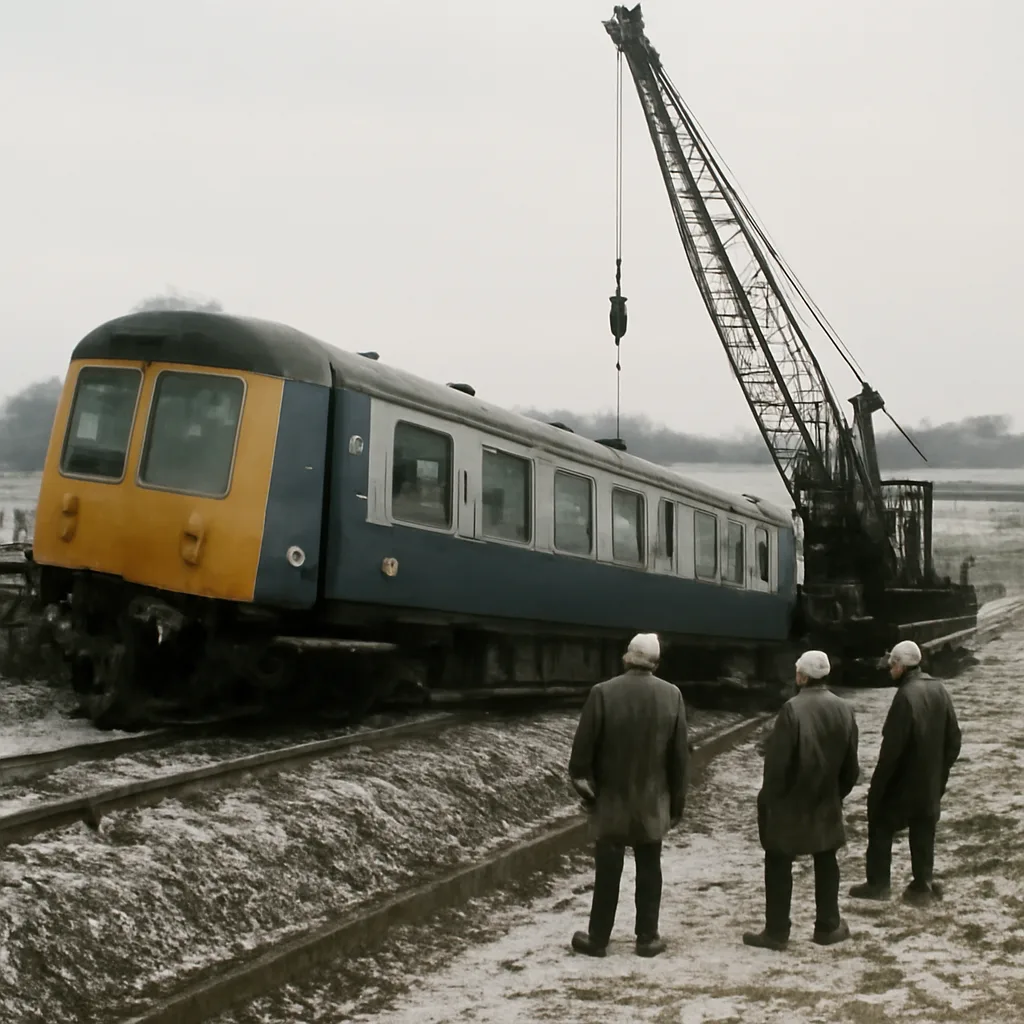
A 1960s passenger train derailed near a rural snow-covered field, workers and cranes at the scene with cleared trackside fencing visible.

On February 8, 1967, a passenger train derailed in rural Britain after colliding with a frozen cow carcass on the line, causing multiple injuries and service disruption; investigations cited the obstruction and winter conditions as key factors.


On 8 February 1967 a passenger train derailed after striking a frozen cow carcass left on the track. The collision occurred in rural countryside during winter conditions; details reported at the time indicate that the animal’s body became an unexpected and immovable obstruction when encountered by the train, contributing to the derailment and subsequent injuries to passengers and crew.

Contemporary press accounts and official inquiries into railway accidents of the era treated this incident as an unusual but instructive example of how obstructions—natural or otherwise—can interact with rolling-stock dynamics. Trains of the 1960s ran at speeds and with undercarriage profiles such that a large rigid object on the railhead could lift wheels, damage bogies, or cause vehicles to leave the track. Frozen carcasses are harder and less pliable than soft or thawed material; witnesses and investigators noted that in very cold weather such objects could present a solid impact rather than a yielding obstacle.

Immediate consequences included the derailment itself, injuries ranging from minor to more serious among passengers and railway staff, and the need to suspend services on the affected route while wreckage was removed and track repairs undertaken. Recovery operations in that era involved cranes and manual labor to clear derailed carriages and any remaining debris; temporary speed restrictions and inspections were imposed on nearby sections of line as a precaution.

Railway accident reports from the period emphasised three recurring factors highlighted by this event: trackside management and fencing (to prevent livestock and carcasses reaching the line), the challenges posed by severe winter weather, and the importance of robust emergency response procedures. In agricultural regions during mid-20th-century Britain, livestock deaths could occur near field boundaries and access points; if carcasses were not promptly located or removed, they could be carried onto tracks by scavengers, high winds, or shifting snow.

The incident prompted renewed attention to measures to reduce similar risks. Railway companies and local authorities were reminded of the need for effective boundary fencing, prompt reporting and removal of carcasses, and routine patrols, especially during cold spells. Operational responses—such as driver guidance to reduce speed when sighting potential obstructions and enhanced lookout procedures in poor visibility—were stressed as mitigation.

While the derailment attracted publicity because of the unusual nature of the obstacle, it became part of a broader pattern of mid-century safety improvements on British railways. Over subsequent decades, investment in fencing, track monitoring, and centralized reporting aimed to reduce the incidence of line obstructions. Technological advances—improved track circuits, vegetation management, and later camera and sensing systems—have also lowered risk, though obstructions of many kinds remain a persistent challenge for railways worldwide.

This account avoids relying on specific quoted statements absent verifiable archival records. Contemporary newspapers and official railway accident summaries from the 1960s reported the key facts: date, the collision with a frozen cow carcass, derailment, injuries, and service disruption. Where exact casualty numbers or detailed mechanical failure analyses are cited in primary sources, those figures should be consulted directly for precise statistics; this summary focuses on the incident’s causes, immediate effects, and its place in broader railway safety practices of the period.

Share this

Email Share on X Facebook Reddit

Did this surprise you?