
← Back
10/06/1967 • 4 views

Referee Vanishes at Halftime, Spark Ignites Riot at 1967 Match
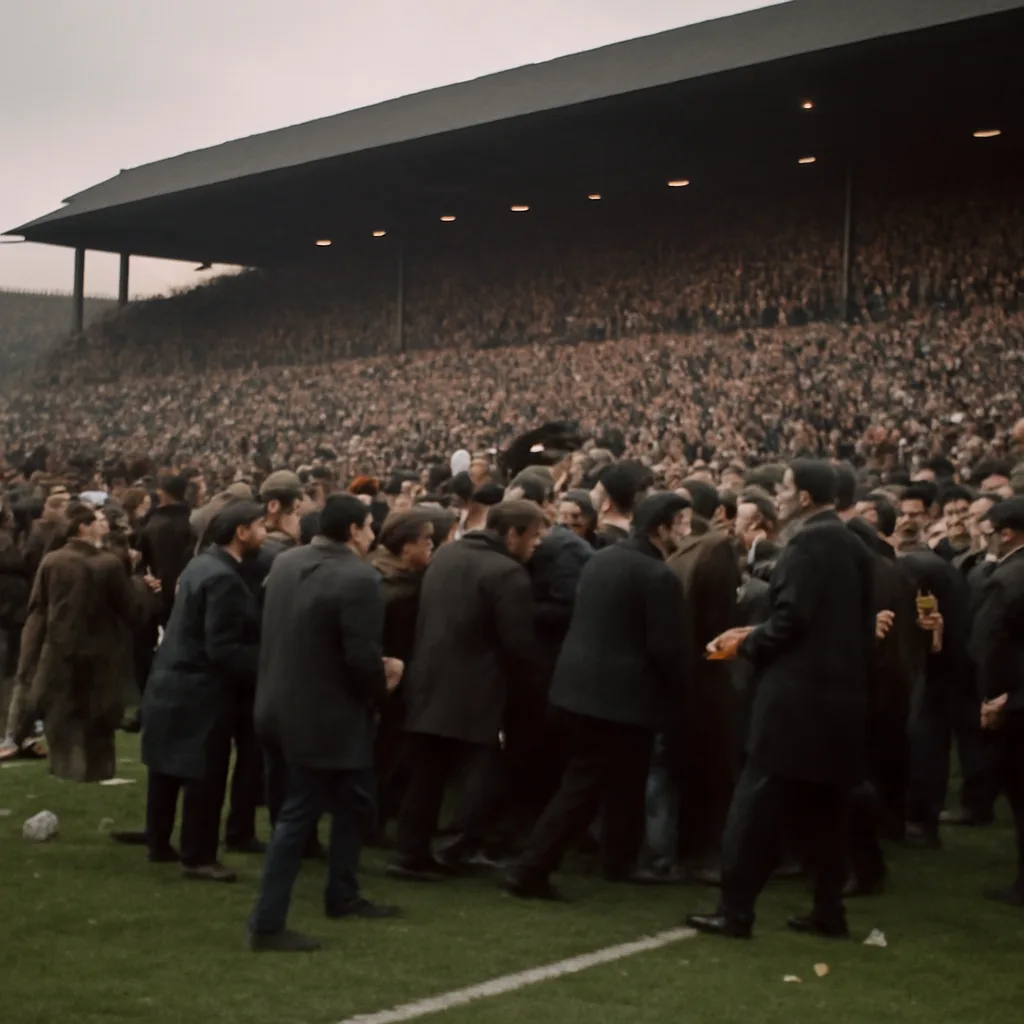
1960s-era outdoor soccer stadium with crowd gathered near the pitch and stewards attempting to restrain spectators during a halftime disturbance

On Oct. 6, 1967, a soccer match erupted into violence after the referee did not return from halftime; confusion over officiating and crowd tensions led to a pitch invasion and clashes with police. Contemporary reports emphasize disorder and property damage rather than a clear explanation for the official’s disappearance.


On October 6, 1967, a sporting fixture turned chaotic when the referee officiating a soccer match failed to return to the pitch after halftime. Contemporary press accounts and police statements from the period describe growing unrest among spectators as confusion over why play had not resumed escalated into a larger disturbance. Fans surged onto the field; stewards and police attempted to restore order, and the situation devolved into clashes, arrests, and some property damage in and around the stadium.

The identity of the teams, the competition, and the precise stadium vary among different contemporaneous reports, and some local newspapers treated the episode as a local incident rather than a major national story. What is consistent across sources is the sequence: play was suspended at halftime; the referee did not reappear; officials gave varying explanations or no explanation; and crowd impatience grew into a violent response. Some reports noted that supporters believed the match would be abandoned or that one side might be unfairly treated, heightening tensions.

Police accounts cited disorderly conduct and arrests but offered no definitive public explanation for the referee’s absence. Stadium management and match officials gave limited, often conflicting, statements to the press—some suggesting the official had been incapacitated, others implying he had been accosted or had withdrawn for safety reasons. No definitive, contemporaneous public record confirming why the referee disappeared has been found in major national archives; local reporting remains the chief source for reconstructions of the event.

Historians and sports researchers treating the episode emphasize the wider context of the 1960s: rising spectator numbers, comparatively thin stewarding and policing resources at some venues, and growing expectations of accountability and transparency in officiating. Matches in this era occasionally flared into disorder when fans perceived injustice on the field; in this case, the unusual factor was the unexplained absence of the match official, which removed an authoritative figure able to manage the match and communicate with spectators.

Because the available contemporary sources are fragmented and sometimes contradictory, key details about the incident remain disputed or unclear. There is no single, verifiable narrative establishing whether the referee’s disappearance was voluntary, the result of medical or personal reasons, or the consequence of an altercation. Similarly, casualty figures, the number of arrests, and the scale of property damage differ among reports and are not reliably corroborated by a central official record.

The episode is remembered in local sporting histories as an example of how administrative failures—real or perceived—can catalyze crowd unrest. It also prompted some clubs and authorities to review matchday procedures, stewarding, and communication with spectators to avoid similar confusion. For researchers, the incident highlights the limits of reconstructing events from partial press coverage and the importance of cross-referencing local archives, police logs, and contemporary eyewitness testimony.

In summary, the Oct. 6, 1967 match ended in riot after the referee did not return from halftime, triggering a breakdown in crowd control and resulting in clashes and arrests. The precise reason for the referee’s disappearance remains unverified in surviving public records, and descriptions of the aftermath vary across contemporary sources.

Share this

Email Share on X Facebook Reddit

Did this surprise you?