
10/08/1871 • 7 views
Revising the Toll: How Estimates of the Great Chicago Fire’s Dead Grew Decades Later
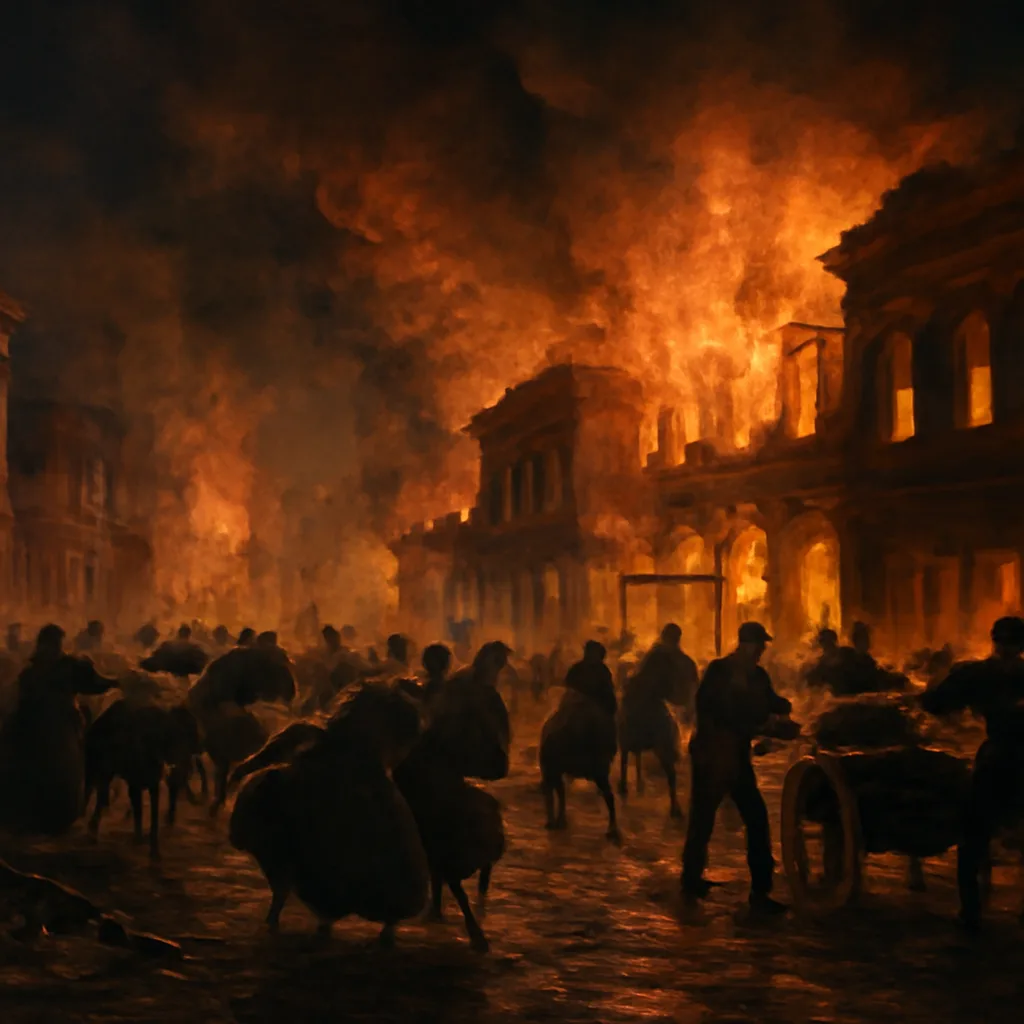
Decades after the Great Chicago Fire of October 1871, historians and officials revised fatality estimates upward as new records, survivor accounts and methodological changes emerged — a gradual reassessment that underscores how chaotic disasters can obscure human cost.
Immediate aftermath and early counts
In the fire’s immediate aftermath, communication and record-keeping were severely disrupted. Many bodies were buried quickly, some without formal documentation, and displaced people often relocated to other communities. Early newspaper reports and city statements offered widely varying figures. The chaotic conditions, the presence of transient populations, and limited formal records meant that early counts likely underreported the actual number of deaths.
Sources that appeared in the weeks and months after the fire focused on visible devastation — burned neighborhoods, homeless families, and damaged infrastructure — rather than definitive demographic accounting. The most commonly cited 19th-century estimates tended to cluster in the low hundreds, but those figures were provisional.
Why estimates rose later
Several factors contributed to revisions in the death toll over ensuing decades:
- Newly discovered records: As municipal archives, church registers, hospital logs and cemetery records were organized and researched, historians could identify deaths that had not been linked to the fire in contemporary press accounts. Some victims whose bodies were buried in mass or unmarked graves were later identified in municipal records or family histories.
- Expanded definitions: Later researchers sometimes used broader criteria for attributing deaths to the fire, including people who died of exposure, disease or injury in the weeks and months after the blaze — fatalities not counted in immediate tallies that focused on on-scene deaths.
- Scholarly methods: By the late 19th and early 20th centuries, historical scholarship increasingly emphasized systematic archival work and demographic methods. Researchers reexamined census data, city records and personal papers to produce more comprehensive casualty estimates.
- Public memory and journalism: Anniversary coverage and civic histories prompted new investigations. Reporters and local historians revisiting the disaster sometimes uncovered overlooked sources or raised questions about earlier official counts.
Examples of reassessment
While there is no single unified later figure universally accepted as definitive, several later studies and commemorations produced higher estimates than those circulating immediately after the fire. Histories published in the decades after 1871 and municipal retrospectives for major anniversaries typically present casualty ranges rather than a precise number, reflecting remaining uncertainties about missing persons and the fate of transient residents.
Limits and continuing uncertainty
Despite revisions, complete certainty about the exact number of people who died as a direct or indirect consequence of the Great Chicago Fire remains elusive. Record loss, the mobility of 19th-century urban populations, and differing criteria for what counts as a fire-related death all complicate efforts to produce a single definitive figure. Modern historians therefore commonly present a range and emphasize the methodological reasons for variation rather than asserting an exact count.
Historical significance
The gradual upward revision of the fire’s death toll is significant not primarily because of a single corrected number but because it illustrates how disaster histories are reconstructed over time. Archival discoveries, changing standards for accounting, and renewed scholarly attention can alter our understanding of human cost. In the case of the Great Chicago Fire, those revisions have contributed to a fuller, if still imperfect, picture of the tragedy and its impact on the city’s residents.
For readers interested in deeper study, primary sources (contemporary newspapers, municipal records, church and cemetery registers) and later scholarly analyses offer the best path to assess how and why estimates changed. Where precise counts are impossible, historians aim to explain the uncertainties and the reasons estimates shifted rather than to present a misleading single figure.