
← Back
02/15/1994 • 5 views

Roswell debris explanation revised again after new analysis
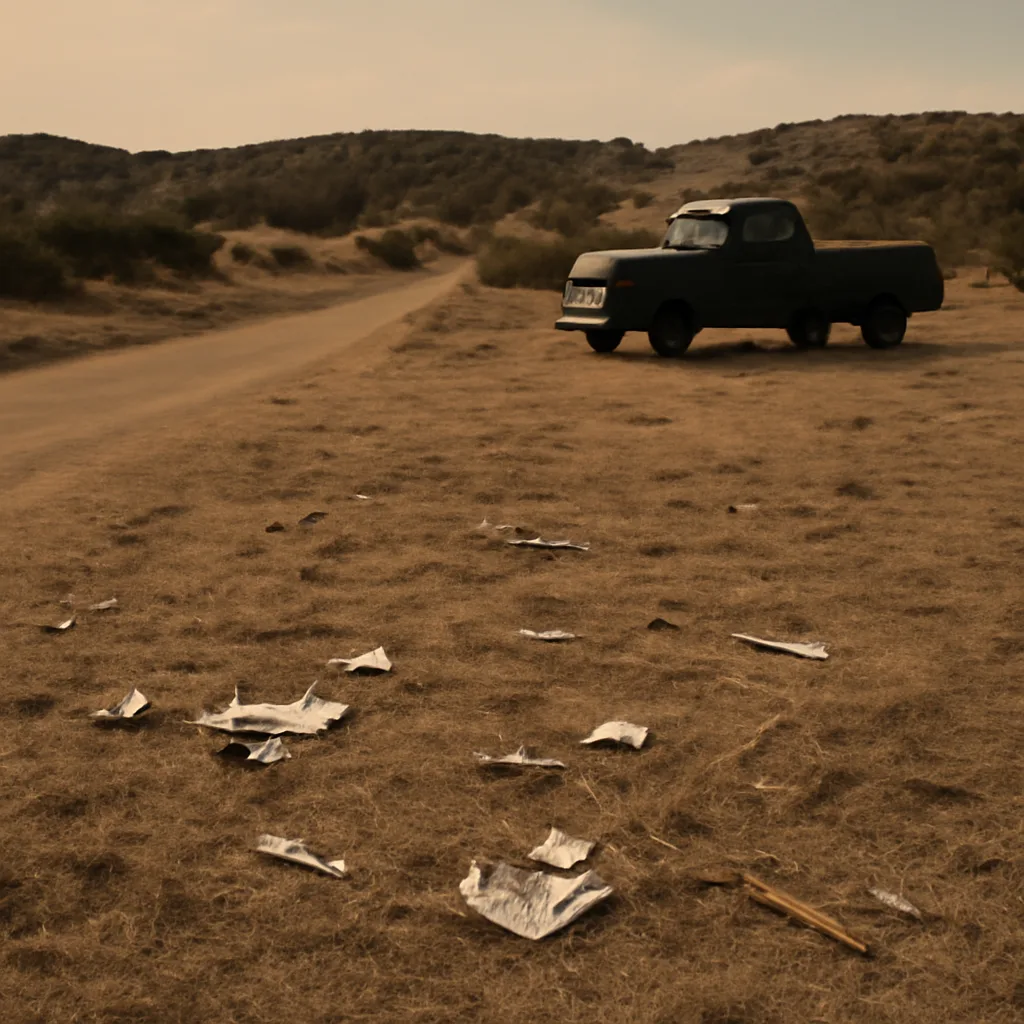
Scattered metallic and paper-like fragments on dry grass beside a dirt road near Roswell, New Mexico, with low scrub and distant hills under a clear sky.

Officials and researchers have revised their explanation of the 1947 Roswell debris multiple times; a recent report reinterprets physical fragments and eyewitness testimony, prompting renewed debate over whether the material was military balloon hardware, experimental craft components, or something else.


Background
In early July 1947, rancher Mac Brazel found unusual debris on his property near Roswell, New Mexico. The U.S. Army issued an initial press release saying a “flying disc” had been recovered; that statement was soon retracted and replaced with an explanation that the wreckage was from a weather balloon. For decades the event was largely dormant in mainstream discussion until the late 1970s and 1980s, when new interviews and claims led to renewed interest and conspiracy theories.
Official explanations and changes
The U.S. Air Force published two investigative reports in 1994 and 1997. The 1994 report concluded the 1947 material likely came from a conventional balloon—specifically a Project Mogul high-altitude acoustic surveillance balloon—whose specialized components were unfamiliar to the public and some military personnel at the time. The 1997 follow-up addressed claims of recovered “alien bodies,” attributing them to misidentified medical or anthropomorphic dummies used in military tests.
Recent revision
A more recent reassessment of surviving fragments, archival documents, and witness interviews—conducted by independent researchers and reviewed in public forums—led to another reinterpretation of the physical evidence. Analysts note that some fragments previously described as paper and metallic tape are consistent with materials used in late-1940s balloon trains, but other fragments show laminated foils and balsa-like wood elements whose configuration does not match standard Mogul assemblies. The reassessment does not claim extraterrestrial origin; rather, it concludes that multiple types of debris and equipment may have been present at or near the crash site, and that initial Army statements collapsed these into a single explanation (a conventional balloon) that did not account for the diversity of recovered materials.
Why the explanation changed
Several factors account for the changing explanations: limited documentation from 1947, the rapid military response and information control during early Cold War operations, deterioration or loss of physical evidence, and varying reliability of decades-later eyewitness testimony. Project Mogul balloon components were deliberately obscure and included unconventional materials (metallized polyethylene films, balsa wood, and sound-recording gear) that could appear unusual to uninformed observers. At the same time, postwar testing with anthropomorphic dummies and other experimental hardware in the region created additional sources of debris that can complicate reconstruction of a single definitive chain of custody.
What remains unresolved
No peer-reviewed study has demonstrated that the Roswell debris was nonterrestrial. The recent revision does not assert alien technology; it narrows the range of plausible terrestrial explanations by acknowledging that more than one type of object was likely involved. Important uncertainties remain: exact provenance for many fragments, a complete inventory of what was collected in 1947, and conclusive linkage between specific items described by witnesses and surviving artifacts. Some eyewitness accounts contradict one another on key points such as the appearance and behavior of recovered materials.
Implications
The evolving explanations illustrate how incomplete records, classified projects, and the passage of time complicate historical reconstruction. For historians and investigators, the Roswell case underscores the need to distinguish between what can be directly evidenced—preserved fragments, contemporaneous documents, and verifiable chain-of-custody—and what rests on memory or interpretation years later. The recent reassessment invites further archival searches, forensic testing of any extant fragments, and critical reexamination of original military records.
Conclusion
The explanation for the Roswell debris has been revised multiple times as new information and reinterpretations have emerged. The latest change stops short of endorsing extraordinary claims and instead emphasizes that multiple types of mid-20th-century military and experimental hardware may account for the diversity of materials reported in 1947. Key questions about provenance and a definitive single explanation remain open pending additional evidence.

Share this

Email Share on X Facebook Reddit

Did this surprise you?