
06/17/1956 • 5 views
The 1956 Dartmouth Workshop: First Public Demonstration of AI Concepts
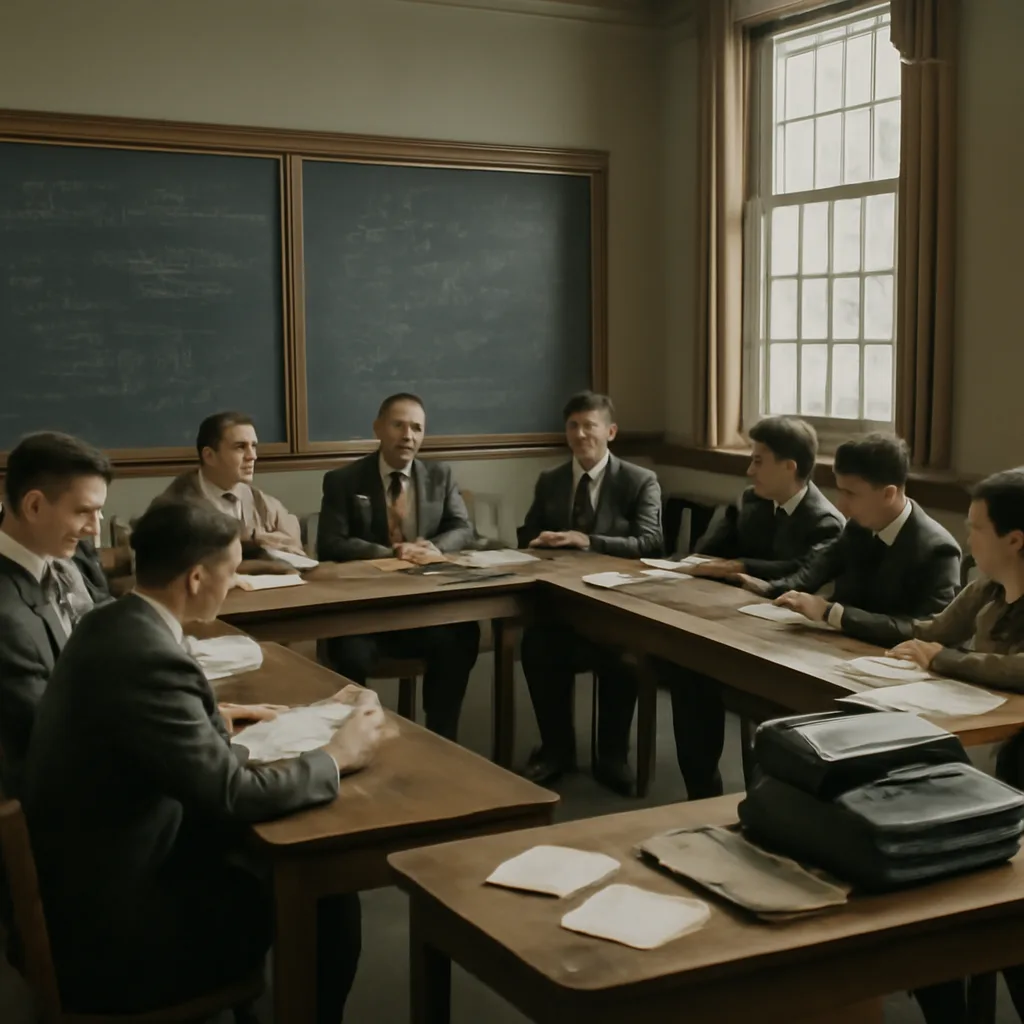
On June 17, 1956, the Dartmouth Summer Research Project on Artificial Intelligence convened, marking the first organized public presentation and discussion of ideas that would define AI research—symbolically launching the field though many concepts were already circulating.
Context and participants
By the mid-1950s, several strands of work—mathematical logic, cybernetics, early computing, and automated problem solving—had been developing in parallel. The organizers invited researchers from computer science, mathematics, psychology, and engineering to consider whether “every aspect of learning or any other feature of intelligence can in principle be so precisely described that a machine can be made to simulate it,” a phrasing used in the workshop’s proposal. Attendees and visitors included figures such as John McCarthy and Marvin Minsky, who were central to later AI research; Allen Newell and Herbert A. Simon, whose earlier work on the Logic Theorist and General Problem Solver was highly relevant; and others from related disciplines. (Exact lists of attendees vary in contemporary accounts; not every invited participant attended the entire summer.)
What happened at Dartmouth
The Dartmouth workshop was not a single public performance but a focused research meeting where participants presented ideas, demonstrations, and plans for future work. Early programs and reports show sessions on symbolic representation, search techniques, learning, and neural-net–like models (then often discussed in terms of “perceptrons” or connectionist ideas). Demonstrations and discussions drew on recent experiments: Newell and Simon’s programs that proved theorems and solved problems on computers, Shannon’s work on information and chess, and McCarthy’s proposals for symbolic computing languages and reasoning systems.
Significance and limitations
Historians and participants treat Dartmouth as a founding moment because it gave the field a name and a community framework. It helped set research agendas—symbolic reasoning, knowledge representation, and machine learning—whose influence persisted for decades. However, Dartmouth did not create AI from scratch. Important antecedent work predated the workshop: Turing’s 1950 paper “Computing Machinery and Intelligence,” cybernetics research in the 1940s, and concrete programs by Newell, Simon, and others in the early 1950s. Moreover, the workshop’s optimistic view of quick progress was tempered over time by technical challenges, funding cycles, and shifting priorities.
Legacy
The Dartmouth meeting’s primary legacy is symbolic and organizational: it articulated a research program, popularized the term “artificial intelligence,” and helped catalyze institutional and funding support. Many foundational ideas discussed there—heuristic search, formal reasoning, and early learning models—continued to evolve. The event is therefore remembered not as a single demonstration of a finished technology but as the first public, organized presentation and debate that framed AI as a distinct scientific endeavor.
Uncertainties and historiography
Contemporary accounts and later histories differ on who exactly attended, which demonstrations took place on which dates, and how directly Dartmouth caused subsequent developments. Scholars caution against mythologizing the workshop as the moment AI was “invented”; instead, they place it within a broader constellation of prior research and parallel efforts. Nonetheless, June 1956 remains a convenient and widely accepted marker for the formal start of AI as a named research field.