
06/17/1896 • 4 views
Europe’s First Recorded Automobile Fatality, June 17, 1896
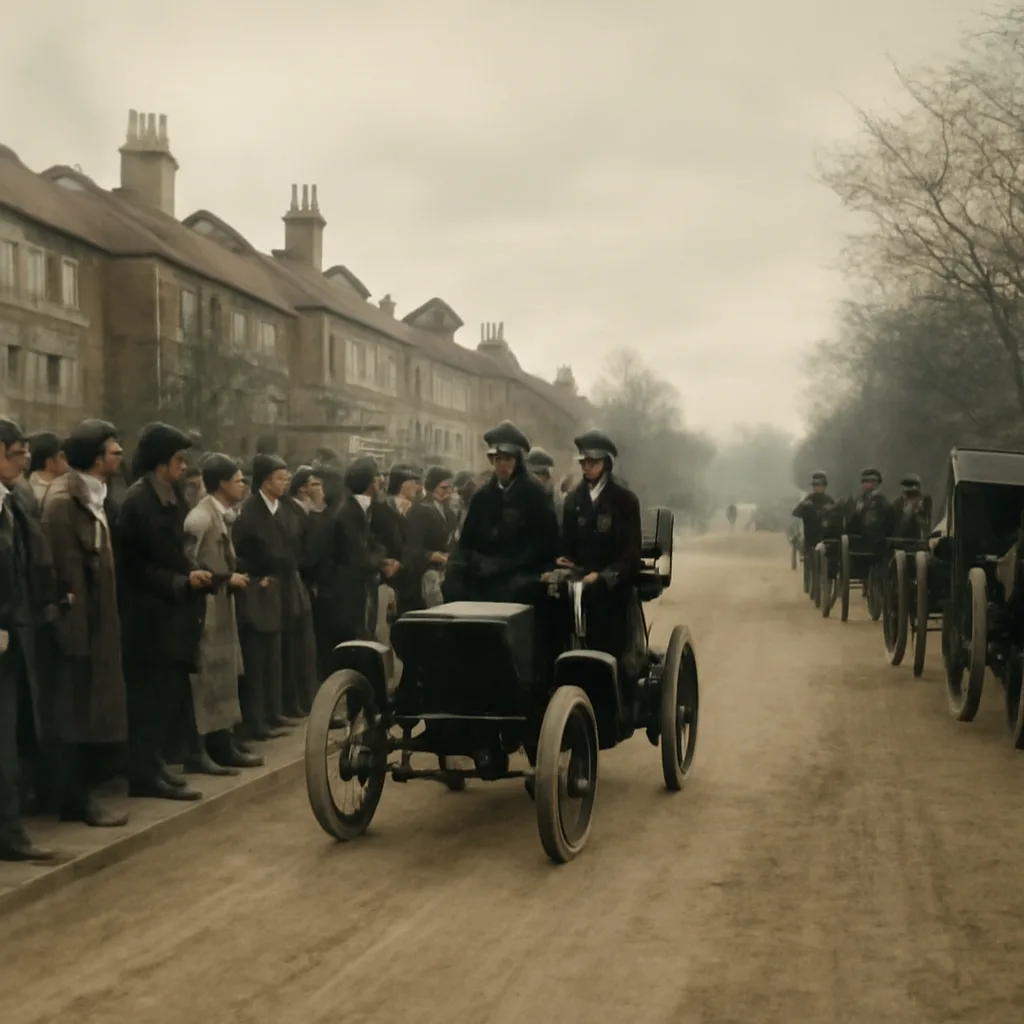
On 17 June 1896 a tragic collision in England produced the first widely reported automobile fatality in Europe, highlighting early tensions over motor vehicles, road safety, and regulation during the transition from horse-drawn transport to motorized traffic.
Imperial Motor Club’s demonstration on a public roadway.
Context and background
In the 1890s Europe was undergoing rapid experimentation with self-propelled vehicles. Early petrol and steam carriages were rare on public streets and often demonstrated at organised runs and exhibitions. Britain’s restrictive speed limits and licensing rules—most notably the Locomotives on Highways Act 1896, which increased the speed limit to 14 mph (after earlier restrictive legislation such as the 1865 Red Flag Act)—existed alongside public anxiety about unfamiliar, noisy machines. Demonstrations and trials drew curious crowds and, in some cases, insufficient crowd control.
The incident
Contemporary press reports describe a motor car taking part in a demonstration being driven along a public road when it struck a woman who was watching the event. The victim died soon after the collision. Newspapers of the time carried headline accounts that framed the tragedy as a dramatic illustration of the potential danger of motor vehicles to pedestrians. Coroner’s inquests and police investigations followed; contemporary records indicate the incident was treated as accidental, and it became an occasion for debate about safe operation, licensing, and regulations.
Significance and aftermath
The Croydon fatality attracted wide public and media attention beyond the locality because it involved a new technology and raised questions about legal responsibility, driver competence, and public safety. It contributed to calls for clearer rules governing motor vehicles, improved crowd management at demonstrations, and greater public education about motor traffic. The event also fed into moral panics about speed and modernity that lawmakers and civic authorities sought to address through regulation and enforcement.
Historiography and uncertainties
While this June 1896 death is commonly cited in secondary sources as Europe’s first recorded automobile fatality, historians note some caveats. Record-keeping at the time was uneven; different jurisdictions used varied definitions of "automobile" versus other self-propelled conveyances (steam, electric, or experimental vehicles). Earlier incidents involving steam-powered road vehicles, industrial traction engines, or experimental machines may have caused fatal injuries but were not always recorded in the same way or publicised as an "automobile" accident. Names, details, and reporting vary across contemporary newspapers, and later retellings sometimes simplify or conflate facts.
Legacy
The Croydon incident remains a touchstone in histories of road safety and motor transport, illustrating how early fatalities influenced public perception and policy. It is cited in studies of the social history of technology as an early moment when the limits of regulation, infrastructure, and social adaptation to automotive transport became manifest. Over the following decades, as automobiles proliferated, legislatures and municipal authorities gradually developed more comprehensive traffic laws, licensing systems, and safety measures—changes to which this early fatality contributed indirectly by highlighting the human costs of unregulated motor travel.