← Back
12/28 • 11 views

The Childermas rituals

The Childermas rituals

The Childermas rituals (celebrated on December 28th) are a fascinating look at how medieval Europe balanced deep religious mourning with "topsy-turvy" carnival energy.


The Childermas rituals (celebrated on December 28th) are a fascinating look at how medieval Europe balanced deep religious mourning with "topsy-turvy" carnival energy.

The day is formally known as the Feast of the Holy Innocents, commemorating the biblical story of King Herod ordering the execution of all male infants in Bethlehem. Because of this dark origin, the day developed a reputation for being cursed, leading to some of the strangest customs in history.

1. The "Whipping" Rituals

The most notorious Childermas tradition involved waking children up on the morning of December 28th with a ritual beating.

The Logic: It wasn't intended to be a punishment for bad behavior. Instead, it was a "mnemonic" device. Medieval parents believed that the physical pain would "beat the memory" of the Holy Innocents' suffering into the child’s mind so they would never forget the sacrifice.

The Variation: In some regions, like Central Europe, this evolved into a "spanking day" where children would actually go house-to-house with evergreen branches, gently striking adults while reciting verses to bring good luck and fertility.

2. The Boy Bishop (The World Turned Upside-Down)

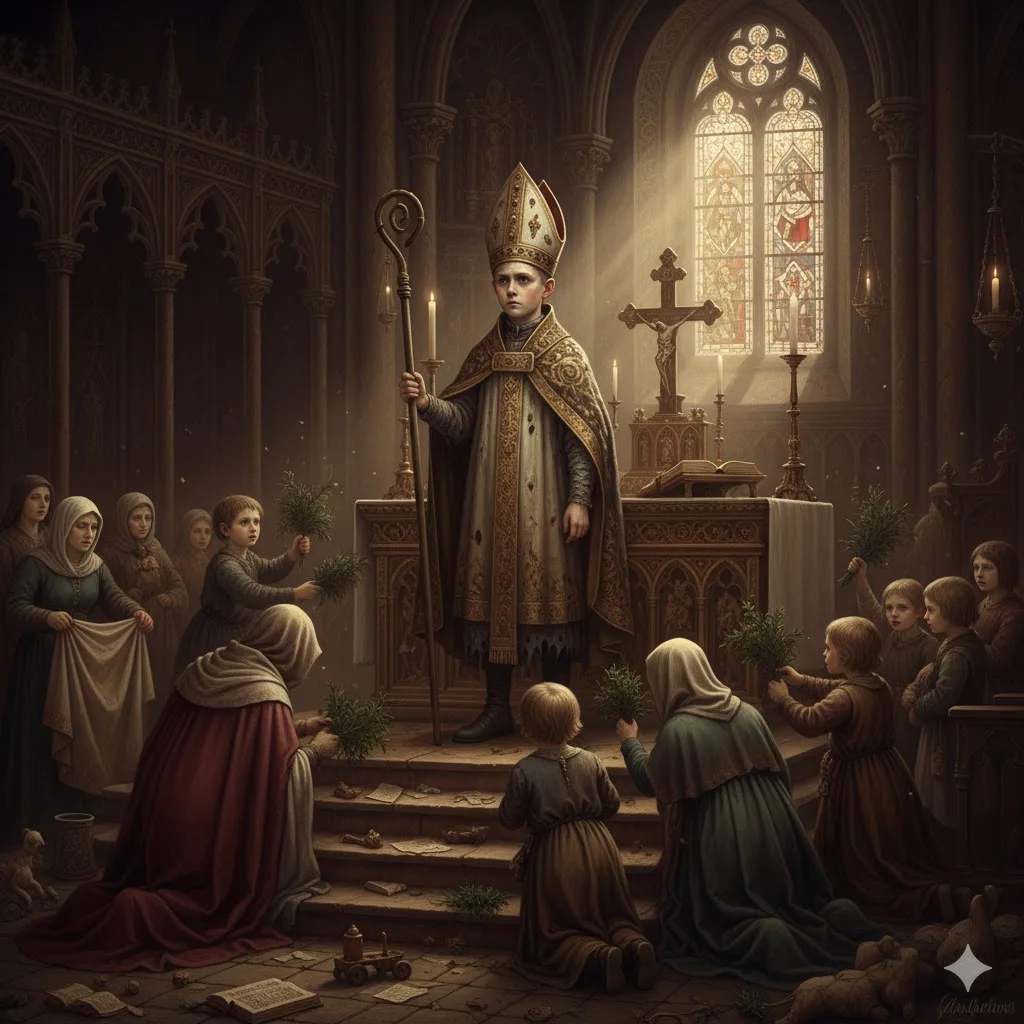
Paradoxically, while some children were being swatted, others were being given total power. From the Feast of St. Nicholas (Dec 6) until Childermas, many towns elected a Boy Bishop.

Total Authority: A choirboy would be dressed in full bishop’s regalia, including a mitre and crozier. He would lead processions, "rule" the local clergy, and even preach sermons to adults, lecturing them on their sins.

The End of the Reign: Childermas marked the final day of his "rule." He would often lead a grand feast before "relinquishing" his power back to the adults. This was part of a larger winter theme of "misrule," where the lowest members of society were temporarily elevated to the top.

3. The "Unlucky" Superstitions

Because Childermas was seen as a "black day," it dictated the luck of the entire coming year.

The Cross Day: In parts of England and Ireland, the day of the week that December 28th fell on was dubbed the "Cross Day" for the rest of the year. If Childermas was a Monday, then every Monday that year was considered unlucky for starting a business, getting married, or traveling.

Strict Bans: People were strictly forbidden from doing laundry on Childermas. It was believed that if you washed clothes on this day, you would "wash away" a member of your family before the next year was out.

4. Practical Jokes (The "April Fools" of Winter)

In Spain and Latin American countries, the "Innocence" of the day took a more playful turn. It became Día de los Santos Inocentes, a day for practical jokes (called inocentadas).

People would try to "trick" others into lending them money or jewelry. If you succeeded, you didn't have to give it back—you simply told them they were an "innocent soul."

The dark history of Childermas even lives on in our music; the haunting "Coventry Carol" was originally written for a medieval play about this specific day.

Share this

Email Share on X Facebook Reddit

Did this surprise you?