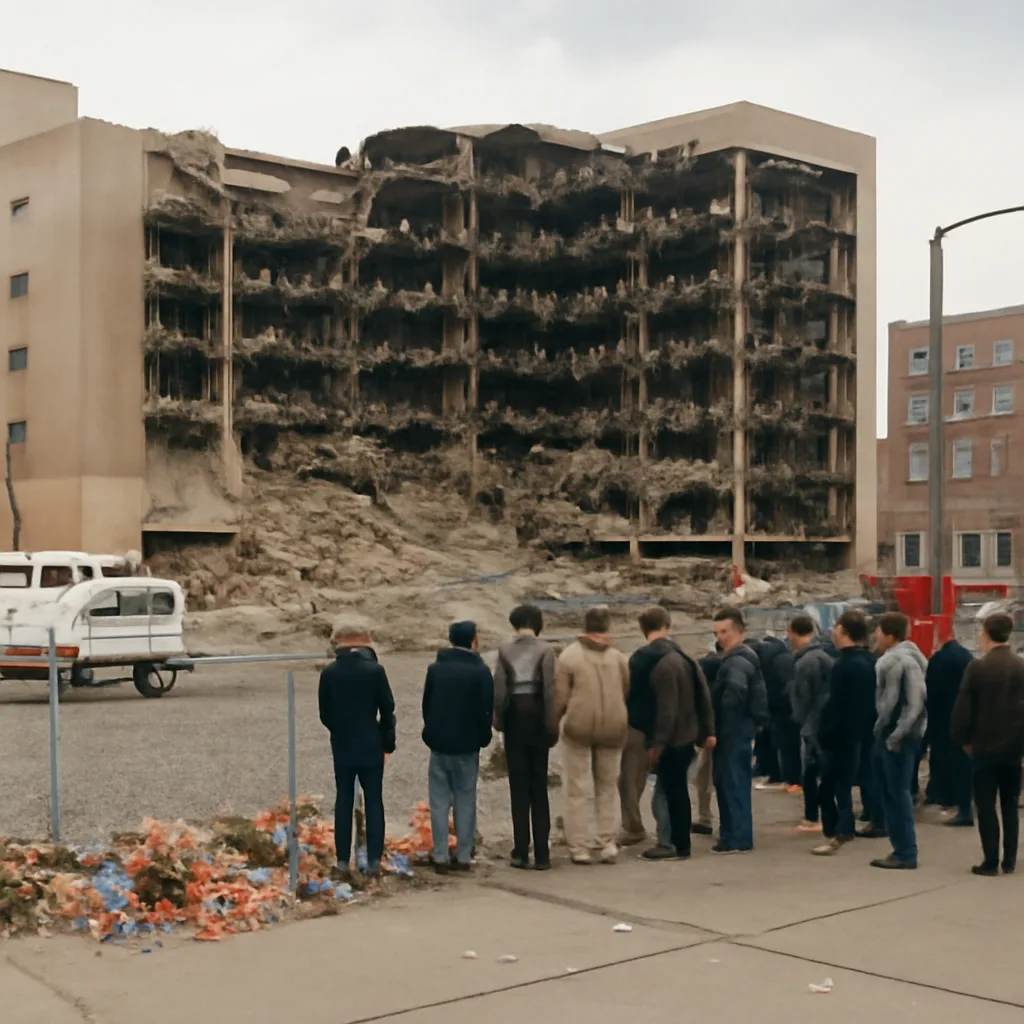
Timothy McVeigh Executed for 1995 Oklahoma City Bombing
Timothy McVeigh, convicted for the 1995 Oklahoma City bombing that killed 168 people, was executed by lethal injection on July 11, 2001, after years of trials, appeals, and a federal death sentence.
On July 11, 2001, Timothy James McVeigh was executed by lethal injection at the U.S. Penitentiary in Terre Haute, Indiana, for his role in the April 19, 1995, bombing of the Alfred P. Murrah Federal Building in Oklahoma City. The attack killed 168 people, including 19 children, injured hundreds more, and was the deadliest act of domestic terrorism in U.S. history at that time. McVeigh had been convicted in a federal trial in 1997 on multiple counts, including conspiracy to use a weapon of mass destruction and murder of federal law enforcement officers, and was sentenced to death.
McVeigh was arrested shortly after the bombing and identified through vehicle registration and other forensic evidence. His trial focused on the preparation and detonation of a truck bomb outside the Murrah Building. He was tried separately from his co-conspirator Terry Nichols, who was convicted in state and federal courts and received life sentences. Throughout his trial and appeals, McVeigh maintained a limited public commentary, sometimes framing his actions as anti-government retribution for events such as the 1993 Waco siege; he did not deny participating in the bombing at trial, and after conviction he exhausted numerous appeals and post-conviction motions.
The execution came after the U.S. Supreme Court declined to grant further relief to McVeigh. Federal authorities carried out the sentence under the auspices of the Bureau of Prisons. On the day of execution, procedures followed federal lethal-injection protocols in place at the time. A small group of witnesses, including victims' relatives, law enforcement representatives, and media, observed the execution; federal and prison officials released limited official statements confirming the time and method.
McVeigh's execution revived public and media attention to the 1995 bombing, the victims and survivors, and debates over capital punishment, domestic terrorism, and federal criminal justice. Victims' families and survivors expressed a range of reactions—some relief or closure, others continuing grief and opposition to the death penalty. The bombing prompted long-term changes in federal building security, emergency response planning, and law enforcement approaches to domestic terrorism. It also spurred extensive criminal investigations and prosecutions of associates and conspirators.
The case remains a significant reference point in U.S. legal and social history: an act of large-scale domestic terrorism, a federal death sentence and execution, and a prolonged legal process that encompassed criminal trials, appeals, and national debate. The factual record is based on court documents, contemporaneous reporting, and official statements from federal authorities and victim advocacy organizations.