
← Back
11/26/1972 • 6 views

U.S. and USSR Sign Landmark Strategic Arms Limitation Treaty
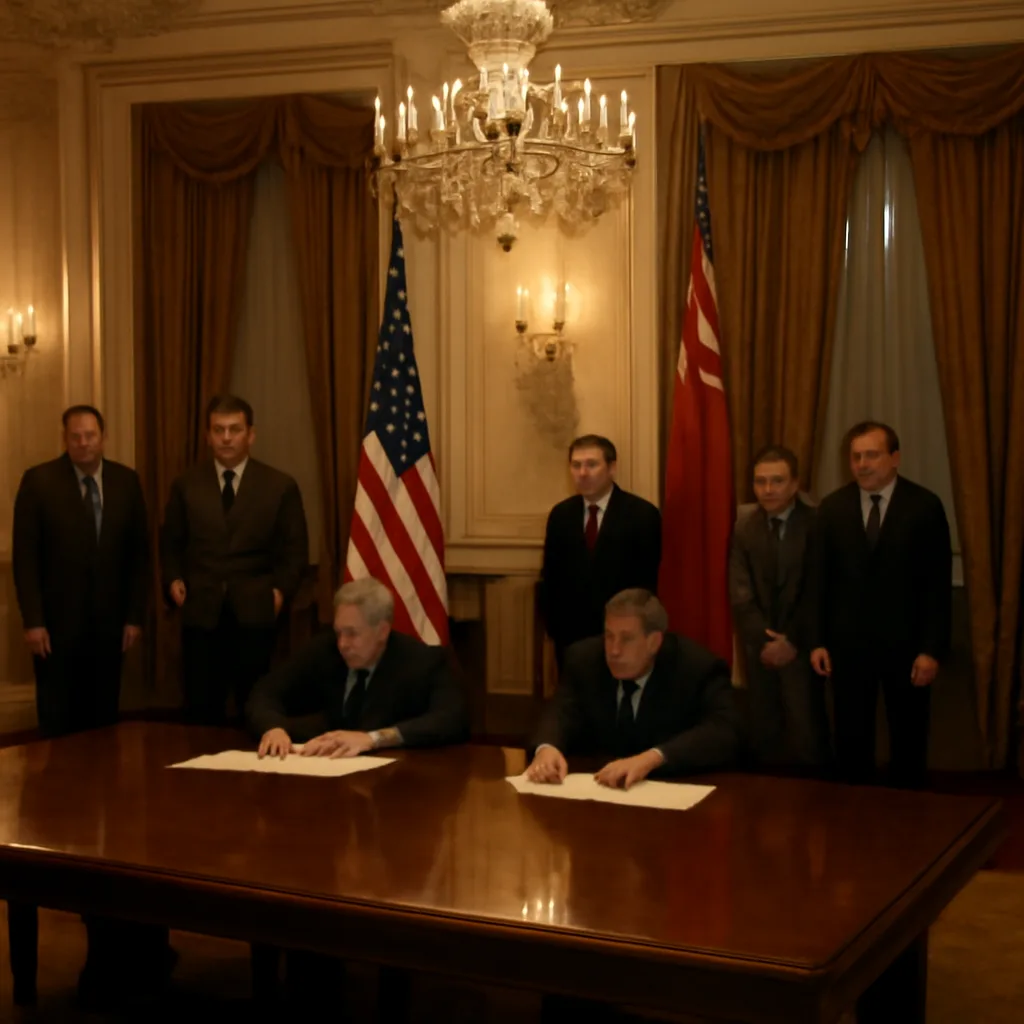
Officials and dignitaries gathered in a formal meeting room in Moscow for the signing of an agreement in 1972; documents and pens on a long table, national flags of the United States and Soviet Union displayed, mid-20th-century suits and dresses.

On November 26, 1972, the United States and the Soviet Union signed the Strategic Arms Limitation Treaty (SALT I), marking a pivotal step in Cold War arms control by capping certain categories of strategic ballistic missiles and launching a framework for future negotiations.


On November 26, 1972, President Richard Nixon and General Secretary Leonid Brezhnev signed the Interim Agreement on Strategic Arms, commonly known as SALT I, in Moscow. The agreement followed nearly two years of intensive bilateral negotiations aimed at halting the rapid expansion of strategic nuclear forces and stabilizing superpower relations during the Cold War.

SALT I comprised two principal elements: the Interim Agreement, which froze the number of strategic ballistic missile launchers at existing levels for five years, and the Anti-Ballistic Missile (ABM) Treaty, which limited each side to two ABM deployment areas (later reduced to one). The freeze on launchers applied to intercontinental ballistic missiles (ICBMs) and submarine-launched ballistic missiles (SLBMs) but permitted the modernization and replacement of certain systems under specified limits. The ABM Treaty curtailed development of nationwide missile defense systems, reflecting the prevailing U.S.-Soviet consensus that mutual vulnerability underpinned strategic stability.

Negotiations began in 1969 under U.S. national security policy that sought détente—a moderation of tensions—and increased communication with Moscow. The talks involved multiple rounds, technical working groups, and complex verification discussions. Verification was a central challenge: both sides relied on national technical means, including satellite reconnaissance, for monitoring compliance, and negotiated detailed provisions to permit observation and to reduce ambiguity about deployed systems. The Interim Agreement avoided some contentious limits on multiple independently targetable reentry vehicles (MIRVs), leaving tougher issues for future rounds of talks.

Domestically, the treaty generated mixed reactions in both countries. Supporters argued that SALT I reduced the risk of uncontrolled arms competition and opened channels for cooperation on broader issues. Critics in the United States, including some members of Congress and defense analysts, contended that the treaty preserved Soviet numerical advantages in certain strategic categories or constrained U.S. defensive options. In the Soviet Union, the leadership presented the accords as validation of their great-power status and as a contribution to international security.

The treaty’s practical effect was to slow the pace of strategic weapons expansion and to institutionalize arms control dialogue. SALT I did not eliminate nuclear deterrence or significantly reduce existing arsenals; rather, it set ceilings and established norms of restraint. It also created precedents for future agreements, most importantly the SALT II negotiations that followed and, eventually, later START (Strategic Arms Reduction Treaty) accords in the late 1980s and early 1990s.

Historians assess SALT I as a milestone of détente: it demonstrated that adversaries with large nuclear arsenals could negotiate limits and verification measures, even amid deep political and ideological differences. The treaty reflected a balance between technical constraints, strategic calculations, and political realities. While some of SALT I’s provisions were limited or temporary, the agreement reshaped the diplomatic landscape of the Cold War and contributed to the development of an arms-control regime that persisted, with adaptations, for decades.

SALT I remains a subject of scholarly study for its diplomatic process, its technical provisions on delivery systems and defenses, and its role in the broader trajectory of U.S.-Soviet relations. Its legacy is measured less in immediate reductions than in establishing negotiation and verification as tools to manage the nuclear competition between the two superpowers.

Share this

Email Share on X Facebook Reddit

Did this surprise you?