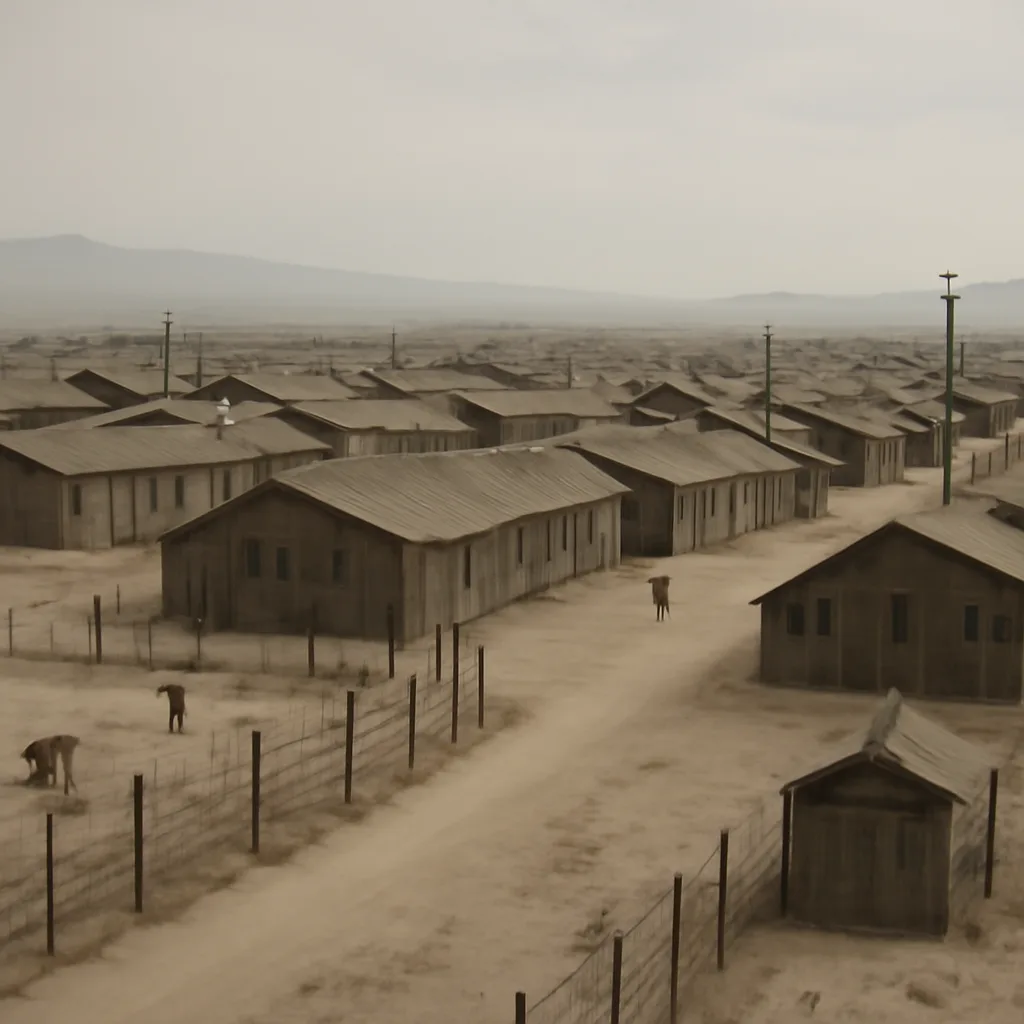
On February 19, 1942, President Franklin D. Roosevelt signed Executive Order 9066, authorizing the removal and incarceration of people of Japanese ancestry from designated West Coast military areas—an action that led to the forced relocation and internment of about 120,000 Japanese Americans during World War II.
On February 19, 1942, President Franklin D. Roosevelt signed Executive Order 9066, granting military commanders authority to designate exclusion zones and to remove any persons from those areas. While the order did not explicitly name Japanese Americans, it paved the way for the forcible relocation and incarceration of roughly 120,000 people of Japanese ancestry—two-thirds of whom were U.S. citizens—primarily from the West Coast. The action followed the attack on Pearl Harbor and growing wartime fears and racial prejudice; federal and military officials argued the measures were necessary for national security, though later investigations and scholarship have shown those justifications were influenced by racial bias and wartime hysteria.
Following the order, the War Relocation Authority (WRA) and military authorities established assembly centers—often at fairgrounds and racetracks—where families lived in crowded, makeshift conditions while awaiting transfer to more permanent incarceration camps located inland. These camps, commonly called "relocation centers" at the time and later referred to as internment camps, were surrounded by barbed wire and guard towers. Living conditions were austere: families lived in standardized barracks with little privacy, communal latrines and mess halls, and a climate and housing poorly suited to some locations. The camps were located in remote areas in states including California, Arizona, Colorado, Utah, Wyoming, Idaho, and Arkansas.
Daily life in the camps involved efforts to maintain community institutions—schools, churches, newspapers, and recreational activities—despite the loss of property, businesses, and jobs many families suffered when removed. Younger internees attended schools within the centers; adults sought work in camp administration, agriculture, or other available labor. Some Japanese Americans resisted or challenged removal orders through legal action; in several landmark Supreme Court cases—most notably Hirabayashi v. United States (1943), Korematsu v. United States (1944), and Ex parte Endo (1944)—the Court addressed curfews, exclusion orders, and the government’s authority to detain loyal citizens. Korematsu’s conviction was upheld in 1944, while Ex parte Endo resulted in a ruling that the government could not continue to detain a concededly loyal citizen, a decision that helped lead to camp closures.
The internment policy resulted in significant economic and personal losses. Many Japanese Americans were forced to sell homes, farms, and businesses at a fraction of their value or abandon property and possessions. Families suffered psychological trauma and social stigma that persisted long after World War II. The camps began to close in 1945 after the war in Europe ended and the tide of public opinion shifted; former internees returned to communities, often facing hostility and economic hardship.
In the decades after the war, scholars, activists, and former internees worked to document the causes and consequences of the incarceration. A federal Commission on Wartime Relocation and Internment of Civilians (CWRIC), established by Congress in 1980, concluded in its 1983 report that the actions were driven largely by "race prejudice, war hysteria, and a failure of political leadership." The report recommended redress. In 1988, Congress passed and President Reagan signed the Civil Liberties Act, which formally apologized on behalf of the U.S. government and provided monetary reparations to surviving Japanese American internees.
Historical assessments emphasize that the internment represented a major infringement on civil liberties carried out under the pressures of war and race-based policymaking. It remains a key example in U.S. history of how national security claims and racial prejudice can combine to justify mass government actions against a specific ethnic group.