
← Back
02/19/1942 • 6 views

U.S. Government Authorizes Internment of Japanese Americans
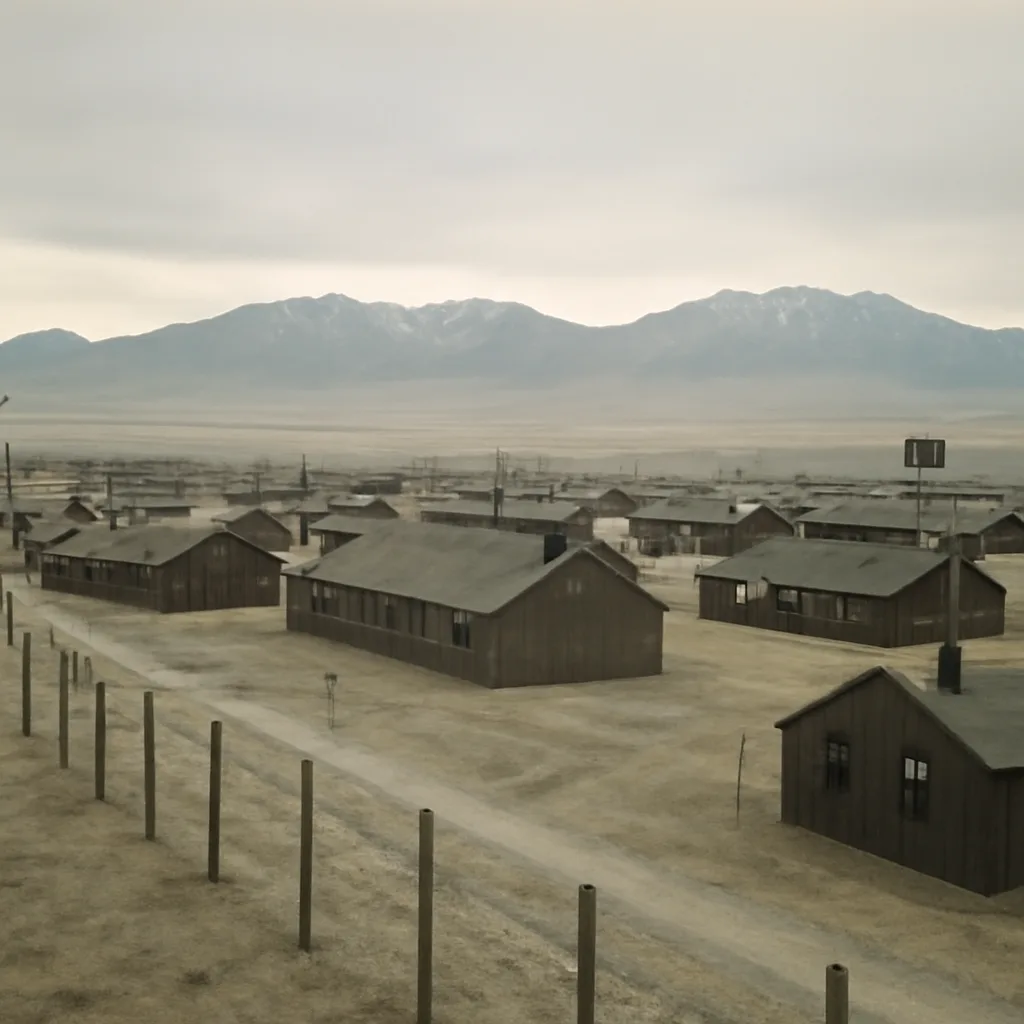
Rows of low wooden barracks and fences at a World War II–era Japanese American relocation camp set on an open plain with distant mountains under a cloudy sky.

On February 19, 1942, President Franklin D. Roosevelt signed Executive Order 9066, authorizing removal and incarceration of people of Japanese ancestry from the U.S. West Coast. The order led to mass forced relocation and confinement of Japanese Americans during World War II.


On February 19, 1942, President Franklin D. Roosevelt issued Executive Order 9066, which authorized military commanders to designate “military areas” and exclude any persons from them. Although the order did not name any ethnic group, it was used primarily to remove and incarcerate approximately 120,000 people of Japanese ancestry—two-thirds of whom were United States citizens—from the West Coast. The order authorized a process of forced relocation into temporary assembly or “relocation” centers and subsequently into more permanent concentration camps run by the War Relocation Authority.

Background: Following Japan’s attack on Pearl Harbor on December 7, 1941, wartime fears, racism, and political pressures in the United States led federal and local officials to advocate for removal of persons of Japanese ancestry from coastal areas. Intelligence reports and military assessments varied in their conclusions; some officials expressed concern about possible espionage or sabotage, while others questioned the evidence for widespread disloyalty. Anti-Japanese sentiment on the West Coast, long present in law and custom, intensified and helped shape public and official support for exclusion and incarceration.

Implementation: Under the order, military commanders issued exclusion zones and set deadlines for evacuation. Families were given short notice—typically days to weeks—to dispose of property, sell businesses, and report to assembly centers. Many evacuees lived in hastily converted facilities such as fairgrounds and racetracks before being transferred to ten more permanent War Relocation Authority camps located inland (including Manzanar, Tule Lake, Heart Mountain, and Rohwer). Living conditions in both temporary and permanent camps varied but often involved crowded barracks, communal latrines, and inadequate heating and medical care.

Legal and political consequences: The constitutionality of wartime exclusion and incarceration was litigated. In 1943, the Supreme Court, in Hirabayashi v. United States and Korematsu v. United States, upheld aspects of curfews and exclusion orders; those decisions have since been widely criticized by legal scholars and civil rights advocates. In later decades, surviving internees and their descendants campaigned for redress. In 1988, Congress passed and President Ronald Reagan signed the Civil Liberties Act, which formally apologized and provided monetary reparations to surviving Japanese American internees, acknowledging that the government’s actions were based on “racial prejudice, war hysteria, and a failure of political leadership.”

Human impact: The internment disrupted lives, careers, and communities. Evacuees lost homes, businesses, farms, and personal property; many never recovered economically. The experience affected generations psychologically and culturally. Some Japanese Americans served in the U.S. military during the war, notably in segregated units such as the 442nd Regimental Combat Team, one of the most decorated units for its size and length of service.

Historical interpretation: Historians view Executive Order 9066 and the resulting incarceration as a wartime civil liberties crisis shaped by a combination of military decision-making, racial prejudice, and political pressures. While some contemporaries argued the measures were necessary for national security, subsequent government investigations and historical research found little evidence of organized disloyalty among Japanese Americans on the West Coast. The episode is now taught and commemorated as a cautionary example of how fear and prejudice can override constitutional protections.

Commemoration and memory: Sites of former camps are preserved as historical landmarks and museums, and annual commemorations and educational programs seek to preserve the memory of those affected. The story of the wartime incarceration continues to inform debates about civil liberties, immigration policy, and racial justice in the United States.

Share this

Email Share on X Facebook Reddit

Did this surprise you?