
10/25/1983 • 5 views
U.S. military intervention in Grenada, 1983
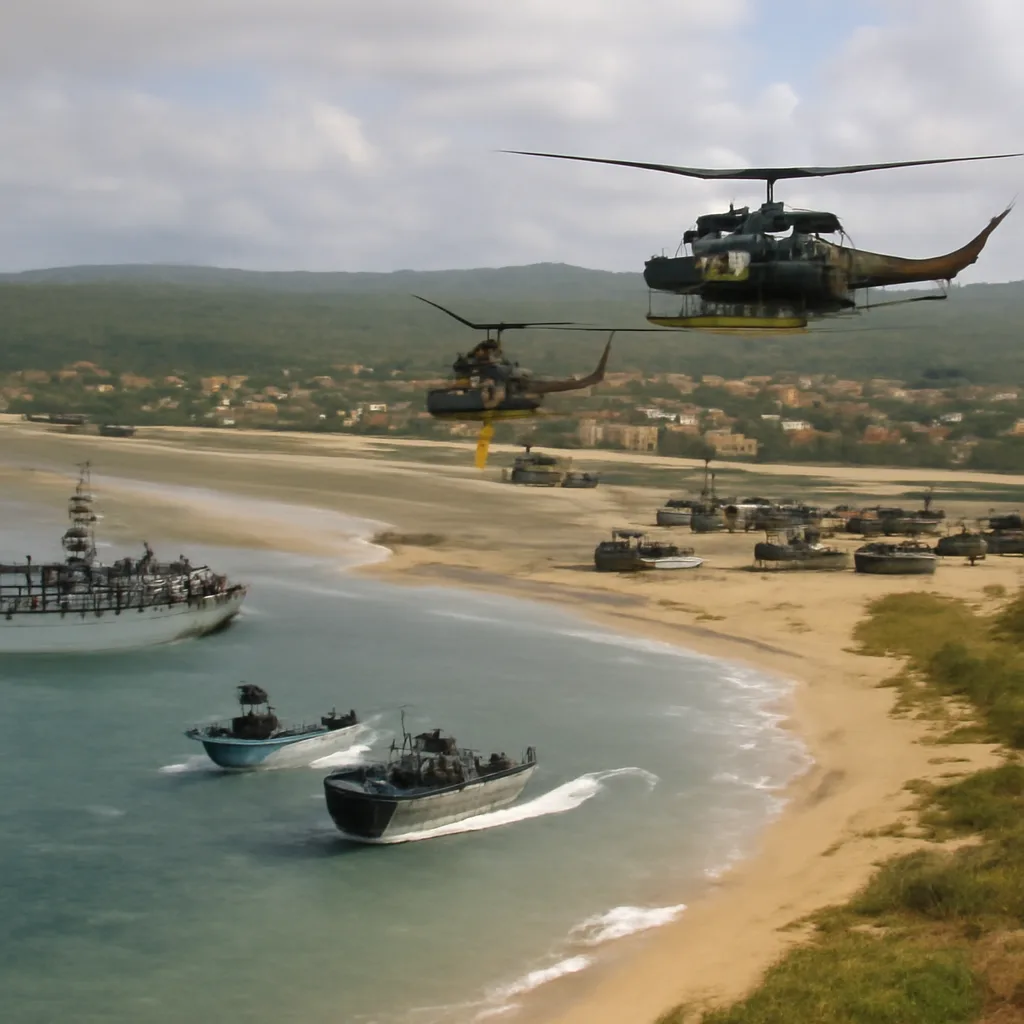
On October 25, 1983, U.S. forces launched a military invasion of Grenada—Operation Urgent Fury—aiming to restore order after a violent coup and to protect American nationals; the intervention sparked international debate over sovereignty and Cold War tensions.
In October 1983, Grenada, a small Caribbean nation, was in political turmoil. The ruling Marxist-oriented New Jewel Movement had governed since a 1979 revolution led by Maurice Bishop. Internal divisions culminated on October 19 when hard-line members of the regime executed Bishop and several associates and installed a military-controlled government. Amid reports of instability and threats to foreign nationals, the United States announced concern for the safety of American citizens on the island—including students at the St. George’s University medical school—and for regional security.
Decision and initiation
On October 25, 1983, under President Ronald Reagan, U.S. forces—supported by Caribbean allies including troops from Jamaica and members of the Regional Security System—launched Operation Urgent Fury. The invasion involved elements of the U.S. Army, Navy, Air Force, Marines, and Coast Guard, employing amphibious landings, airborne assaults, and air strikes. Objectives stated by U.S. officials included protecting American citizens, restoring order, and supporting the re-establishment of a lawful government.
Conduct of the operation
U.S. forces rapidly secured key sites: the point of entry for the international airport, government buildings, and the medical school campus where many foreign students were located. Combat involved firefights with Grenadian military units and Cuban construction workers and military advisors who were present on the island contributing to infrastructure projects. The U.S.-led operation lasted only days in terms of major combat, though stabilization and withdrawal processes continued afterward.
Domestic and international reactions
The invasion elicited mixed reactions. Within the United States, many politicians and the public supported the action as necessary to protect Americans and counter perceived communist expansion in the Caribbean. Critics, including several U.S. Congress members and international bodies, questioned the legality of the intervention and whether it violated Grenada’s sovereignty. The United Nations General Assembly later passed a resolution declaring the intervention a flagrant violation of international law, while some Caribbean governments and regional organizations expressed both support and concern.
Immediate outcomes
After the overthrow of the coup leaders, U.S. forces facilitated the establishment of an interim government and assisted in restoring civil order. Elections were later held in 1984 under international observation. The intervention resulted in the removal of the revolutionary government and a shift in Grenada’s political alignment away from its previous Marxist course. Human and material costs included military and civilian casualties and damage to infrastructure; sources differ on exact figures, and assessments of proportionality and necessity remain debated.
Long-term consequences
Operation Urgent Fury had lasting effects on U.S. military policy and regional politics. The invasion exposed communication and coordination problems among U.S. forces, prompting reforms in joint operations and command structures. Politically, Grenada aligned more closely with Western institutions after the intervention, and the episode became a reference point in discussions of U.S. willingness to use force in the post–Cold War Caribbean. The legality and precedent of the action continue to be analyzed by historians and international law scholars.
Notes on sources and disputes
Details such as casualty counts, the precise roles of Cuban personnel, and evaluations of legality are subjects of ongoing historical and legal debate. Contemporary government statements, congressional hearings, United Nations records, and investigative reporting from the period provide primary documentation; later scholarly analyses assess broader context and consequences.