
← Back
03/05/1845 • 6 views

When an Entire Arctic Expedition Vanished: The Franklin Mystery Begins
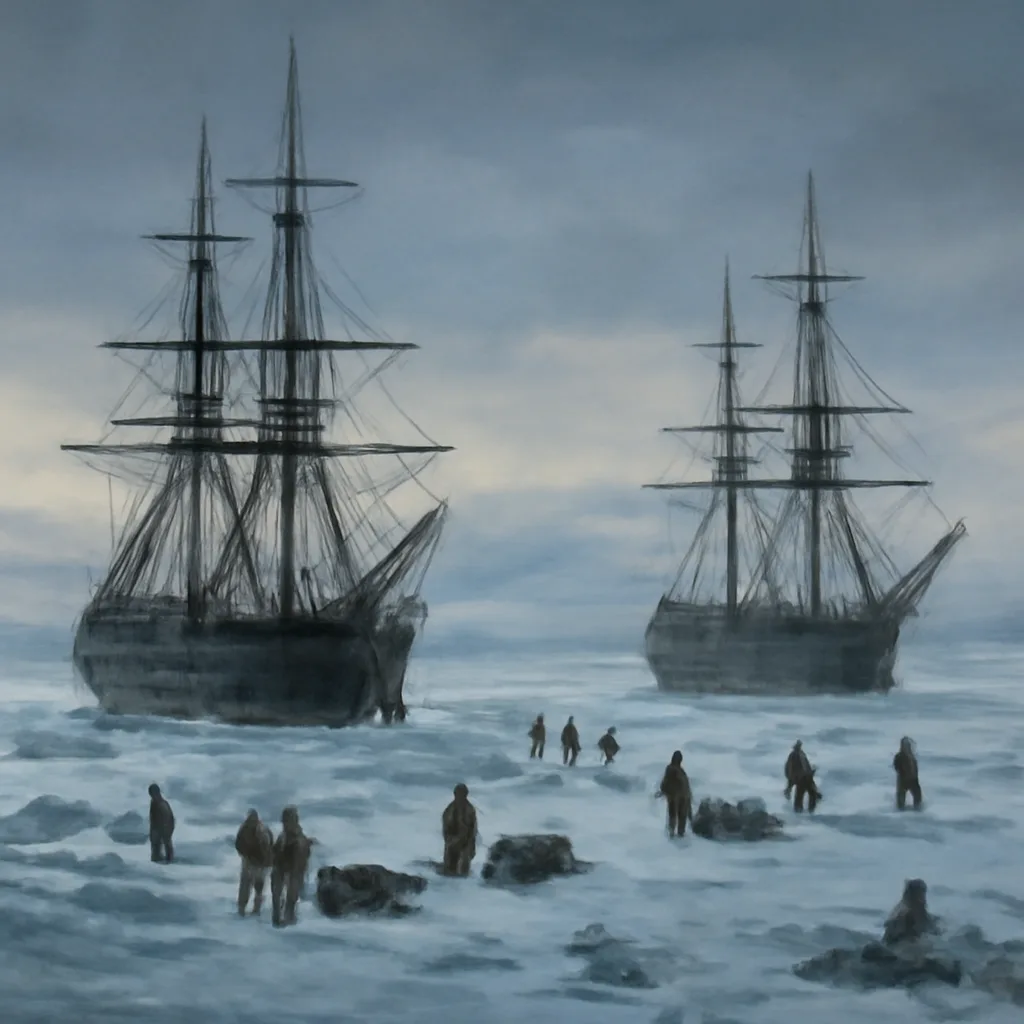
Two mid-19th-century wooden naval ships trapped in Arctic pack ice near a low, snow-covered shoreline under grey sky, with small groups of men in period cold weather gear attending sledges and stores at a distance.

On March 5, 1845, Sir John Franklin’s expedition departed England for the Northwest Passage; it became the first well-documented case in which an entire Royal Navy expedition later vanished, triggering one of the 19th century’s largest polar searches.


In early March 1845 two Royal Navy ships, HMS Erebus and HMS Terror, left Greenhithe, England, under the command of Sir John Franklin. Their stated mission was to navigate and chart the remaining sections of the Northwest Passage through Arctic Canada, a strategic and scientific priority of the era. The expedition was well outfitted by contemporary standards: iron-reinforced hulls, coal-fired engines, extensive provisions and botanical and geological instruments. It was also the first major voyage whose complete disappearance—no confirmed return of officers or crew—was documented in real time by press, government records and subsequent search efforts.

Franklin’s mission was typical of mid-19th-century polar exploration: a mix of imperial ambition, scientific curiosity and confidence in emergent technology. The two ships carried 24 officers and 110 men, along with detailed plans and depot-laying schedules that couriers and later searchers would follow. The last unequivocal communication from the expedition was a telegram sent from England noting their departure; subsequent signals and sightings proved inconclusive or were misinterpreted.

Within a year and a half of their departure, worries mounted in Britain. The Admiralty organized a series of increasingly large and costly searches, involving both naval vessels and privately funded expeditions. These searches returned fragmentary evidence: scattered clothing, abandoned caches, and Inuit testimony recorded later by European visitors. In 1859, a cairn on King William Island contained a note dated April 1848 stating that Franklin had died in June 1847 and recording that the ships had become beset in the ice in 1846. That note and other artifacts provided the first concrete confirmation that the ships had been trapped and that crews had attempted to walk south to seek rescue.

Throughout the 19th and 20th centuries, investigators pieced together an incomplete, often contradictory picture. Inuit oral histories recorded by explorers suggested that survivors had been seen on land and that there were signs of starvation and desperate measures. Later forensic studies of skeletal remains and exhumed human tissues from Beechey Island and elsewhere indicated lead exposure from tinned food and possibly from ship fittings, as well as evidence of scurvy and tuberculosis among some crew. Interpretations vary: some historians emphasize the role of prolonged ice entrapment and inadequate nutrition; others point to contaminated provisions, failures of leadership, or simply an overwhelming combination of Arctic hazards.

Franklin’s expedition occupies a unique place in British and Arctic history because it was among the first widely publicized instances in which an entire official expedition disappeared without survivors returning to tell the story. That absence drove a sustained international effort—involving the Royal Navy, private sponsors, and indigenous communities—to search the polar regions, producing maps, scientific observations and often harsh contact between explorers and indigenous peoples. The event catalyzed advances in polar logistics, ship design and understanding of Arctic conditions, even as the human cost remained a subject of debate and mourning.

Modern research has continued to refine the narrative. In 2014 and 2016, shipwrecks that matched descriptions of Erebus and Terror were located in separate locations by Parks Canada, providing new physical context. Scientific analyses of artifacts and remains have informed but not entirely resolved questions about the causes of death and the final movements of crew members. The Franklin expedition’s fate remains a complex historical puzzle built from government documents, contemporary press coverage, indigenous testimony and material remains—an early, strongly documented case in which an entire expedition effectively disappeared from the public record and spurred decades of inquiry.

Because many details are uncertain or disputed—precise casualty counts, the chronology of the overland attempt to reach safety, and the relative contributions of lead poisoning, disease and starvation—historians treat the Franklin case as an evolving interpretation rather than a closed account. The disappearance had profound effects: reshaping search-and-rescue expectations, altering British public perceptions of exploration’s risks, and leaving a legacy that continues to draw archaeological and archival attention.

Share this

Email Share on X Facebook Reddit

Did this surprise you?